Neighbourhoods · Zona Sul · Updated September 2026
Laranjeiras, Rio de Janeiro: inside the world’s 17th coolest neighbourhood
Written and reviewed by Lotte — Rio local, founder & editor of PlanRio · How we research · First published · Last reviewed
Quick answer
Laranjeiras is Rio’s best neighbourhood for travellers who want culture and everyday Carioca life without living in the tourist corridor. In September 2026, Time Out ranked it the world’s 17th coolest neighbourhood, praising its traditional bars, Saturday street market and revived cultural venues. Stay here for leafy streets and quick access to Cosme Velho; visit on Saturday if your priority is atmosphere. Choose Copacabana or Ipanema instead if walking to an ocean beach matters more than local rhythm.
Laranjeiras at a glance
| Where | Inland Zona Sul, between Flamengo and Cosme Velho |
| Known for | Parque Guinle, historic homes, local bars and weekend street life |
| Best for | Repeat visitors, families, slow travel and a residential Rio base |
| Nearest metro | Largo do Machado, on MetrôRio Lines 1 and 2 |
| Beach access | No ocean beach; use the metro for Copacabana and Ipanema |
| Stay length | Three nights or longer, when local routine matters more than a sea view |
| Main trade-off | Limited hotel choice and longer walks from the upper neighbourhood |
| 2026 recognition | No. 17 in Time Out’s 40 Coolest Neighbourhoods in the World |
Why Laranjeiras is suddenly one of Rio’s coolest neighbourhoods
The new attention is real, but the ranking did not invent the neighbourhood. Time Out’s 2026 list placed Laranjeiras at number 17 worldwide. CNN reported on that list, while CNN Brasil focused on Laranjeiras and São Paulo’s República. The distinction matters: this is Time Out’s ranking, not a separate CNN award.
What makes Laranjeiras cool is not one landmark. It is the overlap of old and new: long-running botecos beside new kitchens, a cinema returned after sixteen years, a historic market brought back into use, and a Saturday feira that still belongs to residents. Rio visitors often experience the city as a chain of famous sights. Here, the attraction is the connective tissue between them.
That also means expectations need recalibrating. Laranjeiras is not a polished attraction district, and its best moments are time-sensitive. A quiet weekday street may feel ordinary; the same street on Saturday can hold food stalls, music and half the neighbourhood. Come to observe a functioning bairro, not to tick off ten monuments.
What to do: six places that explain Laranjeiras
01 · Landscape and modernism
Parque Guinle
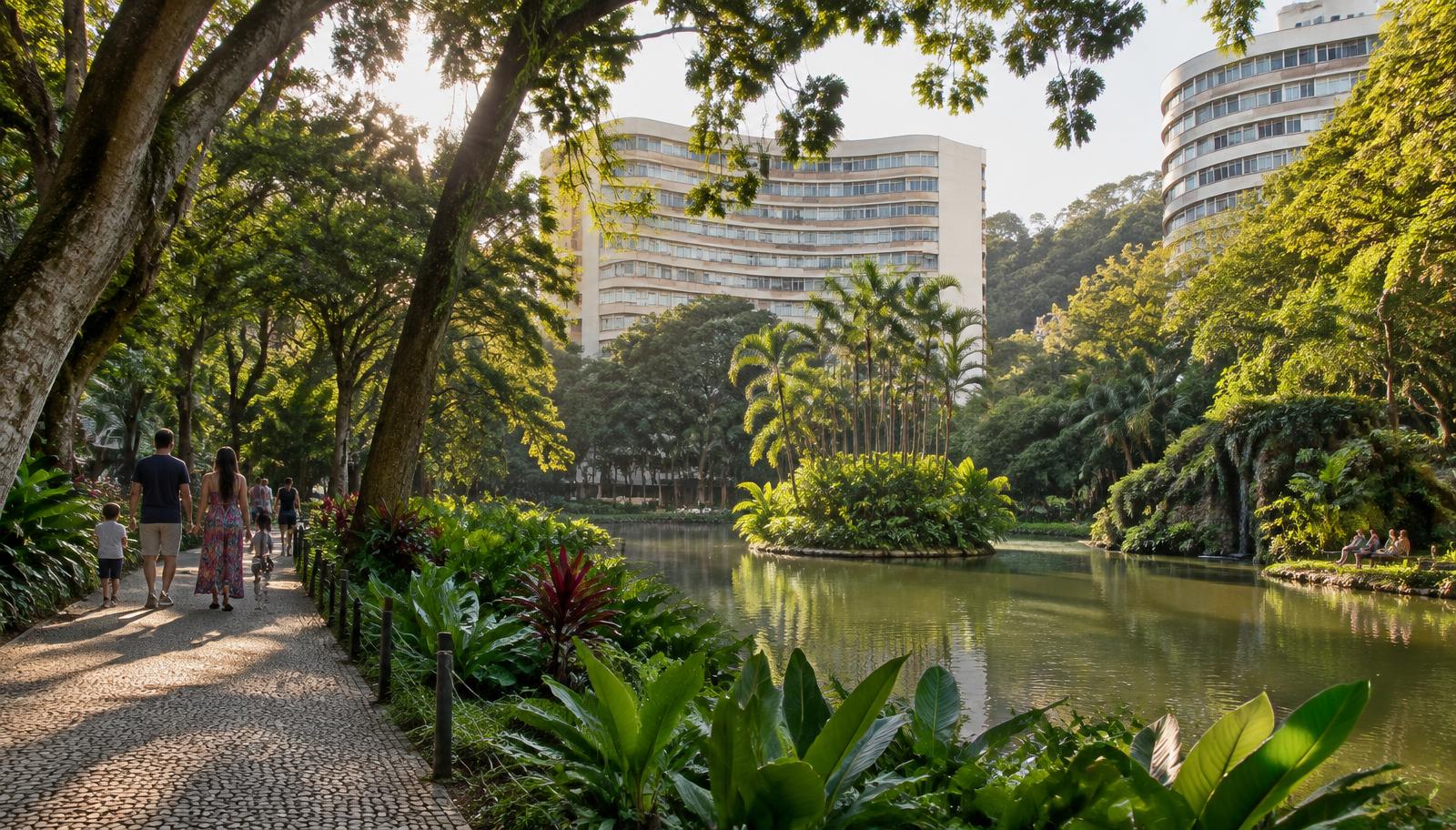
Enter from Rua Gago Coutinho for a short, shaded circuit around the lake. The park frames Lúcio Costa’s curved residential buildings, making it one of Rio’s clearest places to see modern architecture functioning as an everyday neighbourhood backdrop rather than a museum object.
PlanRio tip: Go in the late afternoon for softer light, but do not build a whole day around it: the pleasure is in combining the park with nearby streets and a meal.
02 · Saturday neighbourhood ritual
Rua General Glicério
This is the social centre of the current Laranjeiras story. The Saturday feira (street market) brings produce, prepared food and live music into the same residential street. It feels less like a staged attraction than a weekly appointment shared by neighbours.
PlanRio tip: Arrive during the active morning period and confirm the current market programme locally; individual musicians and stalls change.
03 · A revived local landmark
Mercado São José das Artes
The small historic market returned to neighbourhood life after a long closure. Its recent revival is part of why Laranjeiras feels newly energetic: old fabric is being reused for food, culture and gathering instead of replaced by a generic complex.
PlanRio tip: Treat it as a flexible stop, not a guaranteed full meal; check the day’s openings before travelling across the city for one vendor.
04 · Cinema back in the bairro
Cine Carioca José Wilker
The neighbourhood cinema reopened in late 2024 after sixteen years closed. That matters beyond the screen: it restores an evening anchor for a district where cultural life is dispersed among streets, squares and small venues.
PlanRio tip: Check the current programme and language format. Brazilian screenings marked “legendado” are subtitled; “dublado” means dubbed in Portuguese.
05 · Political and architectural Rio
Palácio Guanabara and Palácio Laranjeiras
Two different palaces explain the area’s elite past. Palácio Guanabara is the seat of Rio state government; Palácio Laranjeiras, beside Parque Guinle, is the governor’s official residence. Security and official use mean these are primarily exterior architecture stops, not dependable walk-in attractions.
PlanRio tip: Do not confuse the two buildings, and never promise yourself an interior visit without a current official opening announcement.
06 · Football history
Fluminense’s Laranjeiras ground
Estádio de Laranjeiras is woven into the history of Fluminense and Brazilian football. It is not Rio’s default match-day stadium now, but its presence explains why the club’s identity remains attached to the neighbourhood.
PlanRio tip: For a live match, use our Maracanã planning guide rather than assuming a fixture will take place here.
A realistic half-day in Laranjeiras
| Sequence | Stop | Why it works |
|---|---|---|
| 1 | Largo do Machado | Arrive by metro and pick up water before walking inland. |
| 2 | General Glicério | On Saturday, begin with the market while it is active. |
| 3 | Parque Guinle | Slow down among the gardens and modernist buildings. |
| 4 | Market or cinema area | Finish with food or culture, subject to the day’s programme. |
Add Christ the Redeemer only with a pre-booked time slot. Otherwise, continue downhill towards Flamengo or take the metro to another South Zone district.
Where to stay in Laranjeiras
Laranjeiras suits a traveller choosing a neighbourhood first and a hotel second. Supply is limited compared with Copacabana, so expect apartments, guesthouses and a smaller set of conventional stays. The lower section near Largo do Machado is easiest for metro use; the upper section towards Cosme Velho is greener and more atmospheric but creates longer walks and more reliance on rides.
Stay near Largo do Machado
Best for metro access, short stays and frequent trips to the beaches or Centro.
Stay near Parque Guinle
Best for greenery, families and a quieter residential atmosphere.
Stay towards Cosme Velho
Best for Corcovado access; weakest for spontaneous metro trips and nightlife.
Compare the limited Laranjeiras inventory early
Use the map before booking: some results described as nearby sit across a hill or beyond a comfortable walk from the metro.
See stays in LaranjeirasWho should not stay here? First-time visitors with only two or three nights, travellers who want a sea view, and anyone who expects a dense strip of international hotels. Compare our complete Rio area guide before deciding.
Is Laranjeiras safe?
Locals generally describe Laranjeiras as calm and residential, but no Rio neighbourhood deserves an absolute “safe day and night” promise. The lower commercial streets stay busier; upper residential streets can empty quickly. Keep your phone secured while walking, carry only what you need and use an app ride for late returns when your route is quiet or unfamiliar.
Daytime
The market, main road and park are straightforward with normal city awareness. Watch traffic at junctions and do not photograph people at close range without asking.
After dark
Plan the final leg from the metro. A short ride is preferable to improvising through empty streets with luggage or a visible phone.
Read the current Rio safety guide before your trip; neighbourhood reputation is not a substitute for same-day awareness.
How to get to and around Laranjeiras
Largo do Machado is the practical gateway. Lines 1 and 2 connect it with Centro and the South Zone, but the station is not equally close to every part of Laranjeiras. From there, walk along the lower streets, use a local bus on Rua das Laranjeiras or take an app ride uphill. Consult the Rio metro guide for current fare and operating details rather than relying on an old screenshot.
| From | Best approach | What to know |
|---|---|---|
| Copacabana / Ipanema | Metro to Largo do Machado | Fastest when traffic is heavy; continue on foot or by ride. |
| Centro / Lapa | Metro or app ride | Use a ride late at night rather than walking from Lapa. |
| Cosme Velho | Bus, ride or a planned walk | Distances and slopes vary; do not assume every hotel is beside the train. |
| GIG airport | Pre-booked transfer or official app ride | Useful with luggage because metro access requires extra connections. |
Pair Laranjeiras with Christ the Redeemer
The most commercially useful reason to stay here is also genuinely practical: Laranjeiras borders Cosme Velho, where the Corcovado railway begins. Book the monument first, then shape the neighbourhood visit around that timed departure. Our transport comparison explains when the train, official van or tour makes sense.
Check Christ the Redeemer ticketsLaranjeiras vs nearby neighbourhoods
| Area | Main strength | Best for | Trade-off |
|---|---|---|---|
| Laranjeiras | Residential streets, parks and weekend culture | Repeat visitors and longer stays | Limited hotel supply; no beach |
| Flamengo | Metro convenience and a vast waterfront park | Value and fast cross-city transport | Bay beach is not the classic ocean-beach stay |
| Botafogo | Restaurants, bars and practical transport | Food-focused visitors and remote workers | Busier and less intimate |
| Santa Teresa | Hillside architecture and an artsy atmosphere | Boutique stays and romantic trips | Steep terrain and no metro |
Laranjeiras FAQ
Is Laranjeiras, Rio de Janeiro safe for tourists?+
Laranjeiras is widely regarded as a calmer, residential part of the South Zone, but it is still a big-city neighbourhood rather than a safety bubble. Keep phones put away while walking, avoid displaying valuables, use an app ride for a late return on quiet streets and ask your accommodation about the immediate block. The busier Largo do Machado end and the quieter upper streets feel different after dark.
Is Laranjeiras a good place to stay in Rio?+
Yes for repeat visitors, families and travellers who want neighbourhood rhythm over a beachfront address. It offers useful access to Largo do Machado metro, Cosme Velho and central Rio. It is less suitable for a first short trip built around daily beach time, and the number of bookable hotels is much smaller than in Copacabana.
Why was Laranjeiras named one of the world’s coolest neighbourhoods?+
Time Out placed Laranjeiras 17th in its 2026 world ranking, highlighting its traditional bars, Saturday market on Rua General Glicério and a wave of revived cultural and food venues. CNN and Brazilian media reported the Time Out list; CNN did not create a separate ranking.
How do I get to Laranjeiras by metro?+
Use Largo do Machado station on Lines 1 and 2, then continue on foot, by bus or by app ride. The lower end of the neighbourhood is easiest from the station; Parque Guinle and the upper residential streets require a longer walk. Check MetrôRio for current service hours before an early or late journey.
Does Laranjeiras have a beach?+
No. Laranjeiras is inland. Flamengo’s waterfront is the closest bayfront area, while Copacabana and Ipanema are the better choices for an ocean-beach day. If waking beside the sand is essential, stay in a beach neighbourhood and visit Laranjeiras for half a day.
What is the best day to visit Laranjeiras?+
Saturday is the strongest choice because the Rua General Glicério street market reveals the neighbourhood at its most social. Pair it with Parque Guinle and the revived market or cinema area. Schedules change, so confirm any specific performance or venue opening on the day.
Can I combine Laranjeiras with Christ the Redeemer?+
Yes. Laranjeiras borders Cosme Velho, home of the Corcovado railway station. Visit the neighbourhood before or after a timed Christ the Redeemer booking, but allow for hills and traffic rather than treating every point in Laranjeiras as a short walk from the train.
How we researched this update
We reviewed Time Out’s 2026 ranking and coverage from CNN, CNN Brasil and Brazilian news outlets; checked MetrôRio for the station serving the area; and removed unsupported price, hotel-saving and absolute safety claims from the previous guide. Venue programmes, market activity and transport operations can change, so confirm time-sensitive details directly before travelling.