
Birdwatching Rio de Janeiro: Best Spots, Birds and Seasons
Written and reviewed by Lotte — Rio local, founder & editor of PlanRio · How we research · First published · Last reviewed
Illustration, not a photograph of a specific place or bird.
Quick answer
For birdwatching in Rio de Janeiro, start at the Jardim Botânico's 8 am opening for toucans, guans and hummingbirds, then walk the Lagoa for cormorants and egrets. Keener birders should stand still in Tijuca Forest's Floresta sector at first light for mixed flocks, and watch frigatebirds from the Leme or Arpoador headlands. Around 400 to 480 species have been recorded in the city.
At a glance
Species in the city
Around 400 to 480 bird species have been recorded inside Rio de Janeiro municipality, depending on the count. A local pocket guide picks the 120 easiest to see.
Best first morning
The Jardim Botânico arboretum at its 8 am opening (11 am on Wednesdays): toucans, guans, wood-rails and hummingbirds on flat paths.
Best forest birding
The Floresta da Tijuca sector of Tijuca National Park, entered at Praça Afonso Viseu in Alto da Boa Vista, plus the Estrada das Paineiras.
Seabirds
Magnificent frigatebirds and brown boobies breed on the Cagarras islands, 5 km off Ipanema. Since 28 June 2026 a short trail on Ilha Comprida is open to visitors.
Signature bird
The black-billed toucan (tucano-de-bico-preto). A PUC-Rio study estimated about 130 in the Jardim Botânico arboretum alone.
Yearly festival
Avistar Rio, the city's birdwatching festival. The 11th edition ran on 4–7 September 2026 at the Jardim Botânico, free, with 7 am guided walks.
Cost
Most birding is free: Tijuca Forest, Lagoa, the Leme fort area and the Barra lagoons charge nothing. The Jardim Botânico lists R$80 for foreign visitors.
Apps to use
Merlin Bird ID (download the Brazil pack), eBird for lists and recent sightings, and WikiAves, the Brazilian bird photo archive, for local names.
Rio is a birding city that happens to have beaches
Most visitors come to Rio for the sea and the views and notice the birds by accident: a frigatebird hanging over Copacabana, a kiskadee yelling from the hotel balcony, a toucan croaking above the queue for the Corcovado train. That accidental list is the hint. Rio sits where Atlantic Forest mountains drop into lagoons, coastal scrub and the ocean, and the city has been built in the gaps between them. Depending on whose count you use, somewhere between about 400 and 480 bird species have been recorded inside the municipality. Few big cities anywhere can match that without leaving town.
The practical upshot is that you do not need a birding holiday to see good birds here. You need one early morning, a pair of binoculars and the right habitat. A first-time visitor can realistically see toucans, several kinds of tanager, two or three hummingbirds, guans, herons, cormorants, frigatebirds and a falcon on the beach before lunch, without a guide and almost without paying. If you want the forest specialists, the endemics and the rare birds, that is where a guide, a longer walk or a trip out of the city starts to earn its keep.
This guide is built around that difference. It starts with the free, easy places where any traveller will see birds, moves on to the forest and the sea for keener birders, and ends with the day trips that serious listers plan whole holidays around. If you are more interested in the city's monkeys, capybaras and caimans than its birds, our Rio wildlife guide covers the mammals and reptiles; this page is for people who want to look up.
Where to go birdwatching in Rio de Janeiro
Choose a spot by the kind of morning you want, not by the longest species list you have read about. The Jardim Botânico and the Lagoa give you the most birds for the least effort. Tijuca Forest gives you the forest specialists if you are prepared to stand still and listen. The headlands at Leme and Arpoador give you seabirds without a boat. The table below is our honest summary of each site; the sections that follow explain how to work them.
| Spot | Habitat | Birds you are likely to see | Best for |
|---|---|---|---|
| Jardim Botânico arboretum | Landscaped garden with old trees, palms and ponds | Black-billed toucan, guans (jacus), slaty-breasted wood-rail, swallow-tailed hummingbird, herons at Lago Frei Leandro | First visit, beginners, families, photographers |
| Tijuca Forest (Floresta sector) | Tall Atlantic Forest, streams | Mixed tanager flocks, trogons, manakins, woodcreepers, rufous-capped motmot; bellbirds more often heard than seen | Forest specialists, people happy to stand still |
| Estrada das Paineiras | Forest road with canopy views | Toucans, parakeets, hawks soaring over the slope, tanagers at fruiting trees | Canopy views without a steep trail |
| Parque Lage and Parque da Catacumba | Forest edge above the city | Wood-rails, tanagers, hummingbirds, plain parakeets | A short add-on after the Jardim Botânico or Lagoa |
| Lagoa Rodrigo de Freitas | Brackish city lagoon | Neotropic cormorants, great and snowy egrets, black-crowned night herons, anhingas, kingfishers | Waterbirds at close range, zero planning |
| Barra and Recreio lagoons and restinga | Coastal scrub (restinga), lagoons, mangrove fringe | Brazilian tanager, wattled jacana, burrowing owl, southern lapwing, herons | Colour and open-country birds |
| Leme fort and Arpoador | Rocky headlands over the sea | Frigatebirds, brown boobies, kelp gulls, terns, yellow-headed caracaras | Seabirds from land, at sunrise |
| Cagarras islands (by boat) | Ocean islands, a protected Natural Monument | Breeding frigatebirds and brown boobies | Fit visitors who can swim 30 m to shore |
The Jardim Botânico: the best first birding morning in Rio
If you only have one morning, spend it in the Jardim Botânico. It is flat, safe, well signed and full of old fruiting trees, and its birds have grown used to people on the paths, so you see them at a distance where binoculars are a bonus rather than a necessity. The arboretum opens at 8 am from Thursday to Tuesday and at 11 am on Wednesdays, which makes Wednesday the worst day for birders. Be at the gate on Rua Jardim Botânico for the opening and give yourself until about 10:30, when the heat and the school groups arrive together.
The star is the black-billed toucan. The species had disappeared from the Tijuca massif and was reintroduced decades ago; a PUC-Rio study later estimated about 130 toucans in the 54-hectare arboretum alone, feeding on 28 kinds of plant, many of them palms. Their density peaked in spring, with October the highest month. You will usually hear them before you see them: a frog-like croak from the crown of a palm. Look along the Aleia Barbosa Rodrigues, the famous avenue of imperial palms, and around any tree in fruit.
On the lawns, watch for guans (jacus), dark turkey-sized birds that walk about with a red flap of skin at the throat, and for the slaty-breasted wood-rail (saracura-do-mato), whose loud, rising duet is one of the sounds of a Rio garden at dawn. Flowering shrubs bring swallow-tailed hummingbirds and the smaller species they chase away. Lago Frei Leandro, the lake near the main avenue, usually has herons and a cormorant or two. Tanagers, including the red Brazilian tanager, work the edges where garden meets forest.
Entry is currently listed at R$80 for foreign visitors and R$40 for Brazil residents, so it is the one paid stop on this page. It is worth it for the birds alone, and the toucans are reliable enough that we send friends here before we send them anywhere else. If you want a guide for the garden rather than going alone, a booked guided visit is the simplest option; we link one at the end of this page.
Tijuca Forest: where the forest birds are, and how to find them
Tijuca National Park is the big Atlantic Forest massif inside the city, and it is where the birding gets harder and more rewarding. Forest birds live in layers, they move in mixed flocks, and most of them are green, brown or high up. The trick is to stop walking. Pick a quiet stretch of road or trail, stand for ten minutes and wait for a flock to come through: a burst of calls, a flicker of movement, then tanagers, woodcreepers, flycatchers and perhaps a trogon or a manakin passing in a minute or two before the forest goes silent again.
For birding, the Floresta da Tijuca sector is the best start. Enter at Praça Afonso Viseu in Alto da Boa Vista and follow the paved road towards the Cascatinha Taunay waterfall, the Capela Mayrink and the Açude da Solidão pond. The road is shaded, easy underfoot and quiet before about 9 am, and its streams and forest edges are where flocks most often cross. The park describes birds as present in all its sectors and all year round, and it publishes an official bird-observation guide; save it on your phone before you go, because the signal is weak under the trees.
Listen for three sounds. A metallic 'tonk', like a hammer striking an anvil, is the bare-throated bellbird (araponga), more often heard than seen. A soft, low 'hoot-hoot' from the understorey is the rufous-capped motmot (juruva). A flash of turquoise, green and orange in a moving flock is the green-headed tanager (saíra-sete-cores), the bird that converts most beginners. For broad canopy views without a steep trail, the Estrada das Paineiras near the Paineiras visitor centre lets you scan the slope for soaring hawks, parakeets and toucans crossing the valley.
Tijuca is also where Rio's most hopeful bird story is happening. The Refauna rewilding project has spent years returning lost animals to the forest, and in January 2026 it released blue-and-yellow macaws, the first to fly free in Rio for more than two centuries. Our Rio wildlife guide tells that story in full. For birders the practical point is simple: if you see a macaw over the forest, note the time and place and report it through the free SISS-Geo app, because every sighting helps the project track the birds.
If you are fit and want to combine birds with a summit, the trail to Pico da Tijuca climbs through higher, cooler forest with a slightly different set of birds, but you will be moving more and listening less. Go with company, start early and follow the park's current safety advice about which trails to use and when.
The Lagoa and the city parks: waterbirds with no planning at all
The Lagoa Rodrigo de Freitas is the least glamorous birding site in Rio and one of the most dependable. Its 7.5 km shoreline path is flat and free, and the brackish water holds neotropic cormorants (biguás) drying their wings on buoys, great and snowy egrets stalking the margins, anhingas swimming with only their snake-like neck above water, and kingfishers on the railings. Look into the trees on the small islands and along the Jardim de Alah side for roosting black-crowned night herons (socós), hunched and motionless by day.
The trick at the Lagoa is to go early, before the runners and the cycle path fill up, and to stand on the west and south shores with the light behind you. You will not see anything rare, but you will see big birds well, at close range, which is exactly what a beginner or a child needs to get hooked. It also pairs naturally with the Jardim Botânico, ten minutes away.
Two small forest parks sit on the slopes nearby and are good for a short add-on. The Parque da Catacumba rises straight up from the Lagoa's eastern shore, and Parque Lage backs onto the forest below Corcovado; both bring forest-edge birds such as wood-rails, tanagers and hummingbirds within a few minutes of a taxi drop-off. In the North Zone, the Quinta da Boa Vista park has hosted the Avistar Rio festival in the past and holds parakeets and other common city birds in its old trees.
The West Zone: restinga, lagoons and owls in Barra and Recreio
West of the mountains, Barra da Tijuca and Recreio were built on a strip of sand between lagoons and the sea, and the remnants of that landscape are some of the most colourful birding in the city. The coastal scrub on sand, called restinga, is the habitat of the Brazilian tanager (tiê-sangue), whose males are such a deep red that first-timers often think they are looking at a flower. Lagoon edges and floating vegetation hold wattled jacanas walking on lily pads, herons and, on sunny banks, the caimans that our wildlife guide describes.
The Bosque da Barra is the easiest place to start: a fenced park with paths through restinga and around a lake, right on Avenida das Américas, where the city's environment department has recorded 113 bird species. The Parque Natural Municipal de Marapendi and the Parque Chico Mendes in Recreio protect larger stretches of the same habitat. Open lots, verges and lawns across Barra and Recreio are where you find burrowing owls (corujas-buraqueiras), small long-legged owls that stand beside their burrows in full daylight. Watch them from the pavement and never walk up to a burrow: the parents will abandon a nest that is disturbed too often.
Further west, the protected beaches of Grumari and Prainha have restinga, forested hills and rocky points in one place, so a morning there can give you tanagers in the scrub and frigatebirds over the sea. Larger birding areas in the Pedra Branca State Park are covered in their own guide; it is a bigger, wilder forest than Tijuca, with entrances spread across the West Zone, and it rewards birders who go with a local guide.
Seabirds from the shore: Leme, Arpoador and the Copacabana sky
The single most watched bird in Rio is probably the magnificent frigatebird (tesourão), the black, angular, fork-tailed seabird that hangs over the beaches without flapping. Frigatebirds cannot land on water, so they patrol the coast for fish and steal from other birds. You can watch them from any beach, but the headlands are better, because you are closer to the birds' flight paths and you can see out to the islands where they breed.
Our two favourite shore watches are the path up to the Forte Duque de Caxias on the Morro do Leme, at the northern end of Copacabana, and the Pedra do Arpoador between Copacabana and Ipanema. Both put you above the water at sunrise, when frigatebirds, brown boobies (atobás-marrons) and kelp gulls move along the coast, terns fish close in, and yellow-headed caracaras walk the sand below looking for scraps left from the night before. The Leme headland's forest also has its own small-bird life; a talk at the 2026 Avistar Rio festival was devoted to the Morro do Leme alone.
Bring the binoculars to the beach, too. On a weekday morning the sand at Copacabana and Ipanema is a good place to learn the common gulls and terns, and from October to March the wet sand and lagoon mudflats can hold small shorebirds that have flown in from North America for the southern summer. They are easy to overlook among the beach volleyball, which is half the fun of finding them.
What is new: the Cagarras trail, a festival and a bird guide for the city
Three recent changes make Rio a better birding destination than it was even a couple of years ago, and none of them is on most visitors' radar yet.
First, you can now set foot on the Cagarras. The islands about 5 km off Ipanema form the Monumento Natural das Ilhas Cagarras, and they hold one of the largest breeding colonies of frigatebirds in the South Atlantic, alongside nesting brown boobies. Until 2026 they were something you looked at from the beach or circled on a boat trip. On 28 June 2026 ICMBio, the federal parks agency, opened the Trilha da Comprida on Ilha Comprida, described as the first island trail open to visitors in a Rio conservation unit and the ocean extension of the Transcarioca long-distance trail. There are three loops of about 400 m, 800 m and 1.2 km, open daily from 7 am to 5 pm, with no overnight stays.
It is not a casual walk. There is no pier, so access is a wet landing: you swim about 30 m from the boat to the rocks using a rope and a life vest, and the trail crosses wet, uneven rock graded moderate to hard. ICMBio recommends it for people over 12 without mobility limitations and advises going with licensed boat operators and accredited guides, who can each take up to five visitors. Read the unit's visitor guide and protocol before you book. For birders, the rule is the one that applies at any seabird colony: stay on the marked route, keep well back from nesting birds and leave if they start flushing.
Second, Rio has a proper birding festival. Avistar Rio, part of the national Avistar Brasil network, held its 11th edition on 4–7 September 2026 at the Jardim Botânico over the Independence Day long weekend. Entry was free, the programme mixed talks on citizen science, pelagic birds, urban birds and birding tourism with films and children's activities, and there were guided 7 am bird walks in the arboretum, an hour before the garden normally opens, which needed advance registration. Earlier editions have moved around the city, from the Paineiras visitor centre to the Quinta da Boa Vista, so if you are in Rio in early September, check the festival's website for the next edition's dates and venue.
Third, the city finally has a portable field guide of its own. A pocket guide to the birds of Rio, photographed by João Quental with design by Renato Rizzaro, picks out 120 of the more than 400 species recorded in the city, chosen because they are the ones you can realistically see, with a map of observation points. It is sold at the Jardim Botânico friends' association shop and in bookshops, and it is the most useful souvenir a birder can take home.
When to go birding in Rio: the year and the day
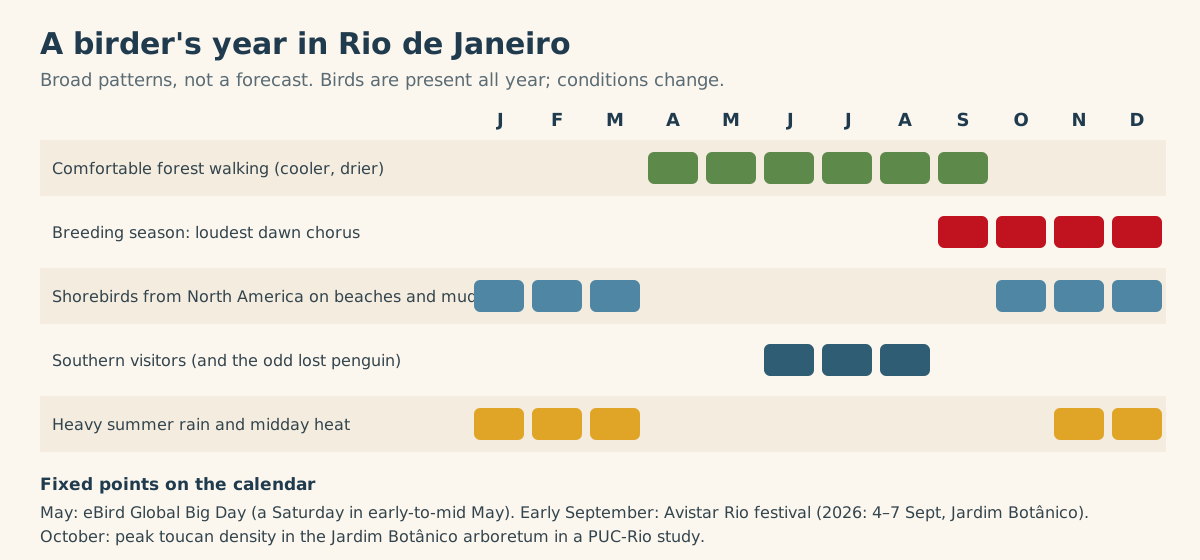
Birds are present all year, so there is no wrong month, only different conditions. The cooler, drier months from about April to September are the most comfortable for forest walking, with clearer air and fewer afternoon storms. Spring, from September to December, is the breeding season, when the dawn chorus is loudest and many birds are easier to locate by song. The southern summer, from roughly November to March, brings heavy rain and real heat; birding is still good, but only in the first two or three hours after sunrise.
Time of day matters more than the month. Be in the forest at first light, or at the Jardim Botânico gate at opening, and plan to be finished by about 10:30. Waterbirds at the Lagoa and the West Zone lagoons are active for longer, and late afternoon is a good second session there. Seabirds are best watched at sunrise from a headland. Rain is not a reason to cancel: a light drizzle after a hot spell can bring a flurry of activity, but heavy rain makes Tijuca's paths slippery and the birds go quiet.
For the summer storms in particular, our guide to Rio's rainy season explains how to plan a morning around them: storms usually build in the afternoon, which suits a birder's dawn start.
Fifteen Rio birds to learn before you land
You will enjoy Rio's birds far more if you can name the common ones on sight, because then the new bird stands out. These fifteen are the birds a visitor is most likely to meet in the first two days, between the hotel, the beach, the Lagoa and the Jardim Botânico. Learn the Portuguese names too: they are what a park guard or a kiosk owner will use, and several of them describe the call or the colour.
| Portuguese name | English name | How to recognise it, and where |
|---|---|---|
| Bem-te-vi | Great kiskadee | Yellow belly, black-and-white striped head. Shouts its own name, 'bem-te-VI', from every rooftop. |
| Sanhaço-cinzento | Sayaca tanager | Soft blue-grey bird eating papaya and banana in street trees and hotel gardens. |
| Beija-flor-tesoura | Swallow-tailed hummingbird | Large, iridescent, with a long forked tail. Chases other hummingbirds off flowering shrubs. |
| Tiê-sangue | Brazilian tanager | Males are blood-red with a black tail. Restinga scrub, forest edges and the Jardim Botânico. |
| Saíra-sete-cores | Green-headed tanager | The 'seven-colour' tanager: turquoise, green, orange and black. Travels in mixed flocks in Tijuca. |
| Tucano-de-bico-preto | Black-billed toucan | Black bill, yellow-orange throat, red band. Listen for a croaking call from the treetops. |
| Jacu | Guan | Turkey-sized dark forest bird with a red throat flap, walking on lawns at the Jardim Botânico. |
| Saracura-do-mato | Slaty-breasted wood-rail | Grey breast, rufous back, red legs. Its loud duet carries across the garden at dawn. |
| Periquito-rico | Plain parakeet | All-green parakeet in noisy flocks. An Atlantic Forest species that thrives in Rio's parks. |
| João-de-barro | Rufous hornero | Brown bird that builds an oven-shaped mud nest on lamp posts and branches. |
| Carrapateiro | Yellow-headed caracara | Pale-headed falcon walking the sand at Copacabana and Ipanema looking for scraps. |
| Tesourão | Magnificent frigatebird | Black, angular wings and a forked tail, hanging motionless over the beaches. |
| Biguá | Neotropic cormorant | Black diving bird drying its wings on the Lagoa's buoys and pedal-boat piers. |
| Coruja-buraqueira | Burrowing owl | Small long-legged owl standing by its burrow on open lots in Barra and Recreio, often in daylight. |
| Quero-quero | Southern lapwing | Grey-and-black plover on lawns and football pitches. Loud and fearless near its nest. |
Three birding mornings we would actually do
The South Zone morning, for anyone. Be at the Jardim Botânico gate at 8 am (not on a Wednesday) for toucans, guans and wood-rails, leave around 10:30, walk or taxi ten minutes to the Lagoa for cormorants, egrets and night herons from the shore path, and finish with lunch by the water. No guide, almost no walking uphill, and a list of 25 to 40 species for a careful observer.
The forest morning, for keener birders. Taxi to Praça Afonso Viseu for first light, walk the Floresta sector road slowly to the Cascatinha and the Açude da Solidão, stopping wherever you hear a flock, then come down via the Estrada das Paineiras for canopy views. You will see fewer birds than at the Jardim Botânico, but they will be the forest species. This is where a local birding guide makes the biggest difference: they know the calls and the flock routes, and they spot in seconds what you would miss for an hour.
The coast morning, for photographers. Watch sunrise from the Pedra do Arpoador or the Leme fort path for frigatebirds, boobies and terns, then head west to the Bosque da Barra or the Marapendi park for Brazilian tanagers, jacanas and burrowing owls on the way. Add a boat trip to the Cagarras on a calm day if you can manage the swim, and check the sea forecast first: a big swell closes the landing.
Day trips for serious birders: endemics within three hours of Rio
Rio is also a base for some of the best Atlantic Forest birding in Brazil, a biome with a long list of birds found nowhere else. The specialist tours that bring birders here spend a day or two in the city and then head for the mountains and lowland reserves of Rio state. Each of these needs an early start, a car or a guide, and ideally a night away.
REGUA, the Reserva Ecológica de Guapiaçu in Cachoeiras de Macacu, about two hours north-east of Rio, is the classic. It protects more than 11,000 hectares of forest climbing from restored lowland wetlands to the mountains of the Serra do Mar, runs a birding lodge and is a fixture on international birding itineraries for its wetland species, manakins, trogons and night birds such as owls. It is better as an overnight stay than a day trip.
The Serra dos Órgãos above Teresópolis and Petrópolis takes you into higher, cooler forest with a different set of species, including the bellbird you only heard in Tijuca; our Teresópolis and Serra dos Órgãos day trip covers the logistics. Further west, Itatiaia National Park, Brazil's oldest national park, is a weekend rather than a day, and one of the country's best-known high-altitude birding areas.
On the coast to the east, the restinga around Cabo Frio is the only home of the restinga antwren (formigueiro-do-litoral), a small bird with one of the tightest ranges in Brazil and a population estimated at fewer than 1,000. The Costa do Sol State Park was created in 2011 to protect almost all of its range. Seeing it needs a local guide who knows the territories, and it is a good example of why Rio-state birding rewards planning.
Guides, apps and the local birding community
Merlin Bird ID, the free app from the Cornell Lab of Ornithology, covers Brazil: download the regional pack before you go and use its sound identification in the forest, but treat every suggestion as a hint to check, not an answer. eBird is where you log your lists and, more usefully, where you see what other birders have recorded at a site in the last few weeks. WikiAves, the large Brazilian archive of bird photos and recordings, is the best place to check the Portuguese name of a bird and see whether it has been photographed in Rio.
For company, the state environment agency INEA runs Vem Passarinhar-RJ, a programme of free guided birding walks in state conservation units, announced on its website with registration details. Avistar Rio is the annual meeting point for the local community. Every May, the global eBird Big Day gives you a reason to join a local group for a dawn-to-dusk count. These are the best ways to meet Rio birders, who are generous with tips about where a bird has been seen this week.
If you hire a private birding guide, ask which habitats they cover, how many people are in the group, whether transport is included, which language they guide in and how they behave around birds. A good guide will tell you plainly that a species may not show, will not use repeated playback to pull birds out, and will not take you into closed areas. Be wary of anyone who guarantees a rare bird.
Birding responsibly in Rio, and the cages you will see
The basics are the same as anywhere: keep to paths, keep your distance, do not use repeated call playback, never approach a nest, and do not share the exact location of a nest or roost online. In a city as busy as Rio, add one more: give other people space. A birder with a tripod across the Lagoa cycle path or blocking a narrow Tijuca trail is a hazard, not a naturalist.
There is also something specific to Brazil you should know. Songbirds are still widely kept in cages here, and a large share of them are caught illegally from the wild. In May 2025 federal and military police stopped a man on the Magé-Manilha road in Rio state transporting 667 wild birds, including the pixoxó, a threatened seedeater endemic to Rio de Janeiro state, destined for clandestine bird fairs in São Gonçalo and the Lagos region. Never buy a wild bird or pay to photograph one in a cage, and if you see wild birds being sold, report it to the state's Linha Verde anonymous hotline.
If you find an injured bird, keep people and dogs away and call 1746, Rio's municipal service line, which routes wildlife rescues to the city's environment department; inside a national or state park, tell the staff. Do not take the bird away, feed it or give it water. Safety matters for you too: go early with company, keep phones and cameras out of sight between viewpoints in quiet areas, and check the park's current advice on trails before you set off.
Book the practical essentials first
Choose a flexible booking, confirm service details directly with the provider, and keep every confirmation accessible offline.
Links may earn us a commission at no extra cost to you. This supports PlanRio.
Common mistakes tourists make
- Turning up at the Jardim Botânico on a Wednesday morning, when the arboretum opens at 11 am instead of 8 am.
- Walking non-stop through Tijuca Forest. Forest birds come in flocks; you find them by standing still and listening.
- Starting at 10 am in summer. By then the heat has silenced the forest; the best birding is the first two or three hours after sunrise.
- Expecting to see the bellbird because you can hear it. Many forest birds are heard far more often than seen, so log them as heard.
- Walking up to burrowing owls on Barra's open lots for a photo. Repeated disturbance makes the parents abandon the nest.
- Booking the Cagarras trail without checking the swell or your swimming. The landing is a 30 m swim to wet rocks.
- Paying to photograph caged songbirds at a market or a roadside. Most were taken illegally from the wild.
Local expert tips
- Be at the Jardim Botânico gate for the 8 am opening and listen for the toucans' croak in the palm crowns along the Aleia Barbosa Rodrigues.
- In Tijuca, start at Praça Afonso Viseu at first light and stop wherever you hear a burst of calls: that is a mixed flock passing.
- Download the Merlin Brazil pack and the Tijuca park's bird guide before you go; mobile signal under the trees is poor.
- Watch sunrise from the Leme fort path or Arpoador for frigatebirds and boobies heading along the coast.
- Visit the Lagoa with the light behind you, on the west and south shores, for close views of cormorants, egrets and night herons.
- Check eBird's recent sightings for a site the night before; Rio's birders log there constantly.
- If you are in Rio in early September, look up the next Avistar Rio festival for free talks and guided dawn walks.
- Buy the pocket guide to the birds of Rio at the Jardim Botânico friends' shop: 120 species, chosen because you can actually see them.
Frequently asked questions
Where is the best birdwatching in Rio de Janeiro?+
For most visitors the best birdwatching in Rio de Janeiro is the Jardim Botânico arboretum at its 8 am opening, for toucans, guans, wood-rails and hummingbirds. Keener birders should add the Floresta sector of Tijuca National Park for forest species, the Lagoa for waterbirds, and the Leme or Arpoador headlands for frigatebirds and boobies.
How many bird species are there in Rio de Janeiro?+
Somewhere between about 400 and 480 bird species have been recorded inside Rio de Janeiro municipality, depending on the count used; one figure based on data from the city's Instituto Pereira Passos is 481. A local pocket guide to the city's birds selects 120 of them as the species a visitor can realistically see.
Where can I see toucans in Rio de Janeiro?+
The easiest place to see toucans in Rio is the Jardim Botânico arboretum, where a PUC-Rio study estimated about 130 black-billed toucans. Go at the 8 am opening and look and listen in the crowns of palms and fruiting trees. They also occur in Tijuca Forest, Parque Lage and wooded neighbourhoods nearby.
When is the best time of year for birdwatching in Rio?+
Rio's birds are present all year. April to September is the most comfortable for forest walking, September to December is the breeding season with the loudest dawn chorus, and October to March brings shorebirds from North America. In summer, from about November to March, bird only in the first hours after sunrise.
Can I visit the Cagarras islands to see seabirds?+
Yes. Since 28 June 2026 the Trilha da Comprida on Ilha Comprida in the Cagarras Natural Monument is open daily from 7 am to 5 pm, with loops of 400 m to 1.2 km. Access needs a 30 m swim from the boat to the rocks, and ICMBio recommends licensed operators and accredited guides.
What is Avistar Rio?+
Avistar Rio is Rio de Janeiro's birdwatching festival, part of the national Avistar Brasil network. Its 11th edition ran on 4–7 September 2026 at the Jardim Botânico, with free talks, films, children's activities and 7 am guided bird walks that needed advance registration. Check its website for the next edition's dates and venue.
Do I need a guide for birdwatching in Rio?+
Not for the easy sites. The Jardim Botânico, the Lagoa and the Leme and Arpoador headlands are simple to bird alone. A local birding guide makes the biggest difference in Tijuca Forest, Pedra Branca and the day-trip reserves, where knowing calls and flock routes turns a quiet walk into a long list.
Is birdwatching in Tijuca National Park safe?+
Birding the main roads and visitor areas of Tijuca National Park is generally fine in daylight. Go early, go with company, keep cameras and phones out of sight between stops, stay on the roads and trails the park currently recommends, and check its latest safety advice before you set off on a longer trail.
What birds will I see on Rio's beaches?+
On Rio's beaches you will see magnificent frigatebirds overhead, kelp gulls and terns, brown boobies offshore and yellow-headed caracaras walking the sand at Copacabana and Ipanema. From October to March, look on wet sand and lagoon mudflats for small shorebirds that migrate from North America for the southern summer.
Which apps are best for birdwatching in Rio?+
Use Merlin Bird ID with its Brazil pack for sight and sound identification, eBird to log lists and see recent sightings at each site, and WikiAves, the Brazilian bird photo archive, to check Portuguese names and local records. Download everything before entering Tijuca Forest, where the mobile signal is weak.
Sources and image credit
Details, eligibility and requirements can change. Use these official, operator and public-information sources to check current access and procedures before you plan or act.
- Instituto de Pesquisas Jardim Botânico do Rio de Janeiro: Avistar Rio returns in 2026 ↗
Official programme for the 11th Avistar Rio, 4–7 September 2026: free entry, 7 am arboretum walks, talks and films.
- Cidade de Niterói: Avistar Rio 2026 brings bird walks and cinema to the Jardim Botânico ↗
Second source for the dates, the registration requirement and the arboretum and museum opening hours.
- Folha de Pernambuco: Rio opens its first island trail in a conservation unit (June 2026) ↗
Trilha da Comprida opened 28 June 2026: three loops, 7 am–5 pm, wet landing, age guidance, accredited guides.
- Time Out Rio: trails on the Cagarras (June 2026) ↗
Second source for the trail and for the frigatebird and brown booby breeding colony.
- CNN Brasil: Ilhas do Rio project completes the Cagarras restoration (July 2021) ↗
The Cagarras as a major South Atlantic nesting site for frigatebirds and boobies, 5 km offshore.
- PUC-Rio: black-billed toucan density and diet in the Jardim Botânico arboretum ↗
About 130 toucans in the 54-hectare arboretum, 28 food plants and a spring peak in October.
- Trilha Transcarioca: fauna and flora ↗
481 bird species recorded in Rio municipality (IPP data) and common species along the trail.
- O Eco: pocket guide to the birds of Rio launched ↗
More than 400 species catalogued in the city and 120 selected for the guide by João Quental and Renato Rizzaro.
- Tijuca National Park: bird observation ↗
Official guidance, the year-round birding note and the park's bird guide.
- World Land Trust: restoring the Atlantic Forest at REGUA (September 2025) ↗
REGUA's 11,000+ hectares, restored wetlands, manakins and owls.
- BirdLife International: state park created to protect the restinga antwren ↗
Costa do Sol State Park (2011), the Cabo Frio range and a population under 1,000.
- ICMBio: national action plan for the restinga antwren ↗
Federal conservation plan for the formigueiro-do-litoral.
- SBT News: man arrested with 667 wild birds in Rio state (May 2025) ↗
The Magé-Manilha seizure, including the pixoxó, and the clandestine bird-fair trade.
- INEA: Vem Passarinhar-RJ ↗
State programme of guided birding walks in conservation units.
Keep planning
Rio wildlife guide
Marmosets, capybaras, caimans and the bay's dolphins.
Jardim Botânico guide
Tickets, hours and what to see in the garden.
Tijuca National Park
Entrances, trails and highlights of the forest.
Lagoa Rodrigo de Freitas
The lagoon loop, kiosks and views.
Bosque da Barra
Restinga paths and a lagoon in Barra.
Pedra Branca State Park
Rio's bigger, wilder forest in the West Zone.
Whale watching from Rio
Humpback season, shore spots and boats.
Rio's rainy season
How to plan around summer storms.