Praia da Macumba Guide: Surf, Access & Beach Day Planning
PlanRio Editorial Team · Official source references checked 27 September 2026Quick answer
Praia da Macumba is a surf-oriented Atlantic beach in Recreio dos Bandeirantes, best as the main stop on a flexible West Zone day. Check INEA’s latest sample-point bulletin, the sea and current access before travelling; use Pedra do Pontal as a landmark, not a guaranteed low-tide crossing or casual hike.
At a glance
Where
Recreio dos Bandeirantes, in Rio’s far West Zone; the official location listing uses Estrada do Pontal
Character
An urban-edge Atlantic beach with a strong surf identity, a cycleway and beach kiosks described in the municipal location record
Best for
A West Zone beach day, watching or surfing waves, and pairing the coast with a planned visit to Recreio
Swimming
Judge the actual surf and lifeguard advice; a surf reputation is not a daily swimming forecast
Water quality
Check INEA’s newest bathing bulletin and match the named sample point to the stretch you intend to use
Landmark
Pedra do Pontal separates Macumba from Praia do Recreio; the shore-level link can depend on low tide
Facilities
Kiosks and a cycleway are recorded, but opening, access and service availability can vary
Planning note
Allow a substantial cross-city transfer from the South Zone and check the road, beach and return plan on the day
Praia da Macumba: what this guide covers
Praia da Macumba is a long Atlantic-facing beach in Recreio dos Bandeirantes, on Rio de Janeiro’s far western coast. Its visitor appeal comes from a combination that is less common on the postcard circuit: a proper urban beachfront, an established surf scene, a cycleway and a route onward toward the more protected beaches of Prainha and Grumari. It is not a secluded nature reserve, and it is not simply another name for Praia do Recreio. The rocky Pedra do Pontal is the most visible landmark between those stretches.
The existing PlanRio Surfing in Rio guide compares lesson locations, ability levels and surf etiquette across the city. This page answers a broader question: how to make a beach day at Macumba work if you might swim, walk, eat, cycle, watch surfers or continue along the West Zone coast. We keep the distinction clear because a useful beach guide should not imply that every visitor is a surfer—or that the beach’s reputation tells you whether today’s water is safe for you.
Use this as a planning framework, then check the latest official bathing-water bulletin, same-day sea and weather conditions, and transport before setting out. The city’s Rio Film Commission listing is useful for the geography and recorded features of the beach, but its filming availability and production fee are not visitor opening hours or beach admission charges. We do not treat a location-catalogue entry as a promise that every kiosk, path or facility will be operating when you arrive.
Where Praia da Macumba sits on Rio’s coast
Macumba is part of Recreio dos Bandeirantes, a large West Zone neighbourhood rather than a compact attraction beside Rio’s central sightseeing districts. The city’s location entry gives Estrada do Pontal as the address. It places Pedra do Pontal between Praia da Macumba and Praia do Recreio, with Prainha visible farther along the coast. Riotur also describes Macumba in the same western sequence as Pontal, Prainha and other beaches in Recreio. These names matter when searching maps: a result marked Recreio can refer to a different stretch of sand from the section you have in mind.
For orientation, imagine the coast as a chain rather than one continuous beach with interchangeable names. Approaching from the more built-up Recreio side, Praia do Recreio and Pedra do Pontal are useful landmarks; Macumba is the surf-oriented stretch beyond the rock, and the road continues toward Prainha and Grumari. Local usage and map labels do not always draw the boundaries in exactly the same place. Use a specific destination pin and inspect the final walk, instead of asking a driver for a generic ‘Recreio beach’ drop-off.
The distance from the classic South Zone base—Copacabana, Ipanema or Leblon—is the main practical cost. A route that looks manageable on a map can take much longer when the coastal roads are busy. Macumba therefore works best as the centre of a West Zone day, or as the everyday beach for a visitor staying in Recreio. It is an inefficient quick detour between central attractions. Before committing, compare the whole trip with our Recreio neighbourhood guide and reserve enough time for the return journey.
How the beach changes along the shore
The official Rio Film Commission describes Macumba as an extensive beach with kiosks along the beachfront and a cycleway. That is a useful broad picture, not a current inventory of every service. At one end the Pedra do Pontal gives you a clear landmark and a visual break from the longer shoreline. Elsewhere, the urban edge and the road set a different mood from Prainha’s protected setting. Walking a little before choosing a place to sit helps you see the actual crowd, surf, shade, access and service options rather than selecting from a generic map label.
Think in practical zones, not in a promise that one section is always calm or more family-friendly. Near a prominent landmark or a busy kiosk cluster, you may find more people and easier orientation. A quieter-looking stretch can mean fewer services and a longer walk back to food, water or the road. The wave pattern also changes from one patch to the next and from one set to another. A visible sandbar, a line of whitewater or a patch that looks flat from the promenade can conceal a strong current or a sudden change in depth.
When you arrive, pause at the edge of the sand and look along the coast before spreading out. Note where lifeguards are working, where other swimmers are entering, what the waves are doing, and whether the shoreline leaves a comfortable route back. Pick a place that does not block other people’s passage or occupy protected vegetation. If the beach is busy, leave space for sports and surfboard movement rather than setting up directly in a route people use to reach the water. A few minutes of observation is more useful than assuming the nearest open-looking patch is the right one.
Who Praia da Macumba suits—and who may prefer another beach
Macumba is a good fit for visitors already spending time in Recreio or Barra, people who want to see Rio’s West Zone beach culture, and travellers comfortable with open-ocean conditions. Surfers can use the beach as a starting point for a session after checking a forecast and their ability against the conditions. Non-surfers can enjoy the scale, watch a surf lesson or competition if one is actually scheduled, use the promenade and kiosks when available, or simply make a longer beach outing out of a west-side stay.
It is a less convenient choice when you have only one free afternoon in Rio, need calm shallow water, rely on step-free access throughout the day, want a guaranteed quiet swimming area, or expect a quick trip from Zona Sul. The beach’s surf reputation is a reason to pay attention, not evidence that a lesson will suit every beginner or that a family can safely choose any section. If calm water is central to the day, compare with Praia Vermelha; if a major surf outing is your main goal, compare the practical choices in the dedicated surf guide before travelling.
The honest test is whether the beach itself is worth the transfer for your group. If you would be disappointed by rough surf, a change in water quality, limited shade or a kiosk that is closed, you need a more reliable alternative. If the whole appeal is the western coastline and you can adjust your plan, Macumba can be a rewarding main stop. Build flexibility into the trip instead of treating a long cross-city ride as a guarantee of a particular sea state.
Surf reputation is not a surf report
Riotur and the Rio Film Commission both identify Macumba with surfing, and Riotur’s beach material describes the waves at Macumba and nearby Prainha as strong. That reputation explains why the beach is well known among board riders. It cannot tell you the size, shape, wind, current or crowd on your visit date. A beach can be famous for surf while offering very different conditions across the day; a beginner-friendly lesson also depends on the instructor’s chosen spot and the conditions they find, not just on a product page or a beach name.
If you are learning, choose a school that clearly confirms the meeting point, what is included, how conditions are assessed and what happens if the sea is unsuitable. Ask whether the instructor changes the location when the forecast shifts. The PlanRio surf guide compares the city’s lesson logistics, including the South Zone convenience of Arpoador. An Arpoador booking is an Arpoador activity; it is not a Macumba lesson. Do not book a product for one place and assume it will operate at another beach because both have waves.
Experienced surfers should make their own condition check before travelling with a board. Review a current surf forecast, observe the sets from the shore, watch how people enter and leave, and check the active lifeguard guidance. Do not paddle out solely because other surfers are in the water: local skill and familiarity vary, and a group can be out in conditions unsuitable for a visitor. If you cannot identify a straightforward entry and exit or the shore break is beyond your level, skip the session. The best choice is the one that lets you get out of the water safely, not the one with the strongest online reputation.
Swimming, surf zones and staying out of trouble
A wave beach should not be read as a swimming pool with a convenient surf corner. Surf, shore break, rip currents and changing water depth can be present even when the sea looks inviting from the promenade. Swim only where conditions and lifeguard instructions support it, keep within your real ability, and do not cross into an active surf line. If you are unsure which section is being used by surfers or where the safe swimming area is, ask a lifeguard before entering rather than following a crowd into the water.
Children need close, active adult supervision at the waterline; an arm’s reach is more useful than watching from a chair. Agree on a visible landmark where your group will regroup, and do not let a child enter while the supervising adult is distracted by a phone, conversation or food. If someone is pulled by current, avoid a panicked straight-line swim against it; call or signal for lifeguard help and follow local rescue instructions. Our Rio beach-safety guide explains flags, surf hazards and practical emergency behaviour across the city.
Weather and sea state can change the plan after you arrive. Back away from rocks and shoreline structures when waves are surging, do not climb onto wet formations for a photograph, and keep clear of people carrying boards in and out. Leave the water if a lifeguard warns you, thunder develops, visibility worsens or the sets become stronger than you expected. It is fine for one person in a group to stay dry; no one needs to swim to justify the trip. A promenade walk, lunch or a view of the coastline can still make Macumba a worthwhile visit.
Check bathing-water quality the right way
The Instituto Estadual do Ambiente (INEA) publishes bathing-water bulletins for beaches across Rio de Janeiro state. Its page explains that monitoring is carried out at named points and that results are released regularly. Use the newest bulletin before swimming and read the locality attached to the result; do not assume that a status for one part of Recreio or Pontal describes the entire length of Macumba. When labels are unclear, choose the closest named sample point and ask local lifeguards for current advice rather than stretching a result beyond the location it covers.
INEA recommends avoiding the sea during the first 24 hours after heavier rain and near storm-water channels or drains. That practical warning matters on this stretch of coast because the nearby Canal de Sernambetiba is a visible geographic feature, but it does not mean every point along Macumba has identical water conditions. Rain can carry runoff into coastal waters; a clear-looking surface does not reveal bacterial quality. Likewise, a bulletin result reflects its sampling and publication timing, not a guarantee that conditions cannot change afterward.
Use a simple sequence: check the latest INEA result before leaving; note the sample location and date; avoid swimming after substantial rain or beside any drainage outfall; then still observe the sea and any local warnings on arrival. If the bulletin is marked unsuitable, the sampling point does not match your section, or you cannot confidently interpret it, choose another activity or another beach. Do not rely on an old screenshot, a decade-old tourism blurb, the colour of the water or an affiliate tour description to decide whether bathing is appropriate.
A changing shoreline: why old photos and reviews can mislead
Praia da Macumba has experienced major coastal damage and repair. The city reported that a powerful sea event damaged part of the promenade, cycleway and road in 2017, followed by recovery and stabilization work. That history is relevant to a visitor because it shows why online photographs, old directions and a remembered route can stop matching the place. It is not a claim that the same damage remains today; nor does a past repair prove that every path, curb or cycle segment is currently open and in perfect condition.
This coast is shaped by the Atlantic, storm swell, rainfall and human infrastructure. After rough weather, sand can shift, access points may be temporarily affected and work crews can alter the normal route. The city’s official location page still describes the broad beachfront features, but the page is not a live maintenance feed. Check current municipal notices and a same-day route map if a recent storm or construction is mentioned. On arrival, follow barriers and detours even if a travel blog describes a familiar shortcut.
The useful takeaway is modest: plan for a real urban beach that can change. Wear footwear suited to the actual route, do not step into a closed section, and keep the cycleway clear when walking. If the pavement has sand, water or work equipment on it, slow down and use the marked alternative. This is one reason to avoid a tightly scheduled onward connection to Prainha or an evening booking. A few minutes of flexibility protects both the visit and the people using the coast every day.
Getting to Praia da Macumba without a brittle itinerary
Start navigation with the exact label Praia da Macumba or the official Estrada do Pontal location reference, then inspect where the route ends. The correct map pin matters more here than a broad search for Recreio. From the South Zone, a taxi or rideshare is often the simplest direct option, especially with a board or beach gear, but traffic can make travel time unpredictable. Agree on the drop-off and pick-up points before the driver leaves and keep the destination saved offline in case mobile reception or battery becomes a problem.
Public transport can serve the broader western corridor, but current routes and transfers should be checked on the day. Do not copy a bus number or fare from an old article, and do not assume the final stop is beside the stretch of sand you intend to use. A connection through Barra may be sensible if price matters more than speed; with children, a surfboard or limited mobility, compare the walking sections as carefully as the ride. If a route involves several transfers, check its return frequency before you go to the beach rather than after sunset.
Driving gives flexibility for a West Zone loop but does not remove parking uncertainty or the need to check traffic and access. Do not block residential entrances, occupy a cycle lane, or treat every empty kerb as authorised beach parking. For a beach-to-beach day, plan a primary stop and a single realistic extension, not a string of destinations that depends on perfect traffic. The Rio transport guide covers the broader city connections; use a live municipal or journey-planning source for the exact route you need today.
Kiosks, the cycleway and what to bring
The official location listing describes kiosks along the beachfront and a cycleway. These make Macumba feel more connected to the neighbourhood than the protected beaches farther west, but they are not a guarantee that a particular kiosk is open, has your preferred food, accepts a particular payment method or operates during poor weather. If a meal matters to the day, check current local listings or bring a small backup snack. Ask the price before ordering or settling into rented furniture, and keep the receipt or total clear when ordering for a group.
The cycleway is part of the beach experience for local residents. Walkers should not drift into the bike path while looking at the sea or stopping for photos, and cyclists should slow down around pedestrian crossings and crowded sections. The surface can be affected by sand or works after rough weather, so use the route cautiously. If you bring a board, carry it in a way that does not strike a passing cyclist or another beachgoer; avoid leaving it across the path while you arrange your bag.
Pack for an exposed Atlantic beach: water, sun protection, a towel, a light cover-up, and a small bag for your rubbish. Bring only the valuables you need and keep your phone and wallet secure when swimming. A compact sunshade can be helpful if permitted and if there is room, but do not stake it in vegetation or obstruct a public passage. If you plan to surf, follow the school or local club’s equipment guidance; do not treat a casual beach visit as a reason to borrow or carry unfamiliar gear into changing surf.
Pedra do Pontal: landmark first, optional outing second
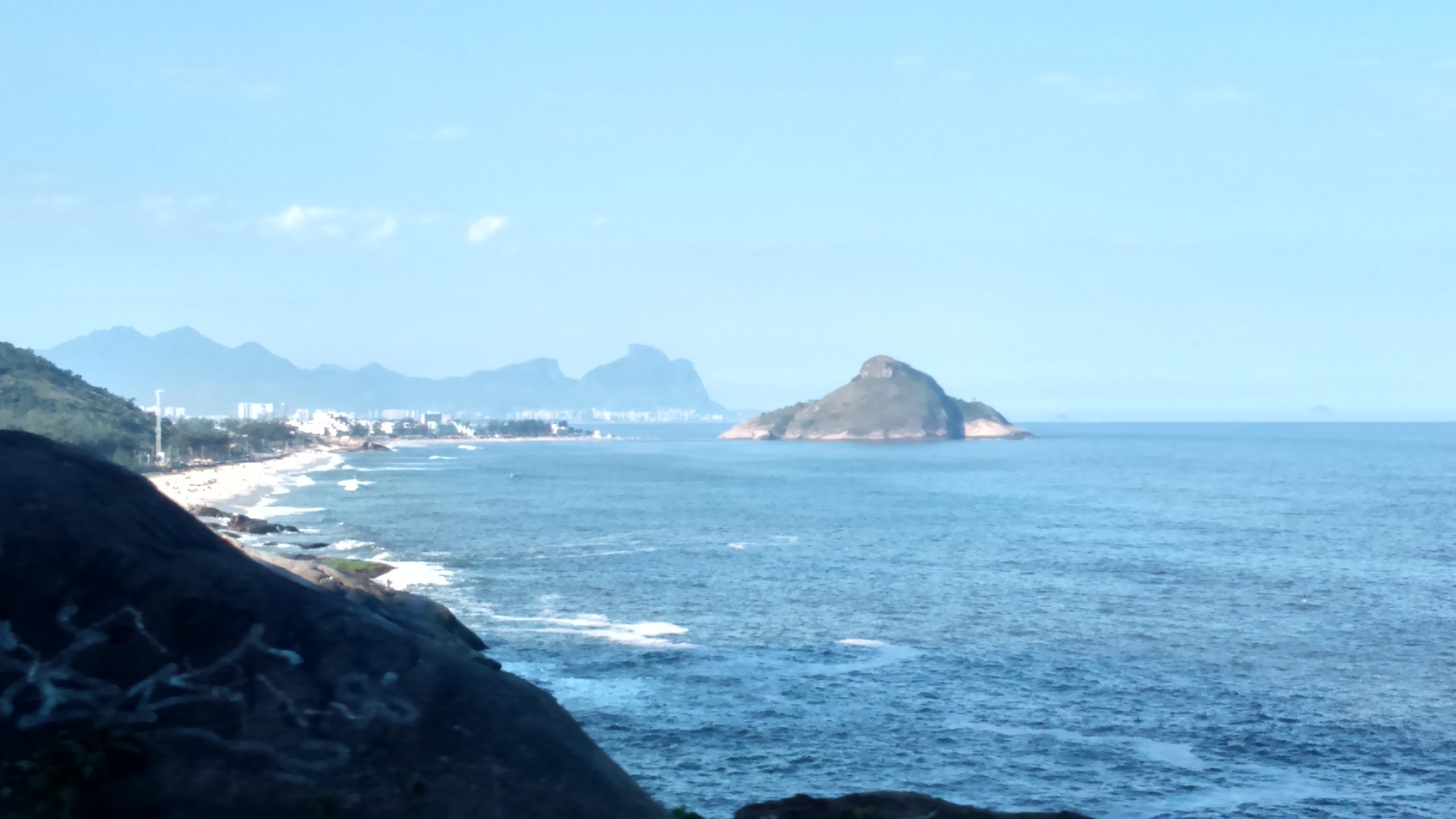
Pedra do Pontal is the clearest natural divider between Macumba and Praia do Recreio. The Rio Film Commission notes that when the tide is low, a narrow sandy path can form between the beach and the rock. It also describes a climb to the top that takes about an hour. Those details explain why the rock appears in beach itineraries, but they do not amount to a managed trail schedule, a guarantee that the route is currently open, or a recommendation that every beach visitor should climb it.
Treat the low-tide sand connection as a changing coastal feature. Check the tide and sea before walking toward it, leave before water closes the route, and never wade through surf or scramble across slippery rocks to save a short return. The route up the rock is a separate hike with uneven footing and exposure; do not start in flip-flops, during rain, in strong wind or when the rock is wet. We do not provide turn-by-turn climbing directions because the municipal location record does not verify current trail condition, signage, access rules or rescue arrangements.
For most visitors, Pedra do Pontal is valuable even without a summit attempt: it helps orient the coast, marks the change to Praia do Recreio and gives the beach its distinctive profile. If the climb is your main goal, confirm the route with a current local authority or qualified guide before going, and do not add it casually to a surf session or a family swim. Keep the beach plan separate from a hike plan so tide, footwear, daylight and return transport all receive proper attention.
Families, mobility and a realistic access check
Macumba’s broader urban edge may make it feel easier to use than a small isolated cove, but beach access is not the same as a fully accessible day out. The municipal location entry does not publish a current accessibility audit, and the presence of a promenade or cycleway alone does not confirm a step-free route onto the sand, accessible toilets, beach wheelchairs or an uninterrupted accessible path. If someone in your group needs those facilities, contact the relevant city service or operator before travelling and confirm the exact access point.
Families should choose a visible place near active lifeguard support, agree on a meeting point and keep children close around both the surf and the cycleway. Do not allow children to climb the rock, run behind surfers carrying boards or play in a drainage channel. For a child who is not a confident swimmer, the beach’s wave profile can make a large difference; check the day’s conditions and consider a sheltered alternative if waves are breaking strongly. Bring shade and water rather than assuming a kiosk or rental will be available at the precise moment you need it.
For travellers with low vision, reduced balance or fatigue, ask about the surface from drop-off to sand and the distance between the chosen point, seating and facilities. Wet sand, loose debris, glare and moving bicycles can all change how manageable a route feels. If the details cannot be confirmed in advance, plan a nearby accessible activity rather than discovering a barrier after a long transfer. Our Accessible Rio guide is a starting point for wider planning, but it should not be taken as a beach-specific access guarantee.
Should you combine Macumba with Prainha or Grumari?
Macumba, Prainha and Grumari belong to the same broad West Zone coastal outing, but they are not interchangeable stops with the same facilities or access rules. Macumba is the more urban-edged beach in this group, with kiosks and a cycleway recorded by the city. Prainha is smaller and more nature-oriented; Grumari is farther along the coast and has a protected setting. The drive continues through roads where parking, traffic, weather and access management can change the day. A map’s short gap between labels does not make them an effortless walk from one to the next.
If your priority is surfing or a beach with nearby neighbourhood services, choose Macumba as the main stop and add another beach only if transport and access are confirmed. If your priority is a compact, scenic surf beach, read our Prainha guide. If you want a longer nature-focused outing, compare the Grumari guide. If you are relying on public transport, check the live routes and return connections in our Rio transport guide before committing to more than one stop.
A guided beach tour may be useful to travellers who want transport and local context, but check the exact itinerary. A product that visits Prainha and Grumari is not a tour of Macumba, and a broad ‘wild beaches’ description can hide which stops are actually included. Ask the operator where the group stops, whether Macumba is included, what happens if access changes and where the return pickup will be. Book only when the description matches the day you want to have.
A flexible half-day plan
Before leaving, check three independent things: the latest INEA bathing-water result, a current surf and weather report, and the live route with its return option. Decide whether swimming, surfing or simply spending time on the coast is the main purpose. Save the destination pin and a second beach or indoor option offline. If the forecast or water report does not support swimming, the trip can still be worthwhile as a walk or meal—but only if that version of the outing makes sense for your group and travel time.
On arrival, take a short walk along the public promenade before choosing a section. Look for active lifeguards, wave patterns, drainage outlets, crowding, open services and any temporary work or barriers. Ask a kiosk about prices before ordering, then keep the cycleway open and set up away from vegetation. If you are surfing, use the meeting point and instructions from your instructor or local surf contact. If you are swimming, choose a section that matches your ability and never enter because a friend says the water looks fine.
Set a return time while you still have enough battery and daylight. If you want to see Pedra do Pontal, check the tide separately and do not start the climb unless the route, footwear and conditions have been verified. Add Prainha or Grumari only if your driver, transit route, access status and expected return all align. A good itinerary is a sequence with room to change, not a challenge to tick off every West Zone beach in a single afternoon.
Local etiquette and care for the coast
Macumba is part of a lived-in neighbourhood. Keep music at a considerate volume, respect the people using the promenade, ask before photographing identifiable residents and do not leave a board, chair or cooler in the way. Agree on kiosk prices before service and treat workers politely. The beach is a public place, not an invitation to film homes, block a driveway or assume that a private-looking facility belongs to visitors.
Take every piece of rubbish away from the sand, including cigarette ends, bottle caps and food scraps. Keep out of planted or fenced vegetation, never pull plants for a photo, and use the marked path rather than cutting across dunes or landscaped buffers. The city’s public-space rules protect restinga and restrict where equipment or sports courts may be set up; if an area is fenced or marked, leave it undisturbed. Avoid glass where possible and do not feed wildlife.
If the sea is rough, follow lifeguard instructions and leave the shoreline clear for rescue access. Surfers should respect priority and give swimmers room; swimmers should avoid the active takeoff and exit zones. These small courtesies make a busy beach more comfortable for everyone and help protect the conditions that make the West Zone coast worth visiting.
When to choose another beach instead
Choose a different beach if you need calm water, short transfer time from the South Zone, guaranteed toilets or step-free sand access that has been confirmed in advance. Praia Vermelha is a more sheltered option for visitors who want to avoid open-ocean surf; Ipanema and Copacabana are easier for public transport and a broader range of city services. No beach is safe under every condition, so use the day’s weather, water-quality information and lifeguard guidance wherever you go.
Choose Prainha when its smaller scale and natural setting matter more than Macumba’s urban-edge services, while remembering that the road and parking may require separate planning. Choose Grumari for a longer West Zone nature outing, not as a guaranteed next stop. Choose Macumba when you want to experience the surf-oriented coast of Recreio and accept the transfer and changing conditions that come with it. Our Rio beaches ranking and beach escape comparison help with the wider destination decision.
There is no prize for sticking to a plan that stopped making sense. If the bathing bulletin is unsuitable, the access is disrupted, the waves are outside your comfort level or the return route looks unreliable, switch to a nearby activity or reschedule. The west coast will still be there on a day when the conditions fit. That willingness to adapt is part of planning well in Rio, especially when the beach is a long way from your hotel.
The honest verdict on Praia da Macumba
Praia da Macumba is worth the trip for visitors who want to see Rio’s West Zone coast, surf or watch the surf, and build a flexible day around Recreio. It is a real neighbourhood beach rather than a remote secret: the city records kiosks and a cycleway, while its strong-wave reputation makes the sea conditions central to the visit. Pedra do Pontal gives the shoreline a recognizable landmark and a potential low-tide walk, but it should not be treated as an automatic climb.
The trade-offs are the cross-city transfer, wave exposure, changing coastal infrastructure and the need to check water quality by named sample point. Macumba is not the easiest answer for a short first-time visitor day or a family that needs calm, predictable swimming. Pick it for the kind of coast it actually is, verify the day’s conditions, and keep an honest fallback. That is a more useful promise than calling it perfect in every season or for every traveller.
Common mistakes tourists make
- Treating Praia da Macumba, Praia do Pontal and Praia do Recreio as one interchangeable pin.
- Assuming strong surf means a surf lesson is available or suitable for every beginner.
- Using last week’s bathing bulletin or a result for a different sample point as today’s guarantee.
- Swimming after heavy rain or beside a visible drainage outlet because the water looks clear.
- Assuming the low-tide sand path to Pedra do Pontal stays passable as the tide rises.
- Planning Macumba as a quick stop between central Rio attractions without allowing for traffic.
- Relying on old photos to confirm that a promenade, cycleway or access point is currently open.
- Leaving boards, glass, rubbish or beach equipment across the cycleway or protected vegetation.
Local expert tips
- Save the exact Macumba map pin and the INEA bathing bulletin before leaving reliable Wi-Fi.
- Check the sample-point name and date in the bulletin; do not generalize one result to every stretch.
- Ask a lifeguard about swimming zones and current conditions before entering unfamiliar surf.
- Carry water, sun protection and a small rubbish bag even if you expect to use a kiosk.
- Check the return route before the beach gets busy and your phone battery runs down.
- Use Pedra do Pontal as an orientation landmark; verify the tide and trail status before any walk or climb.
- Follow temporary barriers or cycleway detours after rough weather, even when an older blog shows another route.
- Keep Prainha and Grumari as separate destinations with their own access and parking checks.
Frequently asked questions
Where is Praia da Macumba in Rio de Janeiro?+
Praia da Macumba is in Recreio dos Bandeirantes, in Rio’s far West Zone. The city’s Rio Film Commission lists Estrada do Pontal as the location and places Pedra do Pontal between Macumba and Praia do Recreio. Use an exact map pin because a generic Recreio result may send you to another part of the coast.
Is Praia da Macumba good for swimming?+
It can be suitable only when the latest INEA bathing-water result and same-day sea conditions support swimming. Macumba is known for surf, and conditions vary along the shore and over time. Check the bulletin, avoid swimming during the first 24 hours after heavier rain or close to storm-water outlets, and follow lifeguard advice.
Is Praia da Macumba good for beginner surfers?+
The beach has a strong surf identity, but that does not guarantee beginner-friendly conditions on a particular day. Confirm the exact lesson meeting point, instructor, equipment and cancellation or relocation policy with a current school. For a comparison of lesson locations and logistics around Rio, see PlanRio’s Surfing in Rio guide.
What is the difference between Praia da Macumba and Praia do Recreio?+
They are separate named stretches in Recreio. The Rio Film Commission identifies Pedra do Pontal as the divider between Praia da Macumba and Praia do Recreio. Local labels can overlap in mapping and casual conversation, so use the precise destination pin and check where a route ends before travelling.
Can you walk from Macumba to Pedra do Pontal?+
The municipal location entry says a narrow strip of sand can connect the beach to Pedra do Pontal at low tide. That connection depends on the tide and sea conditions. Do not cross through waves or scramble across wet rocks, and return before the water closes the route. A climb to the top is a separate outing whose current access and trail condition should be confirmed locally.
Are there kiosks and toilets at Praia da Macumba?+
The city’s Rio Film Commission record describes kiosks along the beachfront and a cycleway, but it is not a live directory of open services and does not guarantee toilets or a specific kiosk will be available. Check current local information, ask about prices before ordering, and bring water and a backup snack.
How do I get to Praia da Macumba from Ipanema or Copacabana?+
Use an exact Praia da Macumba destination pin and compare a direct taxi or rideshare with current public-transport routes to the West Zone. Travel time varies with traffic, and the final stop may still require a walk. Check the return route before you go; do not rely on old bus numbers, fares or average travel-time claims.
Can I visit Macumba, Prainha and Grumari in one day?+
Possibly, if transport, current access, parking and weather align, but they are distinct stops and the map does not guarantee easy connections. Choose one main beach, confirm the onward route and keep a realistic return margin. Do not rely on a tour of Prainha and Grumari as if it also includes Macumba unless its current itinerary says so.
Is Praia da Macumba accessible for wheelchairs?+
We could not verify a current beach-specific accessibility audit from the municipal location listing. A promenade or cycleway does not prove that the sand, toilets, seating or route from drop-off are step-free. Contact the relevant city service before travelling and confirm the precise access point and facilities your group needs.
Does Praia da Macumba have a specific surf tour or lesson?+
Surf schools and instructors may serve the area, but availability, meeting points and lesson suitability vary. Contact a current operator and confirm that the lesson actually takes place at Macumba, what equipment is included, how conditions are assessed and what happens if the sea is unsuitable. A product at Arpoador or a tour of Prainha and Grumari is a different outing.
Sources and image credit
Conditions and access can change. Use these primary references for the latest checks before your visit.
- Rio Film Commission — Praia da Macumba ↗
Municipal location record for the beach’s broad geography, Pedra do Pontal, cycleway and kiosks. Its film availability and production fee are not visitor opening hours or beach charges.
- INEA — Bathing-water quality for beaches in Rio de Janeiro state ↗
Use the newest bulletin and its named sample point. INEA advises avoiding bathing for 24 hours after heavier rain and near storm-water outlets.
- Riotur — Recreio dos Bandeirantes ↗
Official city tourism overview of the western coastline, surf and local cycleway context.
- Riotur — Visit Rio public guide (2023 edition) ↗
Official tourism guide describing the strong waves of Macumba and Prainha; it is general destination context, not a same-day surf report.
- Rio City Hall — recovery works at Praia da Macumba ↗
Historical municipal report on damage and recovery work after coastal erosion and a storm event; cited to explain why old access photos may be outdated, not as a statement of present damage.
- Rio City Hall — Praia da Macumba and Prainha shoreline restoration ↗
Municipal environmental update on earlier shoreline restoration and native planting. Current barriers and route conditions still need a same-day check.
- Rio municipal beach-use rules — Decree 29,881/2008 ↗
Rules for beach equipment and sports courts, including protection of restinga vegetation where it occurs.
- Photograph: Praia da Macumba - Rio.jpg — VinnyWiki, CC BY-SA 4.0 ↗
View from Mirante do Roncador with Pedra do Pontal in the foreground; shown as a cropped hero image. License: https://creativecommons.org/licenses/by-sa/4.0/.
Keep planning
Rio Beaches Hub
Browse beach guides by coastline, swimming conditions and atmosphere.
Recreio dos Bandeirantes Guide
Understand the wider neighbourhood, transport and beach choices.
Surfing in Rio
Compare surf locations, lesson logistics and ability considerations.
Prainha Beach Guide
Plan the smaller, more nature-oriented beach farther west.
Grumari Beach Guide
Compare access and planning for a protected West Zone beach.
Praia do Abricó Naturist Beach Guide
Check the separate naturist designation, visitor code and access plan for the Grumari area.
Rio Beach Safety
Read about flags, currents and water-quality decisions.