Accessible Beaches in Rio: Praia Para Todos Guide
PlanRio Editorial Team · Primary source references checked 27 September 2026Quick answer
Rio’s main documented accessible-beach programme, Praia Para Todos, lists five beach points and offers sand mats, amphibious chairs and supported activities during its seasonal sessions. Its own pages differ on schedule details, so confirm your exact date, post, equipment, route and water conditions with the operator before travelling.
Check the official Praia Para Todos programmeAt a glance
Barra da Tijuca
Praia Para Todos lists Posto 3
Copacabana
Between Postos 5 and 6, near Rua Júlio de Castilhos
Recreio
The project homepage says between Postos 10 and 11; its FAQ says Posto 11
Flamengo
Praia Para Todos lists Posto 3
Ipanema
Praia Para Todos lists Posto 10
Published hours
The homepage says weekends, 9:00–14:00; the FAQ describes a December–August season
Registration
The project FAQ says on-site registration is free; check event capacity and current arrangements
Access equipment
Beach mats, amphibious chairs, shade and assisted activities are described by the project
What an accessible beach day in Rio actually means
Rio has a named, community-run programme for supported beach access, but the phrase accessible beach can describe several very different things. A step-free route across the promenade, a temporary mat over soft sand, an amphibious chair at the shoreline, an adapted sport and an accessible toilet are separate facilities. A beach may have one and lack another. The right starting point is the task you want to do: reach the sand, rest beside the water, swim with support, join an activity or spend a full day with reliable facilities.
The principal citywide programme documented by its operator is Praia Para Todos, created by Instituto Novo Ser. Its official project page describes access ramps and sand mats, amphibious chairs, shade structures and support for bathing and adapted sports. Those services are attached to particular locations and operating periods. They do not make every beach entrance, stretch of sand, restaurant, toilet, transfer vehicle or section of water accessible. This guide separates the programme’s published offer from the extra questions each visitor needs to confirm.
Accessibility also depends on the person using the beach. Someone who transfers independently may need a firm route and a place to position a personal chair. Another visitor may want an amphibious chair and trained support at the water. A person with low vision, fatigue, chronic pain, sensory needs or a service animal may need different information. There is no single Rio beach that can be called the best choice for all those needs. Use the location list as a starting point, then match the service and route to your own requirements.
Praia Para Todos: mats, chairs and supported activities
The operator says its beach setup can include an access ramp, a mat laid over sand, amphibious wheelchairs, tents, chairs and umbrellas. It also lists support for sea bathing, adapted surfing, sitting volleyball, frescobol, stand-up paddle, handbike and a children’s pool. This is a broad programme offer, not a guarantee that every item will be installed at every listed beach on every operating day. Confirm the activity and equipment you need at the specific point and date before travelling.
A sand mat and an amphibious chair solve different problems. The mat creates a firmer passage over a section of loose sand; it does not prove there is a continuous firm route from a hotel or taxi drop-off, nor that the surface is level all the way to a chosen towel spot. An amphibious chair is designed for use near the water and may need a transfer, a companion or staff assistance. Ask the team how the equipment is used and what support is available, then decide what you are comfortable with.
The institute’s FAQ says participation is free for people with disabilities or reduced mobility and that registration takes place in person. That makes the programme an unusually useful public-facing beach option, but the FAQ does not promise a reserved place, a particular piece of equipment or every activity on demand. Ask whether capacity is limited and whether the team recommends arriving early. Bring your usual mobility aid and transfer support unless the operator confirms a different arrangement in writing.
Treat the volunteers and staff as partners in a service, not as an automatic extension of your personal support team. Ask before someone moves a chair, handles mobility equipment or assists with a transfer. Explain what help you want and what you prefer to do independently. You can decline any activity or stop at any stage. A supportive setup should leave the visitor in control of decisions about their body, equipment and time in the water.
Five Rio beach points are listed, with schedule details to verify
The operator currently lists five Rio points: Barra da Tijuca at Posto 3; Copacabana between Postos 5 and 6, near Rua Júlio de Castilhos; Recreio dos Bandeirantes between Postos 10 and 11; Flamengo at Posto 3; and Ipanema at Posto 10. The exact named post is more useful than a general beach name when planning a ride or asking a hotel for directions. Save the location as a place to verify, not as proof that the equipment will be out on a particular date.
The operator’s published pages differ on the schedule. Its homepage says the project serves beaches on Saturdays and Sundays from 9:00 to 14:00. Its FAQ adds that Praia Para Todos runs as a seasonal programme between December and August. At the FAQ’s stated season end, that means a September visit should not be planned around an assumed weekend session. The homepage does not explain the seasonal boundary. The current date-specific notice and a direct reply from the project should settle the question before you travel.
There is also a small difference in the Recreio landmark: the homepage places the programme between Postos 10 and 11, while the FAQ calls it Posto 11. Copacabana is more consistent, with both sources locating it between Postos 5 and 6 by Rua Júlio de Castilhos. Use the project’s latest post or ask for a precise pin if the last few blocks matter. These details are practical examples of why a beach-wide label is not enough for an accessible route plan.
Choose a location by the whole journey, not only the beach name
Start with the transport that will bring you to the access point. A South Zone stay may make the Copacabana or Ipanema points simpler to combine with an existing day, while Flamengo has its own Posto 3 location. Barra and Recreio are farther west; visitors starting in Centro, Ipanema or Copacabana should plan the outbound and return rides as a meaningful part of the outing. None of these neighbourhood comparisons guarantees that a particular hotel, station or vehicle has step-free access on the day.
For the chosen post, trace three separate legs: your accommodation to the vehicle or station, the drop-off to the access mat, and the route from the mat to the place you plan to sit or enter the water. A navigation app usually models streets, not loose sand, temporary ramps, equipment placement or curb conditions. Ask the programme for the exact meeting point and ask your driver or accommodation about the most practical drop-off. If a companion is travelling, agree who will handle the final route check and return booking.
A single nearby metro station or bus stop does not make the full trip step-free. Lift status, pavement surfaces, crossings and construction can change, so confirm the accessible route close to travel and leave extra time for a route that needs to be adjusted. If a transfer is essential, contact the operator in advance and state the mobility aid dimensions, whether it folds, the number of passengers and the space or ramp required. Avoid choosing a generic vehicle based only on a booking app’s short accessibility label.
What each listed beach can help you plan
Copacabana is the clearest starting point in the operator’s written location details: it gives the stretch between Postos 5 and 6 and names Rua Júlio de Castilhos. That is useful for a pickup pin and for discussing the last approach. Confirm whether the mat begins at the same entrance on your date, where the team will meet you and how close a vehicle can legally stop. A long urban promenade beside the sand does not by itself answer those questions.
Ipanema’s listed location is Posto 10. If your plan depends on being close to a particular access ramp, taxi stand, accessible toilet or shaded rest area, ask for that point by name and distance rather than assuming the entire beach has the same setup. The same planning applies at Flamengo Posto 3: confirm the surface from drop-off, the equipment available and the bathing support scheduled for that session. Check current water quality separately for the stretch you expect to use.
The Barra da Tijuca Posto 3 and Recreio Posto 10–11 points serve the west-side beaches. A cross-city journey can make a missed session costly, so get the current schedule and a precise pin first. Ask how the access point is marked and whether the approach includes any section that the operator considers difficult. The Recreio post discrepancy deserves a direct confirmation. These locations can be attractive if you are staying nearby or already spending the day in the West Zone, with a flexible return plan.
The official pages do not publish a visitor-by-visitor accessibility audit for the pavement, shade, toilets, changing space, parking or every section of sand at each of the five points. We therefore do not rank one as universally easiest. Compare the exact services you need, ask the programme to describe the last leg, and choose the point where the confirmed route and support match your own equipment and comfort.
Ask about the access path and the equipment as two separate things
Before leaving, ask where the mat begins, how far it extends and what surface follows its end. Ask whether the route includes a curb, ramp, slope, loose sand or a gap between the public access and the programme tent. If you use a powered chair, ask whether its wheels can use the mat and where it can be parked safely. A plan that works for a compact manual chair may not work for a powered device, and the operator should not have to infer your needs from a booking note.
For an amphibious chair, ask about the model or seating support, transfer method, assistance in and out of the chair, weight or body-position limits, flotation support, availability of a companion and how a return from the water is handled. If you prefer to remain in your own chair or cannot transfer, explain that directly and ask what alternative makes sense. The public project description confirms the broad equipment type; it does not publish every technical specification or guarantee an individual fit.
Ask whether the day includes the activity you actually want. The programme describes sports as well as bathing, but a general list is not a session schedule. Someone looking for a quiet supported swim may not want a sports session; a visitor interested in adaptive surfing needs to ask about the separate activity, conditions and equipment. Use the answer to plan a realistic visit rather than treating the word accessible as a package of services.
Keep beach access, sea safety and water quality distinct
A mat or amphibious chair helps with physical access; it does not certify the water, surf or current. Check INEA’s latest bathing-water bulletin and read the sample-point name and publication date. The exact section used by Praia Para Todos may not have its own sample station, so a nearby result cannot automatically stand in for the full stretch. INEA advises avoiding bathing in the first 24 hours after heavier rain and near storm-water outlets. Apply the same rule when you arrive by a supported-access programme.
Open-ocean conditions, shore break, wind and currents also change through the day. Ask the team where the bathing support will operate, then follow the active lifeguard and beach-authority guidance. Confirm who supervises an assisted entry and whether it is possible under the conditions at that time. If the sea is unsuitable or you do not feel comfortable, use the access setup to enjoy the shore rather than feeling pressure to enter the water.
If a swimming activity matters most, make a same-day decision after checking the weather, water bulletin and local advice. Build a land-based alternative into the plan, such as sitting near the shoreline or visiting another accessible indoor attraction, so a red flag, rain or changed water condition does not end the day. Our Rio beach safety guide explains the general bathing and current checks; the beach team remains the best source for its own service on the day.
Contact the programme with a specific, useful question
The institute lists a phone and WhatsApp contact on its official site, and the project pages provide contact information by email. Use the channel currently shown there rather than copying a number from an old review. Give the beach, date, planned arrival time and the access support you need. Ask whether the service will run, which exact post or entrance to use, whether the activity is free that day, how registration works, and which equipment or staff support is expected to be available.
A concise Portuguese message can help: “Olá, o Praia Para Todos estará no Posto [número] neste sábado, [data]? Qual é o ponto exato de encontro? A esteira e a cadeira anfíbia estarão disponíveis? Preciso fazer inscrição? Há apoio para banho de mar nessa sessão?” In English: “Will Praia Para Todos be at Post [number] this Saturday, [date]? Where exactly is the meeting point? Will the mat and amphibious chair be available? Is registration required? Will assisted bathing be offered?” Add any personal question that affects a safe transfer or return.
The FAQ says registration happens in person and is free. Still ask whether an activity has limited capacity, whether a companion should arrive with you and how the team handles delays or rough conditions. If the reply only confirms that the programme is generally open on weekends, ask again about your exact date. Save the answer and the official page link offline, then check once more if rain or a schedule change is forecast.
Plan for access needs beyond the water’s edge
The project’s public description covers beach access, equipment and adapted activities. It does not give a full inventory of accessible toilets, changing facilities, hoists, quiet spaces, medication storage, accessible parking or all-day shade at each point. If any of those are essential, ask the programme and the relevant city facility directly. A tent or umbrella is useful shade, but it should not be treated as a private changing room or a guaranteed rest space without confirmation.
Visitors with low vision can ask for a precise meeting landmark, verbal orientation and a description of the surface and route changes. Deaf or hard-of-hearing visitors can ask how instructions are communicated during an activity. People with sensory needs or fatigue may want to know how busy the point becomes, whether there is a quieter place to rest and how quickly they can leave. Service-animal access should be confirmed under current local rules and the exact setting, rather than guessed from general beach policy.
Bring the personal supplies you rely on for a day outdoors: medication, water, sun protection, charging support for powered equipment and any transfer items you normally use. Tell a travelling companion how you want them to help, if at all. Keep a route home that does not depend on staying until the programme’s closing minute. An accessible outing includes a comfortable way to pause or leave early.
A practical half-day plan for your first visit
Choose the beach that best fits your start point and confirm that its Praia Para Todos session runs on your date. Before booking a ride, verify the post, meet-up pin, available mat and chair, registration instructions and the type of water support. Check the weather, INEA bulletin and same-day sea guidance. Save the return plan before heading out, and ask your hotel or driver about the most reliable drop-off for the confirmed access entrance.
Arrive with time to locate the team and explain what support you want. Ask where the mat begins, where you can leave your mobility aid and how the activity will be managed. If you are only visiting the shore, agree on a place to rest and a return time. If entering the water, wait for the team and lifeguard guidance; do not attempt a transfer or use an amphibious chair without the assistance the operator says is required.
Keep the rest of the day open. Avoid tying an accessible beach session to a second timed ticket across town, especially when the project schedule, weather or traffic could shift. If the service is unavailable, the mat is too short for your route or the sea does not suit you, use the alternative you chose in advance. A flexible half-day gives you control over comfort and pace.
Keep a backup plan that respects your access needs
If the operator cannot confirm a session, do not spend the day travelling across Rio in the hope that a tent or mat will appear. Keep your beach plan conditional until the date and meeting point are confirmed. Choose a second activity whose access details you can verify, and check whether it is close enough to your accommodation or transport route to work as a same-day alternative. Our Accessible Rio guide can help you compare museums, viewpoints, neighbourhood bases and airport logistics without turning a missed beach session into a stranded day.
If you reach the beach and the expected mat, staff support or equipment is missing, pause at the entrance and assess the route before moving onto the sand. Ask the local team or municipal staff whether another access point is operating. Do not try a steep ramp, loose sand crossing or transfer that was not part of your plan because you have already made the trip. Contact your driver or companion while you still have battery and a stable place to wait, and keep enough time for the return journey.
A change in weather can affect both access and comfort. Wind, rain, heat and glare can make a long exposed wait difficult even when the programme is open. Decide in advance what conditions mean you will shorten the visit. If the access service is operating but you do not have the energy for a full beach day, a brief shoreline visit is still a successful outing. The itinerary should adapt to the person travelling, not require the person to push through discomfort to complete a checklist.
Where this page fits in your wider Rio plan
For beach-first planning, this page gives the operator’s listed locations and the questions that turn a general programme description into a practical route. For broader city planning, our Accessible Rio wheelchair travel guide covers hotels, airport arrival, attractions and transport. It includes a short overview of beach projects; this guide expands that beach-specific detail without assuming that one service solves every access need.
Use the Rio Beaches hub to compare the wider coastline, and our Ipanema and Copacabana guides for their general beach character. Our practical Rio beach-day guide covers the wider routine. None of those destination guides certifies a step-free route or guarantees programme hours. Reconfirm each access detail with the responsible provider before setting out.
Common mistakes tourists make
- Assuming a beach name or posto number means the whole stretch is step-free.
- Taking the homepage’s weekend hours as a year-round promise when the FAQ describes a seasonal programme.
- Driving to Recreio without resolving the published Posto 10–11 versus Posto 11 location difference.
- Assuming the mat, amphibious chair or every adapted activity will be available at every point that day.
- Treating a beach wheelchair as an automatic substitute for your own mobility aid or transfer support.
- Planning transport only to the promenade and ignoring the last route from drop-off to the sand.
- Reading an INEA result for a nearby sample point as a guarantee for the exact bathing area.
- Assuming the programme or chair makes current surf and water conditions safe.
- Counting on a toilet, changing area, parking space or continuous shade that the project does not publish.
- Booking a second timed attraction before confirming the beach session and return transport.
Local expert tips
- Start with the exact activity and support you want: reach sand, rest, join sport or enter the sea.
- Ask about your chosen date, exact post, meeting pin, route surface and equipment in one message.
- Confirm season dates; the FAQ says December–August while the homepage publishes weekend hours without that detail.
- For Recreio, ask whether the current access point is between Postos 10 and 11 or at Posto 11.
- Describe your wheelchair or mobility aid and preferred transfer arrangement before travelling.
- Check INEA’s latest named sample and ask local staff about same-day surf and lifeguard guidance.
- Carry the medication, water, sun protection, charging gear and transfer aids you personally need.
- Save a flexible return plan and a land-based alternative in case equipment, weather or water conditions change.
Frequently asked questions
Which Rio beaches have Praia Para Todos access points?+
Instituto Novo Ser currently lists Barra da Tijuca at Posto 3, Copacabana between Postos 5 and 6 near Rua Júlio de Castilhos, Recreio between Postos 10 and 11, Flamengo at Posto 3 and Ipanema at Posto 10. Confirm the exact beach point and whether a session runs on your date.
What are the Praia Para Todos hours in Rio?+
The project homepage says Saturday and Sunday, 9:00–14:00. Its FAQ says the project runs seasonally from December through August, so those hours should not be treated as year-round. Check a date-specific notice or contact the operator before travelling, especially outside that season.
Is Praia Para Todos free?+
Instituto Novo Ser’s FAQ says registration is in person and free for people with disabilities or reduced mobility. Ask the operator whether any specific activity has limited capacity or extra conditions on your date; do not assume a place or equipment is reserved.
Does Praia Para Todos provide beach wheelchairs?+
The operator’s project description lists amphibious chairs, sand mats, shade tents, chairs and umbrellas, along with support for bathing and adapted sports. It does not guarantee that every item will be available at each location or session. Ask about the equipment you need and how it fits your own mobility aid and transfer needs.
Where exactly is Praia Para Todos in Recreio?+
Its homepage says between Postos 10 and 11, while the FAQ says Posto 11. Ask the operator for the current meeting point or a map pin before setting your route. The exact last few blocks can matter more than the neighbourhood name.
Can I use an amphibious chair to swim in the ocean?+
The project says it offers supported sea bathing with amphibious chairs. Contact the team about the chair, transfer, flotation support, assistance and whether bathing is available under the day’s sea conditions. Follow the operator and lifeguard instructions, and do not assume every session includes an assisted swim.
Are Rio’s accessible beaches open year-round?+
The city beaches themselves remain public spaces, but Praia Para Todos is a seasonal programme according to the operator’s FAQ, which says December through August. Its homepage separately publishes weekend service hours without explaining the season. Confirm the programme’s current status for your travel dates.
Is Copacabana the easiest accessible beach in Rio?+
Copacabana has the most precisely described Praia Para Todos point: between Postos 5 and 6 near Rua Júlio de Castilhos. That does not prove it is easiest for every person. Compare the full route, transport, surface, available equipment, toilet or rest needs and your own preferred support before choosing.
Does accessible beach equipment guarantee safe swimming?+
No. Equipment helps with physical access; bathing-water quality, surf, currents and lifeguard instructions are separate checks. Read INEA’s newest bulletin by sample-point name, avoid bathing for the first 24 hours after heavier rain and near storm-water outlets, and follow same-day guidance at the beach.
Do Rio’s accessible beach points have accessible toilets and parking?+
The project’s published pages do not provide a complete point-by-point inventory of accessible toilets, changing rooms or parking. If any facility is essential, ask the programme and the relevant city service about the exact location and date, and confirm the route from the drop-off to that facility.
How do I contact Praia Para Todos before a visit?+
Use the latest phone, WhatsApp or email shown on Instituto Novo Ser’s official website. Include the beach, date, approximate arrival time, exact access support you need and questions about the point, mat, amphibious chair, registration and bathing support. Reconfirm if the weather changes.
What should I bring to an accessible beach day in Rio?+
Bring your personal mobility equipment and transfer aids, medication, water, sun protection, charging support for powered devices, and anything you need for toileting or changing. Ask what the programme provides and keep your return journey flexible. Its tents and chairs are useful resources, not a substitute for confirming a specific support need.
Sources and image credit
Conditions and access can change. Use these primary references for the latest checks before your visit.
- Instituto Novo Ser — Praia Para Todos programme ↗
Operator description of ramps, sand mats, amphibious chairs, shade, assisted bathing and adapted sports.
- Instituto Novo Ser — current homepage and locations ↗
Operator’s currently published five Rio locations and weekend hours; the page does not specify the seasonal boundary stated in its FAQ.
- Instituto Novo Ser — Praia Para Todos FAQ ↗
Says the project runs seasonally from December through August, gives its listed locations, and describes free in-person registration. Its Recreio point is stated as Posto 11.
- Praia Para Todos — location page ↗
Current project page with location details for Barra, Copacabana and Flamengo; it does not list every Rio point shown on the operator’s homepage.
- INEA — bathing-water quality for beaches in Rio de Janeiro state ↗
Use the latest bulletin and exact sample-point name. INEA advises avoiding bathing for 24 hours after heavier rain and near storm-water outlets.
- Photograph: Copacabana beach rio.jpg — Arne Müseler, CC BY-SA 3.0 DE ↗
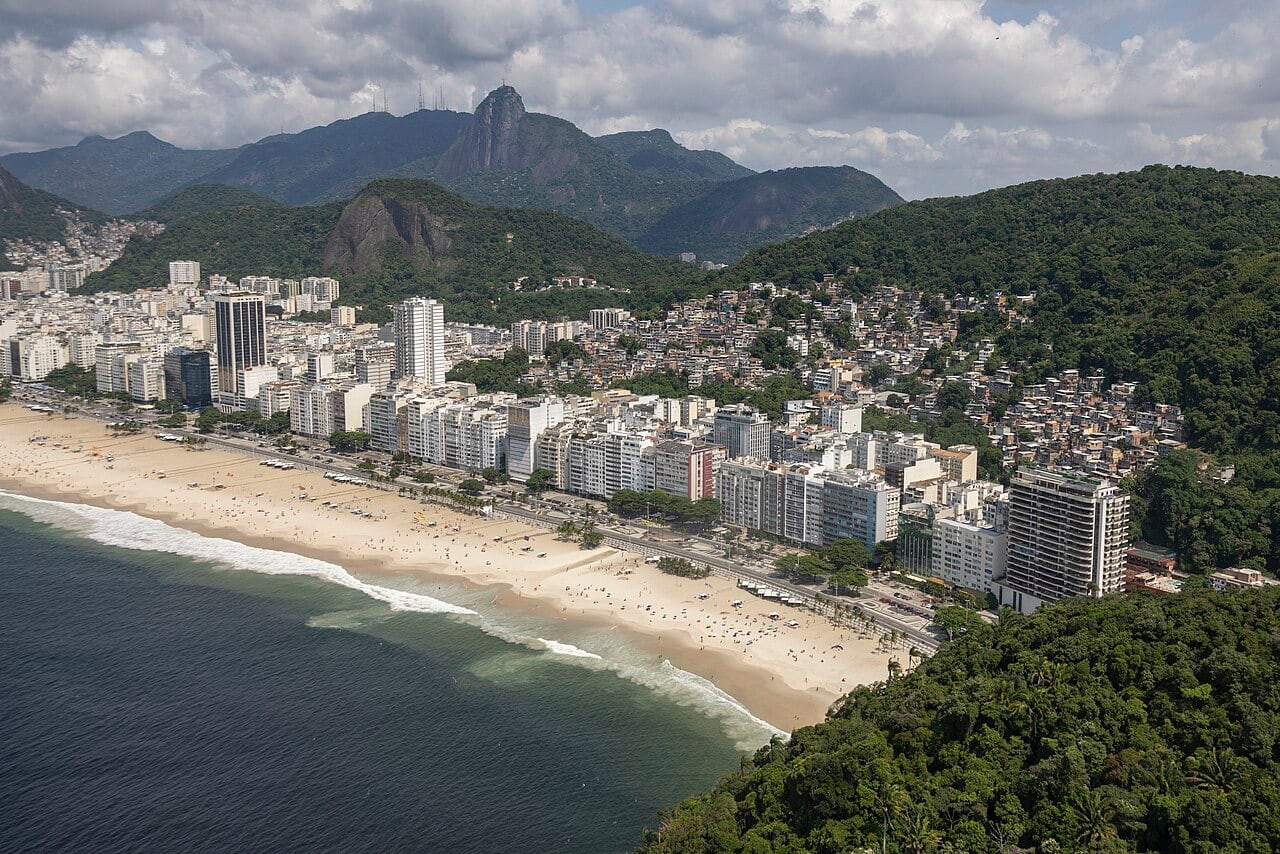
Photo/Map: Arne Müseler / arne-mueseler.com / CC-BY-SA-3.0, linked to the license. Resized for this page; the cropped beachfront panorama is illustrative and does not show Praia Para Todos equipment or certify access. License: https://creativecommons.org/licenses/by-sa/3.0/de/deed.en.
Keep planning
Rio Beaches Hub
Browse beach guides by coastline, water conditions and day-trip style.
Accessible Rio Wheelchair Travel Guide
Plan hotels, airport arrival, attractions and transport across the city.
Plan a Rio Beach Day
Prepare for beach logistics, swimming checks, packing and the everyday setup.
Rio Beach Safety
Check the general surf, lifeguard and bathing-water decisions for a beach day.
Ipanema Beach Guide
Understand the South Zone beach around the programme’s listed Posto 10 point.
Copacabana Beach Guide
Plan around the programme’s most precisely named Rio access point.