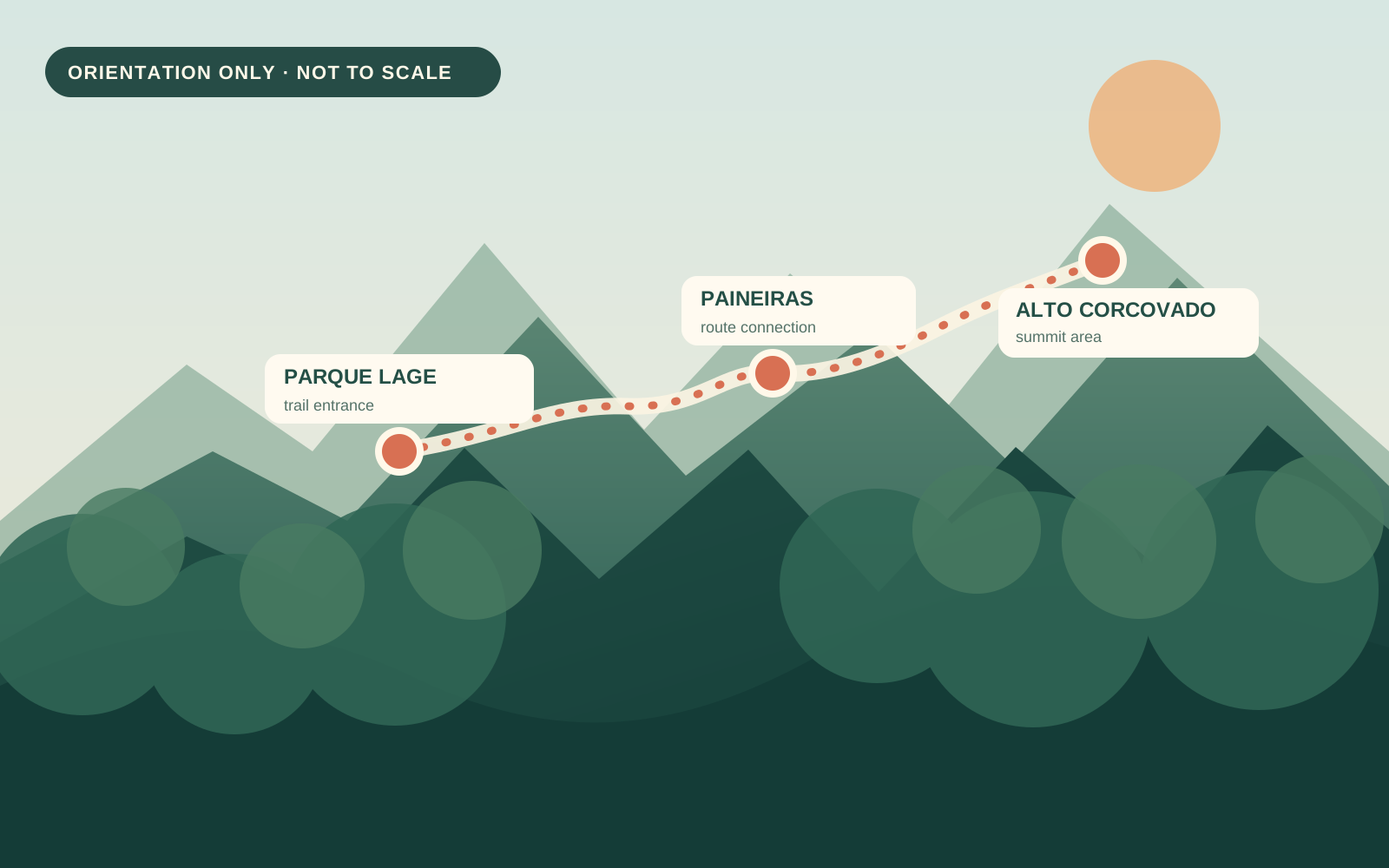
Corcovado Trail from Parque Lage
Written and reviewed by Lotte — Rio local, founder & editor of PlanRio · How we research · First published · Last reviewed
Quick answer
The Corcovado trail from Parque Lage is free, climbs about 690 m and takes the park's estimated four hours. Entering the monument at the top costs R$60 for an adult. Start by 09:00: the trail gate shuts at 15:00, but the summit ticket desk stops selling to hikers at 17:00. Getting down is the part people get wrong — pedestrians are banned from the access road and no one-way van ticket exists, so it is your own legs or a R$37 train to Cosme Velho.
Almost every guide to this hike tells you the same two things: that the trail is free and that the gate closes at 15:00. Both are true. Both are also close to useless, because they leave out the deadline that actually ruins people's days, and the question that strands them at 704 m.
The deadline is buried in a signed PDF on the park's own website: the ticket desk at Alto Corcovado only sells to visitors who arrive by trail between 08:00 and 17:00. The question is how you get back down, which has exactly two legal answers and neither of them is the van. This page is about those two things, plus the measurements the park does publish and the ones it does not. For the gardens, the mansion and the famous courtyard, read our separate Parque Lage visitor guide — that is a different, much gentler morning.
At a glance: what is measured, and what is not
This route is unusually badly documented for something so famous, so it is worth separating the park's own figures from the numbers people repeat. Everything below is from Tijuca National Park, its February 2026 visitation protocol, or the two concessionaires, rechecked on 14 October 2026.
The summit you are aiming at
Morro do Corcovado is 704 m. Parque Lage's gate is a few metres above the Lagoa, so you climb roughly 690 m of it on foot.
The only segment the park has measured
The final Paineiras–Corcovado link: 1.15 km, 260 m of climb, 45 minutes, graded moderate. Opened 3 December 2024.
The segment nobody has measured
Parque Lage up to Paineiras. The park publishes no distance for it — only "up to four hours" for the whole walk, and "very steep sections".
What the trail costs
Nothing. Both halves are free and neither needs a booking. The money starts at the ticket desk on top.
Monument entry for hikers
R$60 for an adult (R$54 plus a R$6 fee passed to the Mitra), R$33 concessions, free under 6. Bought at the desk at the top, not online.
The deadline almost nobody publishes
That desk only sells to trail arrivals between 08:00 and 17:00. Miss it and you have climbed 690 m to look at the statue through a turnstile.
Getting down
Walk back, or buy a R$37 descent-only train seat. There is no one-way van, and pedestrians are banned from the Corcovado access road.
Who the park says should not go
Children under 10 and anyone unaccustomed to hiking. No climbing or technical skill is needed; sustained steep walking is.
Three clocks run this hike, and they do not agree
The single most useful thing we can tell you about this trail is that there is not one cutoff but three, set by three different bits of the same organisation, and that following the best-known of them can still ruin the day.
08:00–15:00 · the trail gate at Parque Lage
The rule: The park's signed visitation protocol admits visitors to Parque Lage from 08:00 to 18:00, gives an hour after the gate shuts to clear the grounds, and ends entry at the Parque Lage–Corcovado guarita at 15:00.
What it means for you: The garden staying open until 18:00 does not extend your start. At the guarita you also sign a simplified risk-and-rules form (termo de conhecimento de riscos e normas) that asks for a phone number for one member of the group — so have a reachable number before you arrive.
08:00–17:00 · the ticket desk at Alto Corcovado
The rule: The same protocol states that ticket sales for monument access, for visitors who reach Alto Corcovado by trail, run from 08:00 to 17:00.
What it means for you: This is the real deadline, and it is buried in a PDF rather than printed on the trail page. The desk is at the top, after the climb, so there is no way to buy early or online as a hiker and no way to fix it once you are late.
19:00 · the last way down that is not your own legs
The rule: The protocol puts the Corcovado railway and the van road service at 08:00–19:00, extended to 20:00 under summer timetables, with the 19:00 train the last one down.
What it means for you: If you intended to ride down and you are still above Paineiras at 19:00, you are walking — in the dark, on a forest trail, with Parque Lage's own gate already shut behind you.

Why we keep labouring this
Because the failure is asymmetric. Arrive at the gate at 15:05 and you lose the hike but keep the afternoon. Arrive at the top at 17:05 and you have spent four hours and 690 vertical metres to stand on the wrong side of a turnstile, with the last train about to go and a forest descent ahead of you. One of those mistakes is an inconvenience. The other is the whole day.
What you are actually climbing: two trails stacked, plus a turnstile
People talk about “the Corcovado trail” as one thing. It is two official trails joined end to end, and a ticket transaction at the finish. Knowing which part you are on matters, because only one of the three has published measurements.
Stage 1 · Parque Lage gate to the guarita
Flat, landscaped, five minutes. The trail access point is inside the grounds, and this is where the gate staff, the cutoff and the risk form live. It is also your last reliable toilet, tap and phone signal, so treat it as the start line rather than a gate you pass through.
Stage 2 · the forest climb to Paineiras
The long, unmeasured, genuinely hard part: a continuous climb through Atlantic Forest on roots, rock and water-cut steps, with sections the park calls very steep. No technical skill is required and there is no rope or chain pitch on the official route, whatever older write-ups claim. What it does require is a few hours of uphill in heat and humidity, which is a different thing.
Stage 3 · the Paineiras–Corcovado link
1.15 km, 260 m, about 45 minutes, with masonry steps built in for footing. It opened on 3 December 2024, which is why pre-2025 articles end with you walking up a road. Partway along is the Mirante Cartão Postal, a glass-walled viewpoint at around 600 m looking over the Lagoa Rodrigo de Freitas, Leblon, the rest of the Zona Sul and across to Pedra da Gávea. It is the best view of the day and most guides do not mention it exists.
Stage 4 · the ticket desk and the 80 steps
The trail delivers you into Alto Corcovado near the first car park. The monument is a separate transaction from here: queue, pay R$60, pass the turnstile, then climb. During the escalator works everyone walks the final 80 stone steps from the second floor up to the plateau.
On the numbers, be sceptical of everything you read, including the apps. The park publishes 1.15 km and 260 m for the final link and “up to four hours” for the whole walk, and nothing else. Published third-party figures for the same route run from 2.3 km to 7.6 km, and from 260 m to over 1,000 m of elevation gain, because some are one-way, some are round trips, some start at Paineiras and some include the Lagoa. Morro do Corcovado is 704 m and Parque Lage sits near the water, so about 690 m of ascent is the number you can actually rely on.
Both halves belong to the Trilha Transcarioca, Brazil's first long-distance trail: roughly 180 km in 25 stretches from Barra de Guaratiba in the west to Morro da Urca, crossing nine protected areas, conceived in 2000 on the model of the Appalachian Trail and Te Araroa. There is a small joke in that. In the Transcarioca's own direction of travel, this stretch descends through Parque Lage on its way to the Lagoa — so what you are doing is walking a long-distance trail backwards, uphill, in the heat. Expect it to feel exactly like that around the three-hour mark.
What the climb costs, and what it actually saves
The trail is free, so people assume the hike is the budget option. It is, by a smaller margin than anyone expects, and only if you also walk back down.

Walking both ways costs R$60 against R$134–139 for a return cog train. That saving of roughly R$74–79 is real, and it is also roughly one decent por-quilo lunch, bought with most of a day and 690 m of climbing. If saving money is the actual goal, the honest answer is that the cheapest way to stand under the statue is not this hike at all: it is the R$87 return van from the Paineiras visitor centre, which involves no walking to speak of.
One billing detail worth knowing before you queue: the park's two pages disagree with each other. Its dedicated Corcovado ticket page lists R$60 for an adult hiker (R$54 plus a R$6 fee passed to the Mitra Arquiepiscopal, which maintains the statue and the shrine beneath it) and R$37 for the descent train, while its own trail page still shows the older R$58 and R$35. Budget the higher figure, carry a little more than that, and do not count on a card reader cooperating at 704 m.
The full ticket matrix — timed slots, children's fares, senior rates, tour packages — belongs on our Christ the Redeemer tickets guide. This page only covers the one ticket a hiker can actually buy.
If you would rather not climb it
The official cog train from Cosme Velho
We would say this even though it costs us the hike: if the statue is the point and the forest is not, the railway is the better purchase. It is the oldest tourist railway in Brazil, the ride up through the park is genuinely good, and it removes all three deadlines on this page at once. Check the current timed slots and the access-works notes on the listing before booking.
Check the Corcovado Train and Christ entry ticketThe descent is the part people get wrong
Every other decision on this hike can be improvised. This one cannot, because two of the four options people assume they have do not exist. Settle it at the gate, with the whole group listening.
Walk back down the way you came
Free, legal, and the only option that returns you to your own starting point. Budget about two-thirds of your climbing time and remember that Parque Lage's gate shuts at 18:00 with an hour's grace. Descending roots and wet rock on tired legs is where people actually get hurt on this route, so this is the choice that most rewards an early start.
Buy the descent-only train seat, R$37
Available at the top, for anyone, and not compulsory. The catch is geography: the railway ends at Rua Cosme Velho 513, on the far side of the mountain from Jardim Botânico. If you left a car, a bag or a slower companion at Parque Lage, you have just put a 30-plus-minute road journey between you and them. Factor that in before you treat it as the easy way out.
The official van — which you cannot do
Worth stating plainly because people plan around it: the van concession sells round trips valid from the boarding point you bought, its vehicles are authorised to stop only at boarding and disembarking points, and it will not sell you a leg down. There is no van ticket for a hiker who arrived on foot.
Walking down the access road — which you may not do
The protocol is explicit: pedestrian entry is not permitted on the Estrada do Corcovado. A separate clause also tells cyclists and pedestrians to stay off that road between 10:00 and 15:00. The Paineiras–Corcovado trail exists precisely so that people on foot have a legal line; use it in both directions.
The practical upshot is a sentence worth repeating to yourself on the way up: the only transport that will take you off this mountain is a R$37 train that lands you in the wrong neighbourhood. Everything else is your legs. Plan the day around that and the hike is straightforward; plan it around a van that will not come and you are making a decision at 704 m with tired legs and a closing gate.
It is also why we start early rather than merely legally. An 08:30 start means you top out around lunchtime, with the desk open, the train still running for hours, and enough daylight to walk down slowly on the ground that actually causes injuries — wet roots, loose rock and water-cut steps, all of it steeper going down.
Worth sorting before you fly
Travel insurance that covers hiking
This is the one place on PlanRio where we will push insurance without hedging. A 690 m descent on wet roots is the most likely way to hurt yourself on a Rio holiday, you will be a few hours from a road, and a twisted ankle up there becomes a stretcher carry. Check that the policy you buy covers unguided hiking and mountain-rescue costs rather than assuming it does.
Get a travel insurance quoteWhat is happening at the top until mid-2027
You can climb a mountain and still not get onto the plateau, which is new. The escalator replacement has changed the last hundred metres of this hike, and one of its rules is aimed squarely at people arriving on foot.
What changed and when
ICMBio announced the work on 1 July 2026 and switched off all four escalators — in service since 2003 — together on 3 August 2026. Four replacements plus two new inclined lifts are going in. Visiting has not been suspended at any point.
The capacity cut that includes you
Simultaneous visitor capacity at Alto Corcovado is halved, and the park says that limit applies to arrivals by trail exactly as it does to train and van arrivals. Walking up buys no priority.
The steps
From the train and van drop-off to the plateau is 220 steps. Three recently replaced lifts still cover first to second floor, but the final 80 stone steps from the ICMBio visitor centre (CAV-ICMBio) to the plateau are mandatory for everyone.
Reduced mobility
ICMBio bought five stair-climbing carriers and five stair-climbing chairs for those 80 steps — eight minutes up, six down, 150 kg for a carrier with a standard wheelchair, 130 kg for a chair. They do not operate in rain or on a wet floor.
When it should end
About ten months, from August 2026 to the end of May 2027, estimated by Petrobras and its contractor. The work is funded by a R$14.988m environmental-compensation agreement tied to the P-56 platform, with IPHAN approval; the new escalators are rated at 6,000 people an hour.
The capacity cut is the one to plan around: ask at the Parque Lage guarita whether the summit is currently full, because that is a question gate staff can sometimes answer and you cannot. If a statue photograph is the non-negotiable part of the day for someone in your group, the honest advice is to buy them a timed train or van ticket and meet them up there. Dates and arrangements shift, so check the park's own notice for your day rather than this paragraph.
Getting to the trail gate for an early start
The entrance is at Rua Jardim Botânico 414, in Jardim Botânico. Everything on this page argues for being there soon after it opens at 08:00, and the good news is that this is one of the easiest trailheads in Rio to reach on public transport.
Bus to the gate
Eighteen lines pass the entrance on Rua Jardim Botânico: 158, 161, 170, 172, 173, 176, 178, 186, 309, 316, 317, 409, 410, 416, 438, 571, 573 and 583. It is one of the best-served trailheads in Rio, which is unusual and worth exploiting at 07:45.
Metro plus a bus
There is no station at the gate. The park's own routing is Botafogo station, then the Integração Botafogo/Gávea bus. Allow for the transfer rather than treating the metro journey as the whole trip.
Ride-hailing or taxi
Set the pin to "Parque Lage — Rua Jardim Botânico 414" and say you want the public entrance. Drivers who know Corcovado will sometimes aim for Cosme Velho or the upper access road instead, which is the wrong side of the mountain and a road you are not allowed to walk.
Fares, the Jaé card and how the integrations work are in our Rio transport guide. If the trail turns out to be closed when you arrive, the Jardim Botânico is a five-minute walk away and the obvious replacement plan.
The small thing that solves the risk form
A working Brazilian data line
The guarita form asks for a phone contact for one member of your group, signal drops inside the forest, and the two questions you most want answered on the way up — is the summit at capacity, has the weather closed anything — live on the park's site. An eSIM you switch on at the airport covers all three. Check your handset supports eSIM and keep your home number on its own line.
Check Airalo Brazil eSIM plansLinks on this page may earn us a commission at no extra cost to you. It does not influence what we recommend — the free trail and the cheaper van are both recommended above a product we are paid for.
Six park rules that catch hikers out
These are all in the park's signed visitation protocol, and none of them are posted anywhere a visitor naturally looks. The drone one has ruined more plans than the rest combined.
Your drone stays in the bag at both ends
Recreational drone use is not permitted at Corcovado at all, and at Parque Lage only with prior park authorisation. That covers the trailhead and the summit — effectively the whole hike.
No glass on the trail
Glass containers are not allowed on trails or at watercourses. Decant that nice bottle of water into something else before you reach the guarita.
No dogs
Domestic animals are not permitted, guide dogs excepted. This is a national park, not the lawn at Parque Lage.
Everything you carry in comes out with you
Visitors are told to take their rubbish out of the conservation unit, organic waste included. Peel and pips count.
No shortcuts, literally
Opening alternative paths is prohibited; you move only on the predetermined trails and roads. On a route with this much root and gully, the desire-line you can see is usually erosion, not a shortcut.
No speakers, and keep the beers for later
Collective sound equipment and musical instruments are not allowed without authorisation. Moderate alcohol may be permitted, but anyone visibly drunk can be refused entry or removed.
Do you need a guide? No — but here is when we would take one
The park's protocol is unambiguous: hiring a guide or visitor conductor is not mandatory, anywhere in Tijuca. The route is waymarked, the gate is staffed, and a reasonably fit person who starts early and has settled the descent question does not need to pay anyone.
Two authorised visitor-conductor groups do work this mountain, both drawn from the communities around the park: the Anfitriões do Cosme Velho in blue shirts and the Condutores do Parque in yellow. Both meet on the Cosme Velho side rather than at Parque Lage, and the park puts their rate at around R$185 for an adult. If you hire anyone, check for an ICMBio credential with a holographic seal on the front and a QR code on the back, and agree what is included before money changes hands.
We would pay for a guide if the group is nervous about navigation, nobody speaks Portuguese and the idea of handling the gate form and the ticket queue in it sounds like work, or the logistics of a dawn start across the city are the thing stopping you going at all. We would skip it if you hike regularly, you are comfortable with a waymarked route, and you would rather spend the money on the train down and a long lunch afterwards.
The one that actually starts at the right gate
Guided Corcovado hike from Parque Lage
Most “Christ the Redeemer hike” listings quietly begin at Paineiras or in Cosme Velho, which is a much shorter walk than the one on this page. This one meets at the main Parque Lage entrance, so it is the route described here. Read the live itinerary for the meeting time, whether monument entry is included and — the point of paying — how it brings you back down.
View the guided Corcovado hike from Parque LageThe honest verdict: three reasons to skip it
You want the statue
Then this is the worst way to get it. You arrive hot, into a capacity-capped plateau, with 80 steps still to climb and a ticket queue you cannot pre-book. The van from Paineiras costs R$27 more and starts fifteen minutes away.
You are doing it to save money
Roughly R$74–79 against the train, and only if you walk back down. That is a lunch. It is not a reason to spend a day of a short trip climbing 690 m in Rio's humidity.
Your day is already booked
The finish time is the least predictable thing about this hike. If there is a timed dinner, a transfer or a flight that evening, do it another day — or walk the 1.15 km Paineiras link instead and still see the best viewpoint.
And the case for going anyway, which is simple: this is a few hours of real Atlantic Forest that starts at a bus stop in the South Zone. You climb out of a landscaped garden, through canopy with its own birds and microclimate, and come out at a glass mirante with the Lagoa, Leblon and Pedra da Gávea laid out underneath you — and then the statue itself. Nothing else in Rio does that in one continuous walk from a city street. Do it for the forest, take the ticket as a bonus, and compare it against the alternatives in our best hikes in Rio guide before you commit the day.
What to carry, specifically
Two litres of water per person minimum. Fill up before the guarita and again at the free drinking fountains the park lists at the top of Corcovado, and carry enough for everything in between — the climb is in humidity even when the canopy feels cool. Closed shoes with real grip that you have already walked in; the descent, not the climb, is what punishes smooth soles. A light rain layer, because the ridge holds cloud that the beach never sees.
Then the four things specific to this hike rather than to hiking generally: R$60 per adult in cash for the ticket desk, plus R$37 each if the train down is a possibility; a phone number that works in Brazil for the gate form; a non-glass water bottle, because glass is not allowed on the trail; and no drone, which is banned at Corcovado and needs authorisation at Parque Lage. Leave the big bag at the hotel — you are going to climb 220 steps at the end of this.
Common mistakes tourists make
- Reading 18:00 as the start deadline. The garden shuts at 18:00; the trail guarita stops admitting hikers at 15:00.
- Not knowing the summit ticket desk closes to trail arrivals at 17:00 — the one deadline that can waste the entire climb.
- Starting at 14:30 because it is still legal. The park's own four-hour estimate puts that arrival after both the desk and the last train.
- Assuming you can buy the hiker's monument ticket online or in advance. It is sold at the desk at the top, on the day.
- Planning a one-way van down. The concession only sells round trips from the point you boarded, so no such ticket exists.
- Planning to walk down the Corcovado access road. Pedestrians are banned from it, and there is a further 10:00–15:00 restriction.
- Taking the R$37 train down without noticing it ends at Cosme Velho, on the opposite side of the mountain from your trailhead.
- Treating the hike as a budget hack. Walking both ways saves roughly R$74–79 against the train — one lunch, for 690 m of climbing.
- Carrying a drone. Recreational flying is banned at Corcovado and needs prior authorisation at Parque Lage.
- Trusting a GPS track from a hiking app. Published figures for this route range from 2.3 km to 7.6 km and from 260 m to over 1,000 m of gain, because they are logging different things.
- Booking a generic Tijuca Forest tour and expecting it to start at Parque Lage or reach the statue.
- Fixing a dinner, a transfer or a flight for the same evening. This is a whole day, and its finish time is the least predictable part.
Local expert tips
- Work backwards from 17:00, not forwards from 15:00. Four hours of climbing means a 12:30 start at the absolute latest; we (Lotte, PlanRio's founder and friends) leave the gate between 08:00 and 09:30.
- Carry R$60 per adult in a form the desk at the top will take, plus R$37 each if there is any chance you will want the train down.
- Decide your descent at the gate, with the group, out loud. It is the one decision that cannot be improvised at 704 m.
- Have a working local number before you reach the guarita — the risk form asks for a phone contact for one member of the party.
- Ask the gate staff two things: whether the route is fully open, and whether the summit is currently at capacity. The second is new since August 2026.
- Slow down for the Mirante Cartão Postal on the final link. It is the best view of the day and takes ten minutes.
- Check a mountain-level forecast, not a beach one. The Corcovado ridge holds cloud that Ipanema never sees, and the stair-climbing equipment at the top stops in rain.
- Treat the 220 steps at the top as part of the hike, not a formality — 80 of them are unavoidable while the escalators are out.
- Download the park trail page and your map before you go; signal drops inside the forest.
- If anyone in the group is hesitating at the guarita, send them round to Paineiras and walk the 1.15 km link instead. It is a real walk with the same best viewpoint, at a fraction of the effort.
Frequently asked questions
Can you hike from Parque Lage to Christ the Redeemer?+
Yes. Tijuca National Park describes a free trail that starts inside Parque Lage at Rua Jardim Botânico 414, climbs through Atlantic Forest past Paineiras, and since December 2024 joins the Paineiras–Corcovado trail to reach Alto Corcovado. Entering the monument itself is a separate R$60 ticket bought at the desk at the top.
What time does the Parque Lage–Corcovado trail close?+
Entry at the Parque Lage–Corcovado guarita ends at 15:00. Parque Lage itself admits visitors from 08:00 to 18:00 and gives an hour after closing to leave the grounds, but those later garden hours do not extend the trail cutoff.
What is the latest I should actually start the hike?+
About 12:30, which is PlanRio's arithmetic rather than a park rule. The park allows entry until 15:00 and estimates up to four hours of walking, but the summit ticket desk stops selling to trail arrivals at 17:00, so a 15:00 start can reach the top with nothing left to buy. Starting between 08:00 and 09:30 removes the problem entirely.
How much does it cost to hike up Corcovado?+
The trail is free in both directions. Entering the monument area costs R$60 for an adult — R$54 plus a R$6 fee passed to the Mitra Arquiepiscopal — with R$33 for students, ID Jovem holders, people with disabilities and over-60s, and free entry under 6. An optional descent-only train seat is R$37.
Can I buy the hiker's Christ the Redeemer ticket in advance?+
No. It is sold at the Trem do Corcovado ticket desk at the top of Corcovado, after the climb, between 08:00 and 17:00 for visitors arriving by trail. Bring a payment method you know will work there and do not plan around a pre-booked slot.
How long is the Corcovado trail from Parque Lage, and how much climbing is it?+
The park publishes no measured distance for the Parque Lage section, only "up to four hours" for the walk and a warning about very steep sections. It does measure the final Paineiras–Corcovado link at 1.15 km with 260 m of climb and 45 minutes. Morro do Corcovado is 704 m, so expect roughly 690 m of ascent in total. Crowd-sourced GPS figures for this route disagree wildly — from 2.3 km to 7.6 km — because they log different start points and round trips.
How do I get back down after hiking up Corcovado?+
Two options only: walk back down the trail you came up, or buy a R$37 descent-only seat on the Corcovado train, which ends at Cosme Velho on the other side of the mountain. The official vans sell round trips from the point you boarded and will not sell a one-way descent, and pedestrians are not permitted on the Estrada do Corcovado.
Is the Parque Lage trail the same as the Paineiras–Corcovado trail?+
No. The Paineiras–Corcovado trail is the final 1.15 km link, opened on 3 December 2024, which starts behind the Paineiras visitor centre and is graded moderate. The Parque Lage route is the long forest climb below it. Driving or taking a van to Paineiras and walking that last section is a legitimate outing, but it is not the Parque Lage hike.
Is the Corcovado hike from Parque Lage difficult?+
The park calls it physically demanding, with very steep sections, and says it does not require climbing. In practice it is a few hours of sustained uphill on roots, rock and uneven steps in heat and humidity. The park does not recommend it for children under 10 or for people unaccustomed to hiking.
Do I need a guide to hike up Corcovado?+
No. The park's February 2026 visitation protocol states that hiring a guide or visitor conductor is not mandatory. Authorised visitor-conductor groups do exist — Anfitriões do Cosme Velho in blue shirts and Condutores do Parque in yellow, both meeting on the Cosme Velho side — and charge around R$185 per adult. Check for an ICMBio credential with a holographic seal and a QR code before paying anyone.
Is the trail or the monument wheelchair accessible?+
The trail is not: it is a steep, uneven forest climb. At the monument, three lifts still run from the first to the second floor, but the final 80 stone steps are currently mandatory, with stair-climbing carriers and chairs available for visitors with reduced mobility. Those devices do not operate in rain or on a wet floor, so contact the park before relying on them.
Are the Christ the Redeemer escalators working in 2026?+
No. All four were switched off on 3 August 2026 for replacement, along with the installation of two inclined lifts. Petrobras and its contractor estimate about ten months, to the end of May 2027. Meanwhile Alto Corcovado runs at half its usual simultaneous capacity, and that limit applies to hikers too.
Is hiking from Parque Lage a cheap way to see Christ the Redeemer?+
Marginally. Hiking up and walking down costs R$60 against R$134–139 for a return cog train from Cosme Velho (depending on date and channel) — a saving of roughly R$74–79 per adult, or about one lunch, in exchange for roughly 690 m of climbing and most of a day. If the budget is the point, the R$87 return van from the Paineiras visitor centre is the cheaper route that involves no hiking at all.
Can I take a drone on the Corcovado trail?+
Not usefully. The park's protocol bans recreational drone use at Corcovado outright, and permits it at Parque Lage only with prior authorisation — so both ends of this hike are closed to it.
Keep planning
Parque Lage visitor guide
The gardens, the courtyard and the restoration limits — the gentle version of this trailhead, on a different morning.
Christ the Redeemer tickets
The full train, van and tour ticket matrix if you decide the statue matters more than the climb.
Best hikes in Rio
Compare this against Dois Irmãos, Pedra Bonita and Pico da Tijuca by effort and payoff.
Pico da Tijuca hike
The park's highest point at 1,022 m — more climbing, no ticket desk, no capacity cap.
Jardim Botânico guide
Five minutes from the gate, and the right backup if the trail is closed when you arrive.
Rio transport guide
Fares, the Jaé card and how to combine metro and bus to reach a trailhead early.