Niterói Beaches: A Guide to Itacoatiara, Itaipu & More
PlanRio Editorial Team · Primary source references checked 27 September 2026Quick answer
Niterói has five Atlantic-facing beaches in its Oceanic Region and several bayfront beaches closer to the city centre. Choose Itacoatiara for a surf setting, compare the two Prainha sections at Itacoatiara and Piratininga, or plan around Camboinhas, Itaipu or access-sensitive Sossego. Check the latest INEA sample, sea conditions and last-mile transport before you go.
At a glance
Five ocean beaches
Itacoatiara, Camboinhas, Piratininga, Sossego and Itaipu
Bayfront beaches
Icaraí, São Francisco, Jurujuba, Flexas, Adão and Eva
Best known for surf
Itacoatiara; check the water and lifeguard advice before entering
Quieter beach character
Itaipu’s fishing community and small Praia do Sossego each feel distinct
Useful family comparison
Itacoatiara’s Prainha and Piratininga’s Prainha are two different sheltered corners
Camboinhas last mile
The tourism board lists bus 39 and a walk of about 20 minutes from its entrance stop
From Rio by ferry
Barcas reach Praça Arariboia in central Niterói; ocean beaches need another land journey
Swimming check
Read INEA’s latest sample-point result for the beach and date you plan to visit
First choose between the ocean coast and the bayfront
Niterói’s shoreline is easier to plan when you split it into two different outings. The city’s tourism board groups five ocean-facing beaches in the Oceanic Region: Itacoatiara, Camboinhas, Piratininga, Praia do Sossego and Itaipu. They look toward the Atlantic, sit farther from central Niterói and are usually the places people mean when they want a full beach day. The same board groups Icaraí, São Francisco, Jurujuba, Flexas, and Adão and Eva as bay beaches. Those urban and harbour-side stretches are more naturally paired with a waterfront walk, a meal, or a city visit.
That distinction is about geography and the kind of day you can build, not a permanent verdict on water quality or safety. Open Atlantic beaches can have surf and changing currents. A bay beach can be a pleasant place to walk or sit even when a particular sample point is not suitable for swimming. Read the current INEA bathing-water bulletin by beach, location and date; do not use a photograph, a clear-looking patch of water or a reputation as a substitute for the latest result.
If your priority is a dramatic surf setting, start with Itacoatiara. If you want a longer stretch with kiosks and a lagoon nearby, compare Camboinhas. Piratininga gives you two different sections along one broad bay, while Itaipu adds a working fishing community and local history. Sossego is the small, nature-focused choice where access planning matters as much as the sand. For a city-side stroll and views back toward Rio, look at Icaraí or São Francisco, then check whether swimming is appropriate that day.
Itacoatiara: the dramatic Atlantic beach
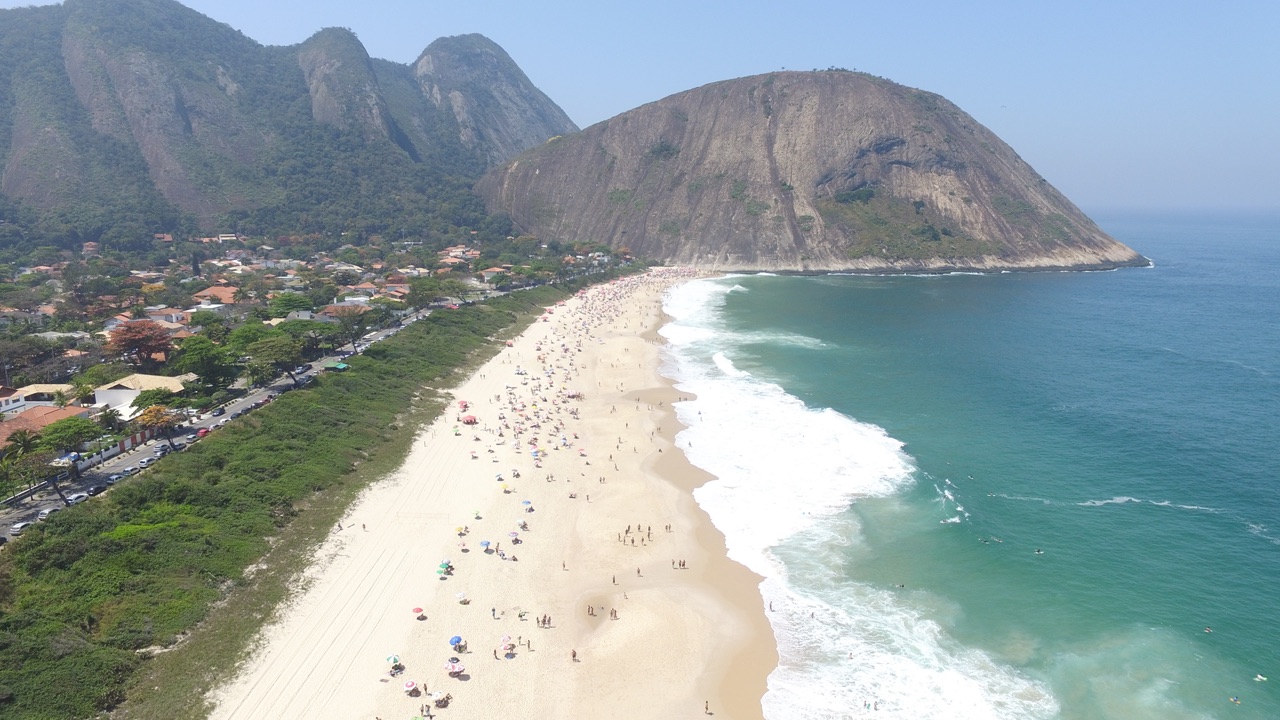
Itacoatiara is the compact, striking beach framed by steep green hills and granite. Niterói’s visitor information describes it as a surf-oriented beach and notes the sheltered pocket called Prainha at one end. That name can confuse visitors because Piratininga has its own Prainha. When you ask for directions or check a map, include the full beach name rather than searching for Prainha alone.
Come here for the scenery, the open-coast atmosphere and, when conditions suit, surfing. The visually dramatic shore is not a promise of gentle swimming. Waves, currents, wind and lifeguard directions change; check the flag and ask locally before entering. If your group includes children or people who prefer calmer water, look at the small Itacoatiara Prainha as a possible option, but treat the day’s conditions as the deciding factor. A cove that is often more sheltered is not a guarantee of safe water.
The tourism board lists local bus routes 38, 38A, 38B and 52 for Itacoatiara, plus the 770D Rio–Niterói line. Route numbers, stop locations and service patterns can change, so verify the journey on the day with the current operator information. If arriving by car or ride-hailing, set the destination to the beach access point rather than a hiking trailhead. The Costão rock and the beach are neighbours in the landscape, but a hike is a separate activity with its own route, access rules and weather considerations.
For a first visit, give Itacoatiara its own time instead of treating it as a quick add-on after MAC or several central Niterói stops. Bring water, sun protection and a flexible return plan. Do not assume that a small beach has the same shade, food choice or services as the long urban beaches in Rio. Confirm what you expect to use, and keep valuables and personal belongings under your control while anyone in your group swims.
Camboinhas: a long Atlantic shoreline beside the lagoon
Camboinhas is the long beach in the oceanic group. Niterói’s municipal description gives it a length of about 2.6 kilometres and identifies it as an extension of Itaipu, with the Itaipu Lagoon behind the residential neighbourhood. The municipal tourism page also mentions fishing, sailing and windsurfing, and describes kiosks along parts of the waterfront. Those are useful orientation details, but services can vary by section and day; check opening and access arrangements directly if a particular place to eat or rent equipment is essential.
Camboinhas is a strong choice when your plan needs room to spread out and a proper coast-side meal. It is not one uninterrupted, fully serviced strip: where you enter affects the walk, shade, available kiosks and how far you are from the next point. Decide on a meeting place before your group separates, especially if some people plan to walk or windsurf while others settle near the water.
The visitor board currently lists bus 39, with a stop near the entrance on Avenida Almirante Tamandaré and an estimated walk of about 20 minutes to the beach entrance. That last walk is a real part of the trip, not a footnote. Consider it when carrying beach gear, travelling with young children, or choosing a hot midday arrival. Recheck the route and exact destination before departure; a line number on a tourism page is not a live bus timetable.
Camboinhas and Itaipu are neighbours, but the channel connecting the lagoon with the ocean marks a natural boundary between the beaches. Do not turn that map relationship into an assumption that the best way to get from one to the other is to swim across or walk through water. Use a road route or local directions and keep the day flexible. For current swimming decisions at either beach, check the INEA result for the relevant sample point rather than applying one beach’s report to the whole coast.
Piratininga: compare Praião with its own Prainha
Piratininga is a broad ocean-facing beach with two sections that the city describes separately. Praião is the longer section; the smaller Prainha is described as shallower and calmer. That is a helpful planning distinction, particularly if your group wants a shorter walk to the water or prefers a more sheltered-feeling corner. It is still a description of typical character, not a guarantee about surf, depth or safety at the time you arrive.
The beach can work well as the centre of a slower Oceanic Region day. The official tourism listing gives bus 39 for Piratininga and names Avenida Almirante Tamandaré as the address. Use the current route planner to check where the service stops relative to your chosen section. Piratininga is long enough that choosing the right end in advance can save a tiring walk along the waterfront, especially if your group has different mobility or heat tolerance.
Because the beach has both an extended shore and a smaller section, avoid giving a driver only the name Piratininga if you need a particular landmark. Agree on a precise entrance or pickup point and share it with the rest of your party. If you move between Praião and Prainha, confirm the route on foot and check the ground conditions before carrying chairs, a stroller or other bulky equipment.
Piratininga also makes a useful contrast to Itacoatiara: both belong to the oceanic coast, but the trip is not simply a choice between a ‘safe’ beach and a ‘rough’ beach. Conditions can shift, and the municipality’s general descriptions cannot replace the current INEA sample or lifeguard guidance. Choose the section that suits your group only after checking the actual weather and water on your date.
Itaipu: a beach day with a living fishing community
Itaipu feels different from a beach chosen only for its view. The municipality describes a fishing colony, a historic church dating to the early eighteenth century and the Archaeology Museum of Itaipu in the surrounding area. The beach sits at the end of its namesake road, and the city’s tourism material describes it as one of Niterói’s ocean beaches with comparatively calm water. Use that as a broad character note, not as a swimming forecast: check the current bulletin and local conditions before entering.
The fishing community is part of the place, not a staged attraction. Treat work areas, boats, nets and people going about their day with respect. If you buy seafood or sit at a local restaurant, ask about the menu and price before ordering, and remember that availability depends on the day’s catch and business hours. Do not walk through a working area to get a photograph or handle equipment without permission.
Itaipu is a good fit for travellers who want a beach visit that includes local history and a meal. It is also an easy beach to misunderstand if you try to combine too many distant stops. The archaeology museum, fishing village and nearby shore can form a compact outing, but the MAC and the Oceanic Region sit on different parts of Niterói’s map. If the museum or a full swim is your priority, choose which one anchors the day before setting out.
Visit Niterói publishes several bus route numbers serving Itaipu, including OC2, 38A and 52, and the Rio–Niterói 770D. It also lists additional services, but those details can change. Check the current operator before travelling, allow time for the final approach and decide how you will return before you leave the city centre. Do not rely on an old screenshot of a route or assume a ride-hailing car will be immediately available at a quieter beach after sunset.
Praia do Sossego: the access route is part of the decision
Sossego is the smallest of the five ocean beaches and the one where it is especially important to check access before leaving. Niterói’s recent municipal update describes a roughly 120-metre strip between Piratininga and Camboinhas, bordered by rocky headlands, Atlantic Forest and restinga vegetation. The city tourism board describes pedestrian access by trail and the beach as a natural heritage area. Do not assume that a car can take you to the sand or that a route described in an old review is open and unchanged.
The municipal notice dated 6 September 2026 says the city was completing technical studies for a future tender covering maintenance and improvements to infrastructure and access. It describes a plan, not proof that every proposed improvement is already complete. Before travelling, check for current work, closures, route changes and beach guidance. If walking on uneven ground, steps, a slope or loose surfaces would be a problem for anyone in your group, ask the responsible city service about the current path rather than judging it from a photograph.
The same notice says the city had previously installed items such as a stone stairway, handrails, rest areas, signs, an accessible toilet, shower and foot-wash area. Conditions and availability may change during maintenance, so confirm any facility you depend on. A past Blue Flag award is also not the same thing as a live bathing-water report or a guarantee that a specific amenity is operating when you arrive.
For the 2026–27 Blue Flag season, the municipal notice said Sossego’s application had passed the national jury stage and was awaiting international review. It had received the award in the five seasons from 2021 through 2025. Keep that history in context: a seasonal environmental and management certification is a useful signal, but you should still check the latest INEA sample, current beach access and the day’s local instructions.
The visitor board lists bus services that stop near the Camboinhas entrance rather than at the sand. That does not establish which walking route is open or suitable at present. If you choose Sossego, make the access route—not its nickname or its small size—the first question. Leave enough daylight and energy for the return, carry water and take rubbish back with you. If the route or conditions do not suit your group, choose a beach with a simpler approach rather than trying an unofficial shortcut over rocks or vegetation.
Bay beaches: a different kind of coastal day
Niterói’s bay beaches are worth understanding even if you mainly want to swim in the ocean. Icaraí is a long urban waterfront with a promenade and a wide view across Guanabara Bay toward Rio. The city’s tourism information lists São Francisco, Jurujuba, Flexas, and Adão and Eva alongside Icaraí in its bay-beach group. Each has a different setting and relationship to roads, neighbourhoods and the harbour; do not treat them as interchangeable swimming beaches.
A bayfront visit works well as a walk, a view stop or part of a city itinerary. Icaraí is particularly easy to pair with the MAC area or a central meal, while São Francisco and Jurujuba put you farther around the shore. That can make a pleasant itinerary without a long beach session. Check current water status before deciding to swim, and do not infer that a beach is clean or polluted from the colour of the water or an old travel article.
The sample location matters. INEA reports bathing-water conditions from named collection points, and a result at one point should not be stretched across an entire beach or neighbouring bay. Open the latest bulletin, find the relevant beach and station, note the collection or publication date, then follow local signs. If the report is unclear or outdated, choose a non-swimming plan until you can confirm the current status.
If you want a skyline photo, a gentle waterfront walk or a sunset meal, a bay beach can be the point of the visit even when swimming is not the plan. Bring the same basic sun and water supplies you would bring elsewhere, and use the promenade rather than stepping onto rocks or into a boat landing for a better angle. A scenic view is a good reason to visit; it is not a reason to ignore a closure, local sign or water warning.
Check water quality and sea conditions separately
Use INEA’s current bathing-water information to answer one question: what does the latest sample say for this beach point? Look for the station name and the date, not just a citywide summary. Water quality can change after a test, and sample points are not positioned at every metre of sand. When a report covers a nearby point rather than the exact entrance you plan to use, treat it as an indication and look for additional local guidance.
Water quality and surf conditions are separate decisions. A favourable bacterial result does not mean that waves, rip currents, wind or visibility are suitable for every swimmer. Check the lifeguard presence and flags, ask where people should enter and stay within your own ability. At an ocean beach, do not swim alone or follow someone else into a break because the shore looks calm from above. For a group with children or weaker swimmers, agree on an adult who stays focused on the water rather than phones or food.
The state environment agency advises avoiding swimming in the hours after rain and near storm-water galleries or drainage channels. When heavy rain has passed through, it is sensible to postpone a swim and check the latest bulletin again. If you are visiting only to walk, eat or enjoy the scenery, you can still make that a good day. Choose a beach with a land-based activity that works for your group and leave the water decision open until you arrive.
Getting from Rio to the right beach takes two legs
The public ferry connects Praça XV in Rio with Praça Arariboia in central Niterói. It is a useful way to cross Guanabara Bay, but it does not deliver you to Itacoatiara, Camboinhas, Piratininga, Sossego or Itaipu. From Arariboia you still need a bus, car, taxi or ride-hailing trip toward the Oceanic Region. If you are carrying beach gear, travelling as a group or arriving at a busy time, compare the complete journey rather than the ferry crossing alone.
Visit Niterói’s transport pages list the bus terminal and water terminal in central Niterói, and its individual beach pages publish route numbers for several beaches. For example, it lists route 39 for Piratininga and Camboinhas, with a substantial walk from the Camboinhas entrance stop. It lists several routes for Itacoatiara and Itaipu as well. Treat these as a starting reference, not a promise about the next departure; verify the route, service and stop with the operator close to your travel date.
A car or taxi can simplify the final approach, but the destination pin still matters. Tell the driver which beach entrance or section you want, agree on a pickup point and confirm the return plan before dropping off. A beach name may cover a long waterfront, and Sossego has a pedestrian approach rather than a normal curbside arrival. If one person in your group uses a mobility aid, carries small children or has limited walking tolerance, check the route from the stop or drop-off all the way to the sand.
For the Rio-to-Niterói crossing and current Barcas information, start with our Rio ferries and Barcas guide. For a wider first-time day plan covering MAC and central Niterói, see Niterói from Rio. This page focuses on the beach decision and last mile, so it does not assume that a museum stop and a distant ocean beach will fit comfortably into every day.
Build a realistic Niterói beach day
For a first beach-only outing, choose one ocean beach and give yourself time to settle in. Itacoatiara makes sense when the scenery and surf setting are the reason for the trip. Camboinhas is a better match when you want a longer shore and expect to use a kiosk. Piratininga gives you room to choose between Praião and the smaller Prainha section. Itaipu makes a good base for combining beach time with the fishing-community setting and local history. Your choice should reflect the group and conditions, not a ranking list.
A second itinerary can pair nearby stops, but keep the transfer honest. Camboinhas and Itaipu share a boundary at the lagoon channel; getting between them by road is different from strolling between two sections of one beach. Piratininga and Camboinhas also sit in the same broad coastal area, yet that does not make every entrance or service a short walk. Check a map at street level, verify transport and carry only what your group can manage on foot.
If you want both architecture and the ocean coast, decide which experience matters most. The MAC and central Niterói belong to a different part of the city from the Oceanic Region. A guided tour may make that combination easier by arranging transport and selecting stops, but confirm how long it actually spends at a beach and which one it visits. If you are planning independently, avoid stacking several fixed-time attractions around a beach session that depends on traffic, weather and current conditions.
Keep a backup that still feels worthwhile. A red flag, rain, construction or an unsuitable water report can change the day after you have left Rio. If you chose Itacoatiara for swimming, you can switch to scenery and a meal; if a trail approach feels uncomfortable, choose a beach with a simpler entrance. You can also move the day to Icaraí or another bayfront walk and save ocean swimming for a better forecast. The best plan is one that can change without making anyone feel they have failed the itinerary.
Facilities, mobility and what to confirm before you go
Beach access means more than whether a car can reach the neighbourhood. Consider the whole chain: the ferry or road arrival, the bus stop or pickup, the pavement, the beach entrance, sand conditions, shade, toilet access and a route back. A venue or beach project may support one part of that journey without making every other part accessible. If a particular facility is essential, contact the relevant municipal service or venue and ask for current details in plain terms.
Sossego has received municipal investment in items such as a path, handrails, resting places and an accessible toilet, but a new round of work was under study in the September 2026 city notice. Confirm what is operating during your visit and whether maintenance has changed the approach. For all beaches, ask about the precise entrance and surface, not only the beach name. A map pin is helpful; a current description of the last stretch is better.
For a full beach day, pack for the services that may not be available at your chosen section: drinking water, sun protection, any medication, a charged phone and a backup way to get home. Do not assume every beach has continuous shade, changing rooms, a staffed kiosk, chair rental or an accessible toilet. Ask before relying on one. If someone in your group needs frequent rest breaks, select a beach with a manageable distance and a clear place to pause.
Respect the coast and the people who use it
Niterói’s ocean coast sits beside sensitive vegetation and protected landscapes. Keep to established paths, avoid trampling restinga plants and do not take shortcuts over dunes, rocks or closed ground. Carry out packaging, cigarette ends and food waste. Sossego’s natural setting and access improvements depend on visitors using the marked routes and respecting any signs, maintenance work or closures. Leave shells, plants and wildlife where they are.
At Itaipu, remember that fishing is a local livelihood and the beach is part of a community, not just a tourist backdrop. Give boats and fishing gear room, ask before photographing people at work and buy from local businesses respectfully. At busier beaches, keep shared space clear, ask a kiosk about prices before ordering and dispose of waste properly. A good beach visit fits around the people who already live and work there.
A Blue Flag history can help visitors understand the attention paid to environmental management at Sossego, but it should encourage care rather than complacency. Certifications are seasonal and cover management criteria, while water quality and sea conditions need their own current checks. Follow local instructions even if you have read a positive report or visited in a previous season. The coastline is dynamic, and a careful visitor plans around what is happening now.
How this guide fits with the rest of your Rio plans
Use the Rio Beaches hub for the city’s beach guides, swimming advice and nearby escapes. Our best beaches near Rio comparison places Niterói alongside other coastal trips, while this guide stays focused on Niterói’s own coastline and the practical differences between its beaches.
Niterói can be more than a half-day photo stop, but it is not necessary to see every beach on one visit. If a single day is all you have, choose a route that matches your interest and use the current water and transport information to shape the details. If you are staying longer, split the central city and ocean coast into separate outings. That leaves time to enjoy a beach without checking the clock after every swim or meal.
For another bookable option, the specific Niterói Oceanic Region and MAC tour combines an ocean-region beach visit with architecture and museum time. The operator describes Itacoatiara, Camboinhas and Piratininga among possible beach stops; confirm the actual itinerary, time at the shore and inclusions before reserving.
Prefer a guided beach visit?
This bookable private tour combines the Oceanic Region beaches with the MAC. The operator names Itacoatiara, Camboinhas and Piratininga as possible beach stops; confirm the actual itinerary and time ashore before reserving.
Links may earn us a commission at no extra cost to you. This supports PlanRio.
Common mistakes tourists make
- Assuming the Rio–Niterói ferry continues all the way to an ocean beach.
- Planning to swim from a bay beach based on a guidebook description instead of INEA’s current station result.
- Treating the Prainha at Itacoatiara and the Prainha at Piratininga as the same place.
- Going to Praia do Sossego without confirming its trail, maintenance and return route.
- Assuming a calmer-water description guarantees safe conditions for children or weaker swimmers.
- Trying to fit MAC, several distant beaches and a return crossing into one fixed schedule.
- Relying on a historic bus number without checking the current operator and stop.
- Assuming kiosks, shade, bathrooms, chair rentals or taxi availability at every beach.
- Reading an environmental award as a current bathing-water report or an open-access guarantee.
- Leaving belongings unattended while the whole group swims or walking through fishing work areas for a photo.
Local expert tips
- Choose the beach by the activity: surf scenery, a long shore, a sheltered corner, local history or a bayfront walk.
- Check the latest INEA result by sample point and date, then check the day’s sea and lifeguard advice separately.
- For Camboinhas, budget for the walk from the bus stop listed at the entrance; check the last mile before you go.
- Use the full name of each Prainha in directions so your driver reaches the correct beach.
- Ask Niterói’s tourism or transport service to verify current bus routes and stops before a long ride from Rio.
- For Sossego, confirm whether maintenance, closures or access changes affect your date before setting out.
- Choose one ocean beach as the anchor for your day and keep a second stop optional.
- At Itaipu, give the fishing community room and ask before photographing work areas or people.
- Save a return plan and enough battery for the last ride back to central Niterói or Rio.
Frequently asked questions
What are the best beaches in Niterói?+
It depends on what you want. Itacoatiara is known for its dramatic surf setting, Camboinhas for a long ocean shoreline, Piratininga for Praião and a smaller Prainha, Itaipu for its fishing-community character, and Sossego for a small natural setting with a more involved approach. Check current access, water quality and sea conditions before choosing.
Which Niterói beaches are ocean beaches?+
Niterói’s tourism board lists Itacoatiara, Camboinhas, Piratininga, Praia do Sossego and Itaipu as oceanic beaches. The same official overview groups Icaraí, São Francisco, Jurujuba, Flexas, and Adão and Eva as bay beaches. Those categories describe geography, not today’s water quality.
Can you swim at Icaraí beach in Niterói?+
Check INEA’s latest bathing-water bulletin for the sample point at Icaraí and note the date. Water quality can vary over time and by point. If the report is unsuitable or unclear, enjoy the promenade and view without swimming, or choose another beach whose current status you can verify.
How do you get from Rio to Niterói’s beaches?+
You can cross by ferry from Praça XV in Rio to Praça Arariboia in central Niterói, then continue by bus, car, taxi or ride-hailing toward the Oceanic Region. The ferry is only the bay crossing; it does not go directly to Itacoatiara, Camboinhas, Piratininga, Sossego or Itaipu. Check the current land route and last mile before travelling.
Is Itacoatiara beach good for swimming?+
Itacoatiara is a surf-oriented Atlantic beach, so suitability depends on the day’s waves, currents, flags and your swimming ability. Check local lifeguard advice before entering. Its small Prainha is often described as more sheltered, but that does not guarantee safe conditions on a particular date.
Is Camboinhas easy to reach by bus?+
Niterói’s tourism page lists bus 39 and says to get off near the entrance on Avenida Almirante Tamandaré, followed by a walk of about 20 minutes. Confirm the current service and stop with the bus operator; include that walk when planning with beach gear or anyone who has limited walking tolerance.
Is Praia do Sossego easy to access?+
It requires more access planning than a beach reached directly from a promenade. Niterói’s tourism board describes pedestrian access by trail, and a municipal update in September 2026 said further access improvements were being studied for a future tender. Check current route conditions, maintenance and closures before going, and do not rely on an old description.
Does Praia do Sossego currently have Blue Flag status?+
The municipality said Sossego received the award for five consecutive seasons from 2021 through 2025. In a 6 September 2026 notice, it said the 2026–27 application had passed the national jury stage and was awaiting international review. Check the current season’s official announcement; an award is not a substitute for INEA’s latest bathing-water result.
Are Niterói’s beaches safe for children?+
There is no single answer for every beach or day. Some official descriptions identify sheltered sections such as the Prainha corners at Itacoatiara and Piratininga, but surf, depth, weather and lifeguard coverage change. Check the current flags and water report, stay within arm’s reach of young children and choose a section that suits your family’s swimming ability.
Can you visit Niterói’s beaches and the MAC in one day?+
It is possible to combine them, but the Oceanic Region beaches are well away from the central MAC area. Choose one priority, allow for the land transfer and verify how long a tour actually stays at the beach. A guided tour can arrange transport, but its selected stop and time ashore may vary; confirm the itinerary before booking.
Is Itaipu beach worth visiting?+
Itaipu suits travellers who want beach time alongside the setting of a fishing community, nearby historic church and Archaeology Museum. Check the current water bulletin and what is open on your date. Treat the fishing area as a working community and give boats, nets and local businesses room.
Do I need a car to visit Niterói beaches?+
No, but the journey takes more than a ferry crossing. Official visitor information lists bus routes for several beaches, while some stops leave a meaningful walk to the sand. A car or ride-hailing trip can simplify the last mile, but confirm the exact beach entrance and return pickup before you leave central Niterói.
Sources and image credit
Conditions and access can change. Use these primary references for the latest checks before your visit.
- VISIT NITERÓI — beaches overview ↗
Official tourism overview separating five Oceanic Region beaches from the bay-beach group.
- VISIT NITERÓI — Itacoatiara ↗
Beach description, the sheltered Prainha and published local and Rio–Niterói bus routes.
- VISIT NITERÓI — Camboinhas ↗
Shoreline description, relationship to Itaipu Lagoon, kiosk context and the published route 39 last-mile walk.
- VISIT NITERÓI — Piratininga ↗
The Praião and Prainha sections and published route information.
- VISIT NITERÓI — Itaipu ↗
Fishing-community setting, local context and published bus information.
- VISIT NITERÓI — Praia do Sossego ↗
Tourism-board description of the beach and pedestrian trail access; confirm current route conditions.
- Niterói City Hall — Praia do Sossego maintenance and 2026–27 Blue Flag application ↗
Published 6 September 2026; describes studies and planned access improvements, prior awards and the pending international review.
- VISIT NITERÓI — transport terminals ↗
Official visitor information for Niterói’s bus and water terminals; use current operator sources for live service.
- INEA — bathing-water quality ↗
Check the latest sample-point result and date. INEA advises avoiding swimming in the hours after rain and near drainage outlets.
- Photograph: Itacoatiara and Costão trail — Gledson Agra de Carvalho, CC BY-SA 4.0 ↗
Photo by Gledson Agra de Carvalho, 19 September 2015. Resized for this page; attribution and share-alike terms: https://creativecommons.org/licenses/by-sa/4.0/.
Keep planning
Rio Beaches Hub
Browse the Rio beach guides and compare city beaches with coastal escapes.
Niterói from Rio
Plan the broader city day trip around the ferry, MAC and central sights.
Rio Ferries and Barcas
Check the crossing between Praça XV and central Niterói.
Best Beaches Near Rio
Compare Niterói with other coast trips from the city.
Rio Beach Safety
Review the general beach, lifeguard and water-quality checks before swimming.