Rio Now23 min read
Politics and Elections in Brazil: The Everyday Rio Behind the Headlines
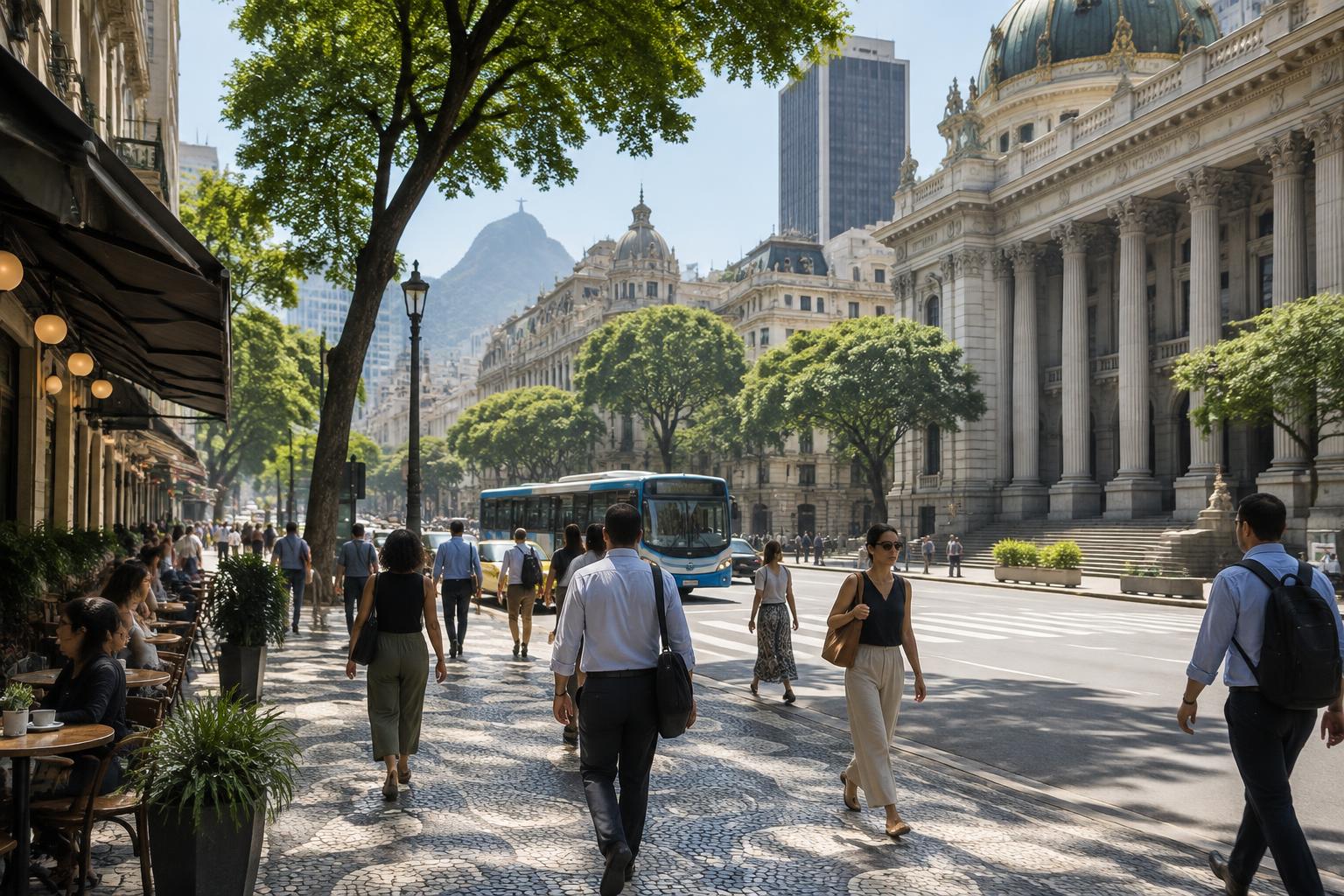
There is the Rio you book, and the Rio that makes the booking possible. A neutral look at how public decisions reach the bus stop, the clinic and the kitchen table—and how to read the headlines without reducing a city to them.
Written and reviewed by PlanRio Editorial Team · First published · Last reviewed
Quick answer
Politics and elections affect daily life in Rio through transport, public healthcare, schools, housing, security and household costs. Brazil divides responsibilities between federal, state and municipal government, so a presidential election does not decide every local service. Visitors should distinguish national political headlines from dated, local instructions about the journey or activity they actually plan.
On this page
- Politics begins at the bus stop, not only on television
- Brazil, Rio state and Rio city: who actually decides what?
- Why one election does not replace every government
- Voting, citizenship and the meaning of belonging
- Transport policy is a policy about time
- Healthcare, schools and the invisible work of care
- Prices, jobs and the real: avoid the one-politician explanation
- Housing, drainage and the politics of a beautiful city
- Public security: a serious subject, not a campaign shortcut
- Talking about politics without turning people into teams
- Election day, demonstrations and the visitor's actual decisions
- Read the news without letting the news become the whole city
- After the vote: what to watch instead of a victory speech
- A more respectful way to visit a politically complex city
- Frequently asked questions
There is the Rio you book, and there is the Rio that makes the booking possible. One has beach views, samba and a table outside a favourite café. The other has transport contracts, public budgets, school places, drainage works and decisions about who receives help when money is tight. They are not separate cities. They are the same city seen from opposite sides of an ordinary day.
This is the perspective we want to bring to the Rio Journal: not a contest between politicians, and not a warning that every election turns a holiday into a crisis. It is an explanation of how public choices reach the kitchen table, the bus stop and the clinic, and why an apparently casual political conversation may mean much more to the person having it than it does to someone visiting for a week.
An important distinction about experience: this is a researched editorial feature, not Lotte's eyewitness election memoir. No personal political recollections or interviews are attributed to her here. The everyday examples below illustrate how institutions work; they are not invented encounters, quotations or claims that we witnessed a particular event. Personal memories belong in this story only when they can genuinely be supplied and identified.
For current headlines, start with our Rio news sources guide. This article does something different: it explains the machinery beneath the headlines. It does not publish election results, predict a government's performance or replace a live advisory. Its reference point is 27 October 2026, and any later election-day arrangements require a new check for the relevant place and date.
At a glance
Three levels, different jobs
Federal government, Rio de Janeiro state and Rio City Hall share some responsibilities and control others separately.
Not every election is local
The 2026 general election cycle is distinct from municipal elections for mayors and councillors.
Citizenship matters
Living in Brazil as a foreign resident does not automatically confer Brazilian voting rights.
A headline is not a closure notice
Use the electoral authority for election rules, COR-Rio for city operations and the operator for a transport service.
Editorial approach
Reported explanation, checked on 27 October 2026; not a claimed eyewitness account or endorsement of a party.
Practical perspective
A resident's commute, treatment and bills can matter more than the political theatre a visitor sees.
Politics begins at the bus stop, not only on television
A visitor can experience a late bus as an irritating interruption between breakfast and a museum. For a resident, the same delay may affect wages, a childcare pickup or an appointment that was difficult to obtain. That difference is the most useful starting point for understanding politics in Rio. Public services are not background scenery. They organise time, determine choices and distribute the cost of things going wrong.
Consider an ordinary household deciding where to live. A cheaper rental can become expensive if it requires long journeys, multiple fares or paid childcare around an unpredictable commute. A home closer to work may cost more but return hours each week. Transport investment, land use and public housing therefore influence a decision that initially looks entirely private. The household pays the rent; public choices shape the alternatives available.
This is also why a visitor should be cautious about comparing the city solely with the beachfront neighbourhood where they are staying. A hotel guest can change plans, order a car or choose a private service. Someone relying on a fixed salary and public infrastructure may not have that flexibility. Neither perspective is imaginary, but the visitor's experience represents a narrow slice of the city rather than a verdict on how Rio works for everyone.
Our guide to living like a local in Rio describes neighbourhood rhythms. This article adds the civic layer: ask what makes those routines possible, who operates the service and what happens when it fails. That turns a political discussion from a distant argument into a practical question. It also encourages a more respectful way of listening to people whose daily exposure is very different from yours.
Brazil, Rio state and Rio city: who actually decides what?
Rio de Janeiro is both the name of a state and the name of its capital city. They are different governments. Above them sits the federal government in Brasília. Under Brazil's Constitution, each level has its own responsibilities, while important areas such as health, education and environmental protection also involve shared duties. An argument about 'the government' can become misleading before it even begins if nobody identifies which government is meant.
The federal level makes decisions about national policy and federal spending, alongside Congress. State government matters to statewide services, including public security and parts of the transport and education systems. Municipal government makes decisions about local services and city planning, alongside the city council. This is an orientation, not an exhaustive legal allocation: funding transfers, regulation and concession arrangements can cross those boundaries.
For a practical example, 'public transport' is not one organisation. A municipal bus journey, an intermunicipal trip and a metro journey may involve different authorities and operators. An operator can be privately managed while the service remains subject to public regulation. Paying a fare to a commercial company does not remove the political questions about service requirements, affordability, accessibility or the terms of its contract.
| Level | Institutions to distinguish | Everyday questions |
|---|---|---|
| Federal | Presidency, ministries and National Congress | National programmes, federal budgets, labour rules and the broader economic framework |
| Rio de Janeiro state | Governor, state departments and legislative assembly | State services, public security and transport responsibilities that extend beyond one municipality |
| Rio city | Mayor, municipal departments and city council | Local services, urban planning, municipal transport and the use of public space |
| Shared responsibilities | More than one level, sometimes with contracted operators | Health, education and infrastructure projects with multiple sources of funding or delivery |
The practical habit is simple: trace the service before assigning credit or blame. If a street is flooded, ask which drainage asset is involved and which authority has issued the operational notice. If a ticketing rule changes, identify the transport network and the body announcing it. Political responsibility is real, but it becomes more meaningful when attached to a specific decision rather than to whichever national politician is most visible that week.
Why one election does not replace every government
Brazil holds general and municipal elections in different cycles. General elections choose national and state representatives, while municipal elections choose mayors and city councillors. That separation matters in Rio: an election that changes the national political conversation is not automatically a vote to replace City Hall. Equally, a mayoral election does not directly choose the president or the state governor.
The TSE's 2026 election resolution scheduled the first round for 4 October 2026 and a possible second round for 25 October 2026. Both dates are past at this article's 27 October reference point. The cycle covered the presidency, governors, senators and federal and state or district deputies. This article does not report winners or imply that every contest required a runoff. The next regular municipal cycle is 2028; its detailed calendar should be checked when the electoral authority publishes it.
Executive offices and legislative seats also do different jobs. A president, governor or mayor does not act as a lone author of every policy. Legislatures consider laws and budgets, courts review legal disputes, and the public administration implements decisions. Coalition-building, legal constraints and available funding can all affect what happens between a campaign promise and the service residents eventually receive.
A campaign is an offer; an approved measure is a decision; a functioning service is an outcome. Keeping those three stages separate is a good defence against both exaggerated enthusiasm and automatic cynicism. A proposed transport improvement may still need a budget, procurement, construction and operating arrangements. A promised benefit may require legislation or rules explaining eligibility. The delay is not proof that nothing matters, but neither is the announcement proof of delivery.
For visitors, an election date is best treated as a planning checkpoint rather than a conclusion. Look for actual notices about the neighbourhood, journey or venue you will use. Do not assume that every attraction closes, that every gathering is dangerous or that every operator follows the same timetable. The Rio public holidays guide handles a different calendar question; voting arrangements require the electoral authority and the relevant local service notices.
Voting, citizenship and the meaning of belonging
Brazil's Constitution distinguishes between compulsory and optional voting. Voting is compulsory for literate Brazilian citizens from age 18 through age 70; it is optional for people aged 16 and 17, people over 70 and illiterate people. Those rules explain why election participation can involve practical family arrangements as well as political preference. The electoral authority provides the current procedures for registration, accessibility, absence and justification.
Foreign nationality and residence are separate from Brazilian citizenship. A person can live in Rio, pay rent and taxes, work within the applicable rules and care deeply about local decisions without automatically becoming eligible to vote. There are specific legal exceptions, including qualified Portuguese citizens under the equality-of-rights framework, but a visitor or foreign resident should not infer eligibility from a visa, a CPF or the length of their stay.
That distinction can produce a particular outsider's position: affected by public decisions, yet not part of the ordinary electorate choosing them. The honest response is not to pretend that distance makes someone objective about everything. It is to recognise the limits of their perspective. A person whose income comes from abroad may experience a currency movement differently from a neighbour whose salary and bills are both in reais.
Respect also means not treating a service worker as a convenient political interview. A hotel receptionist, restaurant employee or driver may welcome a conversation, prefer not to discuss it or feel uncomfortable disagreeing with a customer. Ask permission, accept a short answer and do not publish names, photographs or political affiliations without explicit consent. A conversation can be meaningful without becoming content, and privacy is part of the story's integrity.
Transport policy is a policy about time
Transport arguments are often reported as arguments about fares, but the real question is wider: what does it cost to reach work, study, treatment or family? A lower price helps little if a useful route disappears, while a faster connection may save time but remain unaffordable for some households. The relevant measures include frequency, transfers, reliability, accessibility and the hours when the service actually operates.
A visitor may see a new payment system as another app to download. A resident may need to understand whether an old balance transfers, whether a concession applies, how to top up and whether the system works for a person without the expected phone or bank access. These are not minor details. A technically modern system can still create an access problem if the transition is confusing or the alternatives are difficult to use.
Election-day transport deserves its own check. The TSE's 2026 transport guidance stated that municipal and intermunicipal urban public transport, including metropolitan services, should be free on voting days, with frequency compatible with working days. That is a national electoral requirement, not merely a local courtesy. It still does not establish the precise route, service hours or disruption affecting your journey. Those details belong to the relevant network's current notices, and future elections require a new check.
For the actual journey, use our Rio transport guide and the operator's current information. For the political question, ask who authorised the arrangement, who funds it and who benefits. That approach keeps the explanation neutral without making it empty. It can acknowledge a genuine improvement while still asking whether someone with a longer commute or limited mobility experiences the same benefit.
Healthcare, schools and the invisible work of care
Healthcare is one of the clearest places where the Constitution and daily life meet. Brazil's Sistema Único de Saúde, known as SUS, is a public health system involving federal, state and municipal responsibilities. A discussion about healthcare policy can involve much more than hospitals: primary care, vaccination, staffing, medicines, prevention and the route a patient takes between different levels of treatment all matter.
It is important to separate the right to care from the practical experience of accessing it. A legal principle does not promise that every facility has identical capacity, that a particular medicine is available that day or that a specialist appointment can be obtained immediately. Equally, a difficult individual experience does not describe every part of the system. Honest reporting needs the specific service, place and date, not a universal judgement based on one encounter.
Education has the same combination of public principles and local realities. School places, transport, meals, buildings, teacher availability and timetables influence a household's ability to work. When a school day changes, someone may have to arrange care, change a shift or lose income. That is why education policy is also employment policy in practice, even though those responsibilities may be discussed under different headings in a political programme.
A traveller sees a school from the pavement; a parent sees the structure around the week. The gap between those perspectives should make us careful with easy conclusions about how 'relaxed' life is in Rio. Flexibility can be a pleasure when it is chosen and a burden when it is forced. The most useful political question is not whether the city looks informal, but whether its systems give people dependable choices.
Prices, jobs and the real: avoid the one-politician explanation
When food, fuel or rent becomes more expensive, politics naturally enters the conversation. Government decisions can influence costs through taxation, regulation, spending and other policies. But prices also respond to factors beyond a single administration: weather, global commodity markets, exchange rates, supply chains and competition. Explaining every movement with one politician's name is an attractive shortcut, not a reliable account of cause and effect.
Inflation and exchange rates are related but different. A foreign visitor may find their home currency buys more reais while a local household faces rising prices. That does not mean Brazil has become cheaper for everyone. A useful comparison asks which currency the person earns, what they purchase and over what period. A holiday budget and a household's purchasing power can move in opposite directions at the same time.
Brazil's Banco Central explains monetary policy and the role of Copom, the committee that sets the Selic target. Interest-rate decisions can affect credit costs and broader economic conditions, but they are not a button that instantly changes the price of every meal or room. Fiscal policy, monetary policy and business decisions need to be distinguished. A journal feature should explain the mechanism, not predict the exchange rate or recommend a financial trade based on an election.
Work adds another layer. Someone with a formal salary, an independent business, casual shifts or income from another country may react differently to the same policy proposal. A vendor's concern about a quiet week and an office worker's concern about borrowing costs are both economic concerns, but they are not interchangeable. Neutrality means allowing those differences to exist instead of assigning one political outlook to a whole profession or neighbourhood.
Our Rio money guide covers practical spending. Here the conclusion is more modest: budget with current prices, keep a contingency and avoid turning a favourable exchange rate into a story about how easy local life must be. Buying power is personal. The political context matters, but it does not remove the need to ask whose costs and whose income are being described.
Housing, drainage and the politics of a beautiful city
Rio's landscape is extraordinary, but beauty does not distribute infrastructure evenly. Housing policy, land use, sanitation and transport connections influence where people can live and how vulnerable a household is to disruption. Two addresses in the same municipality can have very different access to services. That makes the neighbourhood an essential unit of explanation, although it should never become a shortcut for stereotyping the people who live there.
Heavy rain exposes the importance of less visible decisions: drainage maintenance, hillside protection, land-use enforcement, warning systems and emergency response. A storm is a weather event; the damage it causes also depends on exposure and infrastructure. That distinction does not justify blaming every incident on one official. It does justify asking what was known, what was planned, which body was responsible and whether promised work was delivered.
The beachfront offers a useful reminder that enjoyable public space is governed space. Cleaning, lighting, accessibility, vendor rules, traffic arrangements and permitted events involve public decisions. A lively square does not appear independently of policy, even if the atmosphere feels spontaneous. The same applies to cultural funding and the practical organisation of large celebrations: a successful event can combine public work, private organisation and the efforts of residents.
Visitors can engage with that context without turning a neighbourhood into a lesson performed for them. Learn the place's history, spend respectfully and ask before photographing people. Do not demand personal accounts of insecurity, poverty or political pressure as the price of a 'real' experience. A city is not more authentic when someone else's vulnerability becomes the most dramatic part of a visitor's story.
Public security: a serious subject, not a campaign shortcut
Although this article is about politics rather than a police guide, public security cannot be omitted from daily life. Brazil's constitutional framework distinguishes different security institutions and responsibilities. In Rio, a resident's concern may include crime, police operations, interrupted transport or the ability to move through a familiar area. Those concerns deserve careful description rather than an automatic conclusion that one slogan explains the solution.
A neutral account can ask about effectiveness, legality, accountability and consequences at the same time. Those are not mutually exclusive questions. It can recognise the seriousness of crime while also considering the disruption that an operation may create for people trying to work or attend school. What it should not do is treat every resident of an affected neighbourhood as a participant in violence or use that neighbourhood as a political label.
For a visitor, the operational question comes first: does reliable current information affect the route or activity planned today? Our Rio safety guide provides broader preparation. The news guide identifies sources, but neither this essay nor a social post guarantees that a street is safe. Do not approach an incident to test a headline, and do not assume that a quiet news feed proves there is no local risk.
For the political discussion, separate a dated incident from a trend and a trend from a causal claim. A dramatic video does not establish the citywide crime rate, and a politician's response does not establish what happened. Read the original reporting, identify the place and date, and look for independent evidence before repeating a conclusion. Restraint is not dishonesty; it is how a serious subject avoids becoming entertainment.
Talking about politics without turning people into teams
Political conversations can be personal because they involve family histories, religion, work, security, inequality and hopes for the future. None of those subjects produces a single predictable opinion. Brazil is not adequately explained by two types of person, and Rio is not a miniature electorate where every café or bairro represents one side. A lively discussion should not be mistaken for permission to classify everyone involved.
If someone wants to talk, a useful opening is a practical question rather than a demand for an endorsement: which public issue affects your week most, or what would make your journey easier? These questions can reveal different priorities without forcing the conversation into an argument about a national figure. They also make room for someone who is disappointed with several options, has changed their mind or prefers not to name a party.
Clothing, colours and symbols need context. A football shirt can mean support for a team; a flag can express national identity; the same objects can also appear in political demonstrations. Do not infer a person's beliefs from an item alone, and do not give travellers a universal clothing ban based on a simplified reading of politics. Around a clearly political gathering, recognise the context and choose whether you want to be present at all.
A few Portuguese phrases can help, but listening matters more than performing fluency. 'Prefiro não falar de política' means 'I prefer not to talk about politics'; accept it without asking why. 'Como isso afeta o seu dia a dia?' asks how something affects everyday life, but should still be used only when the other person is comfortable. Our Portuguese phrasebook covers the everyday language rather than teaching a visitor to win a political debate.
Election day, demonstrations and the visitor's actual decisions
An election day can change a local routine without changing every part of a trip. A school may function as a polling place; someone working in hospitality may need time to vote; a transport network may publish special arrangements. Those are reasons to confirm a plan, not to declare the whole city closed. Ask the venue about its own opening and the operator about its own service instead of relying on a national generalisation.
Alcohol restrictions are a particular source of recycled travel advice. Do not assume a single permanent nationwide election-day ban. Relevant restrictions, when imposed, must be checked against the competent authority's notice for the place and election in question. An old screenshot from another state cannot tell you whether a Rio restaurant may serve drinks on your date. Nor should a travel article promise there are no restrictions without checking the current local position.
Demonstrations require similar precision. A peaceful assembly, an announced march, an unexpected roadblock and a violent incident are not the same event. Brazil's Constitution protects peaceful assembly under specified conditions. For a visitor, that constitutional principle does not answer whether a particular junction is passable at a particular hour. COR-Rio and current local reporting are more useful for that operational decision than a general argument about the legitimacy of protest.
Do not join a political gathering simply because it looks like an interesting crowd photograph. Keep a route away from tension, follow current instructions and avoid filming identifiable participants casually. If a route changes, notify your accommodation or activity provider and agree a realistic alternative meeting point. The aim is not to dramatise the day. It is to preserve a straightforward plan while respecting that the gathering may have a different significance for those attending.
Before making a claim about an election-day rule, establish:
- The exact date, municipality and election round concerned—not merely the year.
- The authority issuing the notice and whether it applies to your transport mode or venue.
- The effective hours, exceptions and any later correction or replacement notice.
- Whether the information describes an official rule, an operator's arrangement or a journalist's summary.
Read the news without letting the news become the whole city
A national headline is designed to explain something important, not to provide your afternoon itinerary. It may describe a dispute in Brasília, an economic indicator or a legal decision that has no immediate effect on the street outside your hotel. Conversely, a small local transport notice can matter greatly to your next journey while receiving little international coverage. The scale of the headline and the scale of your decision are different things.
Start by asking what kind of information you need. For election procedures, use the electoral authority. For the operation of a city service, use the responsible authority or operator. For interpretation, compare reliable journalism and look for named evidence. For an allegation, distinguish what is claimed from what has been established. These categories can appear together in one story, but they should not be blended into one certainty.
Social media needs an extra date check. A video can be real and still misleading if it is old, filmed elsewhere or presented without its original context. A forwarded message can be persuasive precisely because it sounds personal. Before sharing, look for the original source, location, publication date and independent confirmation. If none is available, saying 'I cannot verify this' is more useful than sending it onward with a worried caption.
A bounded routine helps: check relevant updates before a cross-city journey, check the activity provider if the route changes, then return to the day you planned. Constantly refreshing national political arguments rarely improves a visitor's decisions. The point of understanding the civic context is to see Rio more clearly, not to reduce every conversation, meal and walk to a running commentary on the latest headline.
After the vote: what to watch instead of a victory speech
Election night creates a clean narrative: somebody wins, somebody loses and a new chapter begins. Public administration is less tidy. Services continue, budgets have existing commitments, contracts may remain in force and new programmes need implementation. Some changes can happen quickly; others require legislation, staffing or construction. A serious account should not promise an immediate transformation of daily life merely because an outcome has been announced.
For residents, the useful follow-up is specific. Has a measure been formally approved? Is there funding? Who qualifies? When does it start? Which office delivers it? Is there a route for questions or complaints? These details are less dramatic than a campaign rally, but they are closer to the experience of the person waiting for a service. They also allow political promises to be assessed against something more concrete than tone.
For visitors, the corresponding questions concern actual travel conditions: has an entry rule changed, has an operator published a new fare, has a venue changed access, or has a street restriction been announced? Check the measure itself before altering a booking. Political uncertainty is not an automatic reason to cancel a trip, and political reassurance is not a substitute for current travel advice from your own government and local operational sources.
The most honest conclusion is that elections matter, but not as a single explanation for everything. They shape priorities, representation and decisions within a wider system of institutions and constraints. Everyday life then tests those decisions in thousands of small ways. The bus arrives or it does not; the appointment happens or it does not; the promised improvement becomes usable or remains an announcement. Those outcomes deserve attention after the cameras move on.
A more respectful way to visit a politically complex city
You do not need to become an expert in Brazilian politics to enjoy Rio, but a little understanding changes how you interpret the city. It makes the slow journey more than a complaint, the public square more than a photo and the political conversation more than an argument between strangers. It can also make you less confident in the wrong places: about someone else's beliefs, a neighbourhood's identity or the supposed simplicity of a solution.
Neutrality here does not mean pretending that every claim is equally supported. Official rules can be checked; allegations require evidence; experiences can be real without being representative. When evidence establishes a consequence, describe it plainly. When causation is uncertain, say so. When a personal memory is unavailable, do not invent one to make the writing warmer. The reader deserves both an engaging story and a clear boundary around what that story knows.
The Rio Journal's purpose is to help visitors see the city behind the postcard without replacing joy with anxiety. Have the beach day, enjoy the music and leave time for the neighbourhood café. Remember that the people keeping those places running have lives organised around wages, care, services and decisions you may never encounter directly. Paying attention to that reality is not choosing a party. It is choosing to visit with more respect.
Frequently asked questions
How do politics and elections affect daily life in Rio de Janeiro?
Politics and elections influence public budgets, transport, healthcare, schools, housing, security and household costs. Responsibilities are divided between federal, state and municipal institutions, so the effect of a specific decision depends on the service, the authority and how it is implemented.
Does a presidential election also choose Rio's mayor?
No. Brazil's general and municipal elections are separate cycles. General elections choose national and state representatives; municipal elections choose mayors and city councillors. A change in national leadership does not automatically replace Rio City Hall.
Can foreign residents vote in Brazilian elections?
Foreign residence alone does not create Brazilian voting rights. Citizenship and specific legal exceptions matter, including qualifying Portuguese citizens under the equality-of-rights framework. A CPF, visa or lengthy stay should not be treated as proof of electoral eligibility.
Is voting compulsory in Brazil?
Voting is compulsory for literate Brazilian citizens from age 18 through age 70. It is optional for people aged 16 and 17, people over 70 and illiterate people. The electoral authority explains registration, absence and justification procedures.
Should tourists avoid Rio during elections?
An election date alone does not establish that a Rio trip should be cancelled. Check your government's current travel advice, local operational information and the arrangements for your actual route and venue. Avoid assumptions that the entire city closes or that every gathering has the same risk.
Is alcohol always banned on election day in Rio?
Do not assume a permanent nationwide ban or copy restrictions from another state or year. Check the competent authority's current notice for the specific municipality and election date, then confirm the venue's arrangements. This article does not announce a current Rio restriction.
Does an election result determine the Brazilian real exchange rate?
An election can affect expectations, but exchange rates also respond to monetary conditions, global markets and other factors. No result guarantees a particular exchange rate. A visitor's home-currency buying power is different from the purchasing power of someone paid in reais.
Is this article Lotte's personal election experience?
No. This is a researched Rio Journal editorial, not an eyewitness memoir. It attributes no political encounters, interviews or election attendance to Lotte. Everyday examples explain institutions rather than claiming that a particular personal event occurred.
Sources
Prices, rules and opening information change. These are the sources behind this article — check them for your own dates before relying on a figure.
- Brazilian Constitution ↗
Federal, state and municipal responsibilities; citizenship, electoral rights, peaceful assembly, education and public security.
- TSE: 2026 general election resolution ↗
The scheduled October 2026 rounds and offices; cited as a calendar, not evidence of results.
- TSE: Election Law ↗
General and municipal election cycles and runoff provisions.
- TSE: constitutional voting rules ↗
Article 14: compulsory and optional voting and voter-registration exclusions.
- TSE: 2026 voter procedures and Portuguese equality status ↗
Specific electoral eligibility rules; foreign residence alone is not voting eligibility.
- TSE: election-day transport in 2026 ↗
National free urban public transport requirement and frequency guidance for the 2026 voting days; local route notices remain necessary.
- Law 8.080: the SUS framework ↗
Public health organisation and responsibilities, not a promise of availability at an individual facility.
- Rio Municipal Health Secretariat: service charter ↗
The city's health-policy and service responsibilities within SUS.
- Banco Central: Copom ↗
Monetary policy and the committee responsible for the Selic target.
- Banco Central: Selic ↗
The policy rate; this article makes no rate or currency forecast.
- COR-Rio ↗
Current city operations and road information; not an election-result source.
Keep planning
Rio news sources and live alerts
Match the source to the decision instead of relying on one feed.
Everyday neighbourhood life
The routines behind Rio's landmarks and beach views.
Rio transport guide
Plan the journey itself with current operator checks.
Money in Rio
Payments and budgeting rather than exchange-rate predictions.
Brazil and Rio public holidays
Distinguish holiday planning from election-day arrangements.
Portuguese phrasebook
Useful everyday language for a more considerate visit.
More from the Rio Journal

Rio Now: The NFL Game in Rio and Its R$462.7m Visitor Impact
Rio City Hall estimates R$462.7m in total impact from the Ravens–Cowboys game. We unpack what the number includes, where the crowd came from, and what the report cannot predict about the next Maracanã event.
Rio Now10 min read
What's Changed in Rio de Janeiro: The Updates That Affect a 2026–27 Trip
Buses stopped taking cash, the Maracanã turnstile reads your face, and the 2027 bloco programme is not final until January. A quarterly digest of the changes that alter how you plan — each one dated and sourced.
Rio Now12 min read