What Is a Favela? The Honest Explainer
Written and reviewed by Lotte — Rio local, founder & editor of PlanRio · How we research · First published · Last reviewed
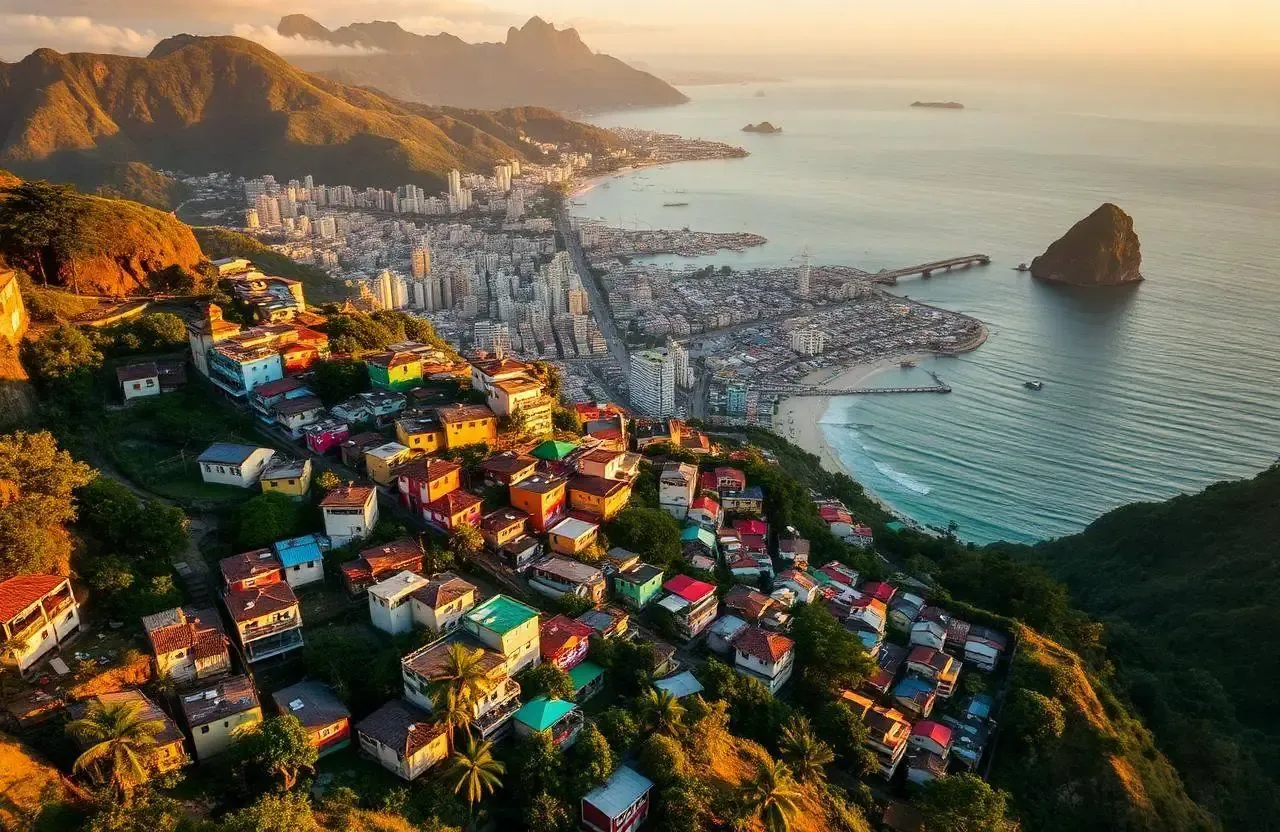
Self-built does not mean temporary: much of Rio's favela housing is multi-storey brick and concrete, decades old, with metered utilities.
Quick answer
A favela is an urban neighbourhood built by its own residents outside formal planning and land title — a description of how the housing came to exist, not of the people in it. Brazil's 2022 Census counted 12,348 favelas and urban communities housing 16.39 million people, 8.1% of the country.
See IBGE's official definition and census dataAt a glance
What it is
A self-built urban neighbourhood that grew outside formal planning and land title — housing, not a category of poverty.
Brazil-wide (2022 Census)
16.39 million people, 8.1% of the population, across 12,348 favelas and urban communities.
In Rio
13.3% of the city's population — roughly one resident in seven — across around 1,700 identified communities.
The largest
Rocinha: 72,021 residents and 30,371 occupied households, the most populous in Brazil.
The word
From the favela plant on a hill near Canudos, Bahia, via the soldiers who settled Morro da Providência in 1897.
What it is not
Not a slum, not a shanty town, not a no-go zone, and not interchangeable with “dangerous”.
The definition, without euphemism
A favela is an urban neighbourhood built by its own residents, incrementally, outside the formal system of planning permission and land title. That is the whole definition. It says something about how the housing came to exist and nothing about the people who live in it, their incomes, their jobs or their safety.
Brazil's statistics agency, IBGE, currently defines the category by a set of physical and legal characteristics: occupation of land without title, irregular street layouts, self-built construction, and incomplete provision of public services such as formal sewerage, waste collection or street lighting. In the 2022 Census it counted 12,348 favelas and urban communities nationally, home to 16.39 million people — 8.1% of Brazil's population, and 7.2% of all Brazilian households.
In Rio specifically, 13.3% of the city's population lives in favelas and urban communities, spread across roughly 1,700 identified communities ranging from a few dozen households to Rocinha's 30,371. Roughly one carioca in seven. A visitor who thinks of favelas as a marginal edge of the city has the geography backwards: they are woven through it, including directly above Ipanema, Leblon, Gávea and Copacabana.
Where the word comes from, and why it matters
In 1897, soldiers returning from the Canudos War in the Bahian backlands arrived in Rio — then Brazil's capital — expecting the land they had been promised for their service. It was not granted. They occupied the scrub on a hill near the Ministry of War and built on it. They called the hill Morro da Favela, after the favela plant, a skin-irritating shrub that had covered the hillside they had camped on in Bahia. The hill is now called Morro da Providência and is generally recognised as Brazil's first favela.
What happened next is the actual history of Rio's housing: freed slaves, with no property and no compensation after abolition in 1888, moved into the same hills; European migrants followed, because it was the only affordable ground within walking distance of work in the port and the centre. Later came waves of internal migration from the Northeast through the twentieth century. Every one of those groups was housing itself in a city that was not building housing for it.
This is why the vocabulary question is not pedantry. The structures exist because of a specific historical failure to provide land and housing, not because of a culture or a choice. A word that implies otherwise describes the wrong thing.
Why Brazil's census changed the word in 2024
For about fifty years, IBGE's official term for these areas was aglomerados subnormais — literally “subnormal agglomerations”. It was a technical label, and it was also an insult that residents, researchers and community organisations objected to for decades.
When the 2022 Census data was released in 2024, IBGE formally returned to the word favela, publishing the category as Favelas e Comunidades Urbanas — favelas and urban communities. The change followed technical studies and consultation with community organisations, and it matters because the state had spent half a century describing roughly eight per cent of the population with a word built on a deficit.
The practical lesson for a visitor is that favela is the correct, current, officially used Portuguese word, and it is not a slur. Many residents use it with pride; others prefer comunidade (community). Both are fine. What is not fine is the English vocabulary that usually gets attached to it.
What not to call it: slum, shanty town, ghetto
Slum and shanty town both imply impermanence and squalor. Most of Rio's favelas are neither. They are brick-and-concrete neighbourhoods a century old in places, with multi-storey buildings, metered electricity, piped water, broadband, registered businesses, churches, schools, nurseries, samba schools, bars, bakeries and property markets where homes are bought and sold for real money. Describing that as a shanty town is simply inaccurate.
Ghetto is wrong in a different way: it implies enforced segregation of a group. Favelas are economically segregated by a housing market, not legally segregated by identity, and they are not ethnically uniform — though they are disproportionately Black, which is a direct consequence of the history above and a fact worth stating rather than smoothing over.
The one English phrase that mostly works is “informal settlement”, and even that undersells places like Rocinha, which has the population of a small city and a formal commercial high street. If in doubt in Portuguese, say favela or comunidade. In English, say the community's name — Rocinha, Vidigal, Santa Marta — the way you would say Botafogo.
Governance, policing and the thing visitors actually mean
When people ask whether favelas are dangerous, they are usually asking about armed territorial control. Here is the honest version: a proportion of Rio's communities are controlled or contested by armed groups — drug factions in some areas, milícias (militias, often involving current or former police) in others. In those places, public authority is partial, and the violence that drives Rio's homicide statistics is concentrated there. That is a real phenomenon and it is not evenly distributed.
It is also not the condition of every community, and it is not the daily experience of most of the 1.7 million-odd cariocas who live in them. People go to work, take children to school, run businesses and complain about the rubbish collection. The Pacifying Police Unit (UPP) programme of the 2010s attempted permanent policing of specific communities and produced mixed, largely reversed results — a useful caution against treating any single community's situation as settled or permanent.
The practical upshot for a visitor is that “favela” is far too coarse a unit to make a safety decision with. Our neighbourhood safety map works at the resolution that actually matters, and the crime data explainer shows why the indicator that makes international headlines is the one least likely to reach you.
Favelas you can see from the beach
Part of what makes Rio unlike other unequal cities is the vertical adjacency. Vidigal sits on the hillside between Leblon and São Conrado with what is probably the best view in the city. Rocinha is a ten-minute drive from Leblon. Santa Marta rises directly above Botafogo. Cantagalo and Pavão-Pavãozinho sit between Ipanema and Copacabana, reachable by a public lift from General Osório metro station.
This is not incidental. The hills were the land nobody with money wanted — too steep to build on conventionally — which is precisely why they were available to people with no money, and why they now have the views. The R$8 million apartment and the self-built house are four hundred metres apart and always have been.
It also means that several things visitors enjoy without noticing are in or from these communities: the view from Mirante Dona Marta above Santa Marta, the Dois Irmãos hike that starts in Vidigal, and a large share of the music, food and football the city is famous for. Samba and funk carioca are not favela-adjacent cultural products; they are favela cultural products.
If you want to visit: the ethics, stated plainly
Visiting a favela can be entirely respectable or straightforwardly extractive, and the difference is structural rather than a matter of intention. The version that works: you go on foot, with a guide who lives there, to a community that has decided it wants visitors, you spend money in local businesses, and a defined share of the fee stays in the community. That is a neighbourhood tour, and it is no more problematic than a walking tour of Santa Teresa.
The version that does not work: an open-top jeep driven through narrow residential streets so that outsiders can photograph people's homes from a vehicle, without stopping, without spending, without consent. This is often called a “human safari” by the people being photographed, and we think it is indefensible. We will not link to one, and the fact that it is the cheapest option is part of why it is the wrong one.
If you do go, go to a community that is organised for it — Rocinha and Vidigal are the two that most clearly are — with a resident guide, on foot, in daylight, and ask before you photograph anyone. Our favela tour comparison assesses operators on exactly those criteria, and is a favela tour worth it? is the honest answer to whether you should bother at all. Going independently, without a local contact, is the one option we would actively discourage.
If you decide to visit, visit on foot
Rocinha and Vidigal are the two Rio communities most clearly organised to receive visitors. Check that the guide lives there, that the route is walked rather than driven, and what share of the fee stays local — and read our tour comparison before booking anything.
Links may earn us a commission at no extra cost to you. This supports PlanRio.
Common mistakes tourists make
- Using “slum” or “shanty town”. Most of Rio's favelas are century-old brick-and-concrete neighbourhoods with utilities, businesses and property markets.
- Treating “favela” as a synonym for “dangerous”. It covers around 1,700 Rio communities in very different situations.
- Assuming favelas are on the edge of the city. They sit directly above Ipanema, Leblon, Botafogo and Copacabana.
- Thinking the word is a slur. Since 2024 it is the official census term, replacing a label residents objected to for fifty years.
- Entering a community independently without a local contact, on the basis that a particular hillside “looked fine”.
- Booking the cheapest jeep tour. Driving through residential streets to photograph homes is what residents call a human safari.
- Photographing people or their houses without asking, in a place where you are the visitor.
Local expert tips
- In Portuguese, favela and comunidade are both correct and both commonly used. In English, use the community's own name.
- If you want the view without the ethical complexity, Mirante Dona Marta and the Dois Irmãos trailhead are public and spectacular.
- Judge a tour by three things: is the guide a resident, is it on foot, and does a stated share of the fee stay in the community.
- Spend money inside the community if you visit — at the bakery, the bar, the viewpoint kiosk. That is the part that actually matters.
- Read the history before the safety advice. Almost everything confusing about favelas makes sense once you know about 1888 and 1897.
- Remember that samba, funk carioca and a large share of Rio's football culture are favela products, not favela-adjacent ones.
Frequently asked questions
What is a favela?+
A favela is an urban neighbourhood built incrementally by its own residents outside the formal systems of planning permission and land title. Brazil's census defines the category by physical and legal characteristics — untitled land, irregular layout, self-built housing, incomplete public services — not by the income or character of the people living there. In 2022 there were 12,348 favelas and urban communities in Brazil, home to 16.39 million people.
Is favela a rude word?+
No. Favela is the correct, current Portuguese word, and since 2024 it is also the official census term: IBGE publishes the category as Favelas e Comunidades Urbanas, having dropped the fifty-year-old label aglomerados subnormais (“subnormal agglomerations”) that residents had long objected to. Many residents use favela with pride; others prefer comunidade. Both are fine.
What should I not call a favela?+
Avoid slum and shanty town, which imply impermanence and squalor that do not describe brick-and-concrete neighbourhoods a century old with metered electricity, broadband, registered businesses and property markets. Avoid ghetto, which implies legal segregation by identity rather than economic segregation by a housing market. In English, the safest option is to use the community's own name — Rocinha, Vidigal, Santa Marta.
How many people live in favelas in Rio de Janeiro?+
About 13.3% of the city's population — roughly one resident in seven — across around 1,700 identified favelas and urban communities. Nationally the figure is 16.39 million people, or 8.1% of Brazil's population, up from 11.4 million (6.0%) recorded in the 2010 Census under the previous terminology.
What is the biggest favela in Rio?+
Rocinha, with 72,021 residents and 30,371 occupied permanent households recorded in the 2022 Census — the most populous favela in Brazil. Sol Nascente in the Federal District is comparable or larger depending on whether you count people or households, so the “biggest in Brazil” title depends on the measure used.
Where does the word favela come from?+
From a plant. Soldiers returning from the Canudos War in 1897 had camped near a hill in Bahia covered in favela, a skin-irritating shrub. Denied the land they had been promised in Rio, they occupied a hill near the Ministry of War and named it Morro da Favela after that Bahian hillside. It is now called Morro da Providência and is recognised as Brazil's first favela.
Are favelas dangerous for tourists?+
Some communities are controlled or contested by armed groups and the violence behind Rio's homicide statistics is concentrated in those places; many others are not, and daily life in them is ordinary. “Favela” is far too coarse a unit to make a safety decision with — it covers around 1,700 communities with very different situations. Never enter one independently without a local contact; go with a resident guide, on foot, in daylight, or not at all.
Why are favelas built on hillsides in Rio?+
Because the hills were the land nobody with capital wanted — too steep for conventional construction — which made them the only ground available to people with no money and no title. That is why Vidigal, Santa Marta, Cantagalo and Rocinha sit directly above some of the most expensive real estate in Brazil, and why they have the better views.
Is it ethical to take a favela tour?+
It depends entirely on the format. A walking tour with a guide who lives there, in a community that has chosen to receive visitors, where you spend money locally and a share of the fee stays in the community, is a neighbourhood tour and is defensible. An open-top jeep driving through residential streets so outsiders can photograph homes without stopping or spending is what residents call a human safari, and it is not.
What is the difference between a favela and a comunidade?+
Nothing, in terms of what the place is — comunidade (community) is the preferred term for many residents and organisations, and favela is the term the state now uses officially. Choosing between them is a question of register rather than definition. Both are widely used in Rio, often by the same person in the same conversation.
Sources and image credit
Details and access can change. Use these venue, operator and public-information sources to recheck key details before visiting.
- IBGE: Favelas e Comunidades Urbanas — official typology and data ↗
The statistical definition, the criteria used, and the 2022 Census datasets.
- Agência Brasil: 16.39 million people live in favelas, 2022 Census ↗
The national totals, the 8.1% share and the 12,348 communities.
- IBGE returns to the word “favela” in the census ↗
The 2024 terminology change away from aglomerados subnormais, after technical studies and consultation.
- Census 2022: Rocinha's population and the largest communities ↗
The 72,021 residents and 30,371 households figures, and the Rio share of 13.3%.
- Morro da Providência: the 1897 origin and the favela plant ↗
The Canudos War veterans, the Bahian hillside the word comes from, and the hill's later history.
Keep planning
Favela tours compared
Operators assessed on resident guides, walking routes and what share of the fee stays local.
Is a favela tour worth it?
The honest answer, including when the answer is no.
Rocinha guide
Brazil's most populous community, in detail.
Little Africa walking guide
The port-area history that explains how Rio's hills came to be settled.
Rio safety map
Street-level judgement, at the resolution the word “favela” cannot provide.