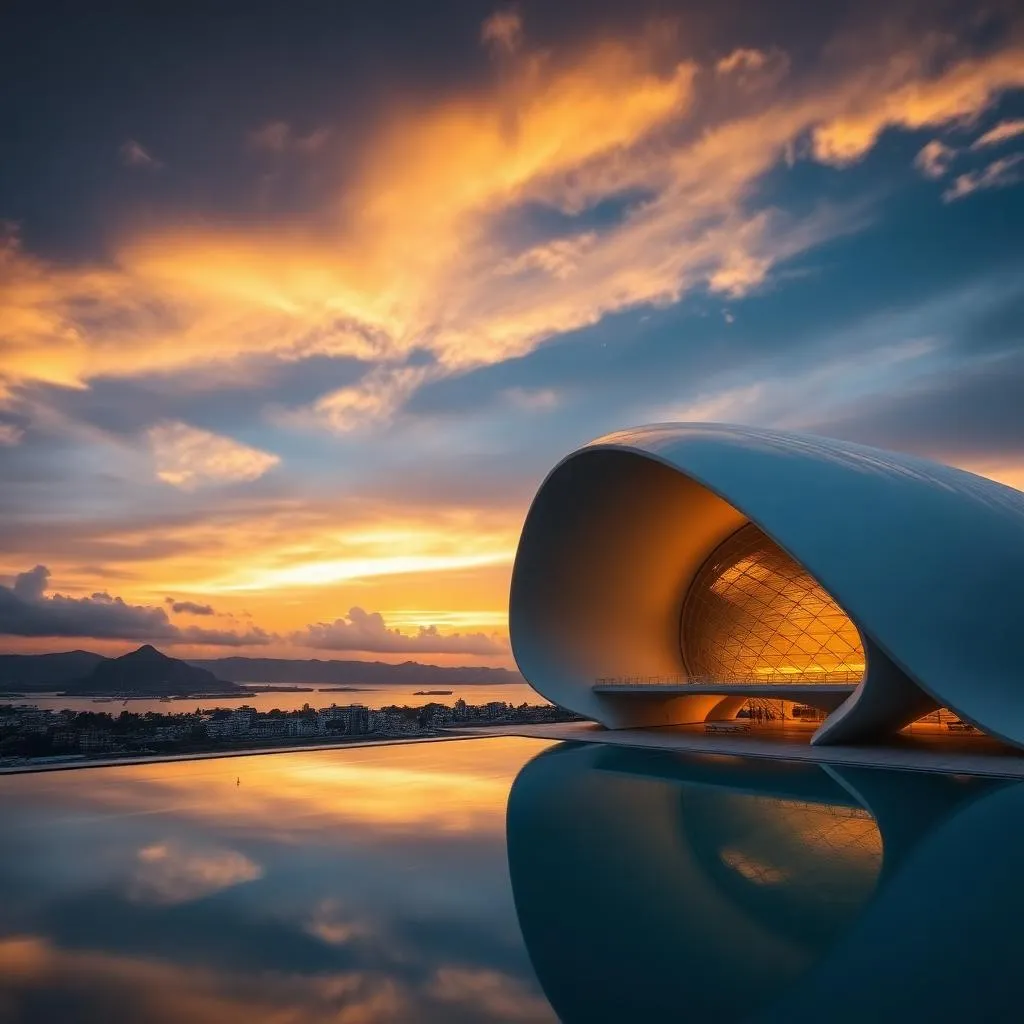
Rio de Janeiro Architecture Guide
Fifteen buildings, three practical routes and an honest way to read five centuries of Rio without turning the city into a façade checklist.
Written and reviewed by Lotte — Rio local, founder & editor of PlanRio · How we research · First published · Last reviewed
Quick answer
Rio's essential architecture route runs from colonial Praça XV through Belle Époque Cinelândia to modernist Palácio Capanema and MAM, then crosses Guanabara Bay for Oscar Niemeyer's MAC Niterói. Use weekday daylight for Centro, pre-book Capanema, and allow a separate half-day for Niterói instead of racing between façades.
At a glance
Best first route
Praça XV to Capanema
Time needed
Two architecture-focused days
Best modernist stop
Palácio Capanema
Best building + view
MAC Niterói
Best interior
Real Gabinete
Best free experience
Centro exterior route
Go when
Weekday morning
Key rule
Book interiors first
Rio rarely introduces itself as an architecture city. The mountains and beaches dominate every first impression, while the buildings are treated as background. That misses the point. Rio's strongest architecture is precisely about the argument between structure and landscape: shaded pilotis opening to public ground, gardens entering concrete frames, ceremonial façades facing squares, and windows turning Guanabara Bay into part of the room.
This is not a recycled list of Rio's prettiest attractions. We chose buildings that explain a different chapter of the city and that a visitor can realistically read from public space or through a legitimate visit. Several famous sights are absent on purpose. Christ the Redeemer is a masterpiece of sculpture and engineering but a weak architecture stop; Selarón is public art; Sugarloaf's cable-car stations matter less than the landscape they serve.
The order below is chronological, not a ranking. If you only have one day, follow the Centro route. If you studied architecture, add MAM and Capanema before chasing more remote residential works. And if a building is still in everyday use—a station, monastery, library or housing complex—behave like a guest, not a location scout.
Best guided starting point
Put the façades back into the city
A strong Centro walk explains why Praça XV, Cinelândia, Lapa and the modernist ministry district look so different—and what urban renewal displaced along the way. This specific small-group route includes central landmarks and lunch, making it useful context rather than paid transport between free sights.
Links may earn us a commission at no extra cost to you. This supports PlanRio.

Colonial to contemporary
The 15 essential buildings
Paço Imperial
Colonial · 18th century
Praça XV, Centro
Public cultural centre; check the current exhibition calendar
Start where Rio's architecture was still organised around empire, church and port. The former royal and imperial palace is restrained rather than theatrical: a low, white complex built around courtyards, with thick walls and deep openings suited to heat. Its significance is urban as much as architectural. Stand in Praça XV and read the relationship between palace, harbour and nearby churches before going inside.
Our take: The courtyard proportions and stone portals matter more than the galleries. Pair it with the Arco do Teles and CCBB rather than making a special cross-city journey for this building alone.
Plan a Centro dayMosteiro de São Bento
Colonial Baroque · 17th–18th centuries
Morro de São Bento, Centro
Working monastery; enter quietly outside services
The plain façade deliberately hides one of Rio's most lavish interiors. Gilded carving climbs across altars, arches and the ceiling, creating the clearest contrast on this list between austere colonial exterior and Brazilian Baroque interior. It is also a reminder that the city's early monumental building programme was inseparable from Catholic power, wealth and forced labour.
Our take: Go for the interior, not a façade photograph. Dress respectfully, keep voices low and never treat a service as a performance. Access can change around liturgical celebrations, so check before crossing town.
Real Gabinete Português de Leitura
Neo-Manueline · opened 1887
Rua Luís de Camões, Centro
Free general visits on published weekdays; guided visits vary
Rafael da Silva e Castro's library compresses Portugal's maritime-revival symbolism into a narrow Centro plot. The limestone façade announces the neo-Manueline style; inside, dark carved timber, a vast iron skylight and tier after tier of books turn the reading room into a vertical chamber. It is photogenic, but the shelves are not theatre scenery: this remains a working research library.
Our take: Look up at the iron-and-glass roof, then down at the hydraulic floor and GPL monogram. Arrive with a quiet indoor plan and accept that photography rules or guided-visit availability may change.
Read the full library guideTheatro Municipal
Eclectic / Belle Époque · 1909
Cinelândia, Centro
Best seen at a performance or on an official guided visit
Rio's grand opera house belongs to the Pereira Passos remaking of central Rio, when broad avenues and monumental façades were used to project a European-style capital. The final design combined two competition proposals and borrowed its basic theatrical language from the Paris Opéra. The result is exuberant: dome, sculpture, mosaic, gilding and an interior shaped by artists including Eliseu Visconti.
Our take: The exterior is impressive, but a ticketed performance gives the building purpose. We would choose a modestly priced seat for ballet or orchestra over paying only to photograph the staircase.
Check the visitor guideBiblioteca Nacional
Eclectic / Neoclassical · 1910
Cinelândia, Centro
Research institution; interiors depend on current visits and events
Across Cinelândia, the National Library completes the civic ensemble with a more controlled composition than the theatre. Classical columns, a raised entrance and a ceremonial stair communicate national authority; inside, skylights, decorative iron and reading rooms reveal how architecture was used to stage knowledge. See it together with the theatre and Museu Nacional de Belas Artes, not as an isolated stop.
Our take: The best view is diagonal across Cinelândia, where the library's order plays against the theatre's ornament. Do not assume every reading room is open to casual visitors.
Ilha Fiscal palace
Neo-Gothic · 1889
Guanabara Bay, off Praça XV
Timed Navy-managed visits; departures depend on operations and weather
This small green palace looks like a fantasy set in the bay, but it is a compact lesson in late-imperial image-making. Pointed arches, pinnacles and stained glass form a neo-Gothic customs building best known for hosting the empire's last great ball. The water approach is part of the architecture: its scale and silhouette make more sense when the city recedes behind it.
Our take: Worth the logistics for architecture and imperial-history readers; not essential on a first two-day visit. Never build a tight connection around a boat departure, because operational changes can reshape the visit.
Plan an Ilha Fiscal visitEdifício A Noite
Early skyscraper / Art Deco · 1920s
Praça Mauá, Centro
Read from the square; interior access is not a visitor attraction
Before Museu do Amanhã turned Praça Mauá into a waterfront postcard, A Noite supplied the vertical drama. Architects Joseph Gire and Elisário Bahiana used a stepped tower and strong piers to make the building feel taller from street level. It housed Rádio Nacional and became a symbol of mass media as much as engineering, linking Rio's skyline to a new urban age.
Our take: Photograph it from the open square, where its height can be compared with the low port buildings. Restoration and use have changed over time, so treat it as an exterior architecture stop.
Central do Brasil
Art Deco · 1940s
Praça da República, Centro
Active commuter station; visit in busy daytime hours
Central is monumental infrastructure, not a polished museum. Its clock tower and vertical fins turn a railway terminus into one of Rio's strongest Art Deco silhouettes. The scale is clearest from Campo de Santana, while the concourse shows how the building still absorbs everyday metropolitan movement. That living use is the reason to look—and the reason not to block commuters for photographs.
Our take: Architecture fans can add it after the cathedral or Sambadrome, but casual visitors can skip the detour. Keep cameras discreet around the station and go when the district is busy.
Palácio Gustavo Capanema
Brazilian Modernism · 1937–1945
Rua da Imprensa, Centro
Free educational visits by advance booking on the official schedule
Capanema is the pivot of this entire guide. Led by Lucio Costa with Oscar Niemeyer, Affonso Eduardo Reidy, Carlos Leão, Jorge Moreira and Ernani Vasconcelos—and with Le Corbusier consulting—the ministry building translated international modernism into a Brazilian civic language. Pilotis free the ground plane; brise-soleil shade the façade; Portinari tiles and Burle Marx planting fold art and landscape into the architecture.
Our take: After its 2025 restoration, the interior is visitable again through limited, pre-booked educational tours. Reserve first, bring the requested identification and read the current photography and clothing rules rather than assuming museum-style access.
MAM Rio
Modernism · 1950s–60s
Aterro do Flamengo
Museum ticket for galleries; gardens and exterior are integral to the visit
Affonso Eduardo Reidy's exposed concrete frames are powerful because they do not seal the museum away from Rio. The structure holds wide, flexible galleries while glass preserves the relationship with Guanabara Bay. Roberto Burle Marx's geometric gardens make the approach a designed sequence, not leftover landscaping, and Carmen Portinho's role in delivering the institution belongs in the story.
Our take: Even when the exhibition is not for you, walk the gardens and study the external frame. The museum publishes architecture-focused visits and an audio guide; use those instead of rushing through only for air conditioning.
Compare Rio's museumsCatedral Metropolitana
Modernist concrete · completed 1979
Avenida República do Chile, Centro
Working cathedral; main nave is generally free outside services
Edgar de Oliveira da Fonseca's truncated cone is intentionally difficult from the street: broad, raw and almost windowless. The interior reverses that impression. Four strips of stained glass climb toward a cross-shaped skylight, colouring a vast column-free nave. It is Rio's best lesson in withholding the architectural payoff until a visitor crosses the threshold.
Our take: Give it twenty focused minutes and combine it with Lapa rather than treating it as a half-day sight. Go for interior light, respect worship and avoid wandering empty surrounding blocks after working hours.
Read the cathedral guideSambódromo Marquês de Sapucaí
Oscar Niemeyer · 1984
Cidade Nova
Public-event venue; the experience changes completely during Carnaval
Niemeyer's parade avenue is architecture designed for a temporary city. Concrete grandstands frame a long performance ground that fills with schools, percussion, floats and spectators, then returns to urban infrastructure outside Carnaval. The great white arch at Praça da Apoteose provides the ceremonial finish. Empty, the place can feel severe; activated, the architecture becomes choreography and crowd control.
Our take: Do not cross town only to see bare concrete in the off-season. Visit for a scheduled event, rehearsal context or a broader Carnaval plan; the building's meaning comes from use.
Understand the SambadromeMAC Niterói
Oscar Niemeyer · 1996
Boa Viagem, Niterói
Museum admission; the exterior ramp and bay setting are the main draw
MAC works because Niemeyer's flower-like volume, red ramp and circular gallery are composed with the bay rather than placed against it. A single cylindrical support gives the upper body apparent lightness, while the continuous window turns Rio's skyline into part of the exhibition. It is not a UFO dropped at random; it is a viewing instrument aimed back at the landscape.
Our take: The building and panorama routinely outshine the exhibition, and that is an honest reason to go. Make it a Niterói half-day rather than a rushed taxi out-and-back from the ferry.
Build a Niterói dayMuseu do Amanhã
Contemporary · 2015
Praça Mauá, Centro
Timed museum admission; the plaza and exterior are public
Santiago Calatrava's science museum is deliberately kinetic: a long white structure with a projecting roof system that seems to open toward the bay. The best architectural experience is not the front-door photograph but the complete walk around the reflecting pools, rear terrace and waterfront. Its arrival also represents the contested remaking of Porto Maravilha, so the building should never be discussed without the neighbourhood around it.
Our take: Come for the urban sequence as much as the exhibitions. Pair the museum with A Noite, MAR, the port and Little Africa to see both the spectacle and the redevelopment debate.
Plan the museum visitCidade das Artes
Contemporary · opened 2013
Barra da Tijuca
Performance complex; programme-led visits make most sense
Christian de Portzamparc lifted the cultural complex above the flat Barra landscape, creating a concrete platform of theatres, terraces, voids and ramps between two broad horizontal planes. It is a city-within-a-building idea at a scale rarely seen elsewhere in Rio. The openness is dramatic, but the road-dominated surroundings explain why the complex can feel detached when nothing is scheduled.
Our take: Choose a concert, dance performance or event and let the architecture be a bonus. Architecture-only visitors with limited time get more from Centro, MAM and Niterói.
Plan time in BarraDoable, not theoretical
Three architecture routes that actually work
4–5 hours · weekday daylight
The first-timer route: historic Centro
Paço Imperial → Real Gabinete → Cinelândia → Palácio Capanema
This is the highest-return route: colonial power, neo-Manueline fantasy, Belle Époque civic architecture and mature Brazilian modernism within one daytime district. Add Theatro Municipal or the National Library only when interior access aligns; otherwise the façades still make a coherent sequence.
Half day · book Capanema first
The modernist route: concrete, art and landscape
Palácio Capanema → MAM and Burle Marx gardens → Catedral Metropolitana
Use the metro or a short ride between MAM and the cathedral rather than walking every exposed road edge. Capanema and MAM explain how shade, pilotis, structure, tiles and landscape created a Brazilian modernism that was never simply copied from Europe.
Half to full day · best in clear weather
The Niemeyer route: Niterói across the bay
Ferry → Caminho Niemeyer → MAC → optional Charitas terminal
The ferry supplies the essential approach. The official Caminho Niemeyer connects civic buildings along the shore, while MAC delivers the single strongest building-and-landscape composition. A guide earns the fee when it joins those scattered works and handles transport—not when it merely drives to one photo stop.
Best paid architecture day
Cross the bay for Niemeyer properly
MAC is easy to photograph independently, but it is only one work. This specific Niterói product joins MAC with the wider Caminho Niemeyer and the oceanic side of the city. It converts a scattered set of buildings into a coherent day and avoids wasting time negotiating local transfers.
When an architecture tour is not worth it
Worth it if…
- You want the politics and urban history behind the styles, not just building names.
- Your priority is Capanema, MAM, MAC or another work whose landscape and access need explanation.
- You have already seen Rio's headline natural landmarks and want a deeper second-visit day.
- The guide names the architects, route and interior access before you book.
Skip it if…
- You have one day in Rio; the cityscape from Christ and Sugarloaf teaches more geography.
- The product promises only exterior photographs of free, compact Centro landmarks.
- You dislike museums and have no interest in the social history behind urban renewal.
- The itinerary enters residential buildings such as Pedregulho without a legitimate community connection.
Common mistakes architecture travellers make
- 1.Trying to walk every gap in Centro. The landmark clusters are walkable; some connectors are empty, exposed or simply dull. Use transport strategically.
- 2.Scheduling Centro on Sunday afternoon. Working-day movement is part of the practical safety plan, and several interiors follow weekday calendars.
- 3.Calling every concrete building 'Niemeyer'. Reidy, Costa, Portinho, Burle Marx, Fonseca and many others shaped Rio's modern city.
- 4.Ignoring the social cost of monumental renewal. Pereira Passos-era demolition and Porto Maravilha redevelopment are part of the architecture story.
- 5.Photographing a working library, church or station as though it were an empty set. People using the building have priority.
- 6.Assuming restoration means open access. Book Capanema and check official interior programmes before building the day around them.
Local expert tips
- ●Start with access, then design the route. Capanema, Theatro Municipal and special interiors are the constraints; exterior stops fill the gaps.
- ●Photograph corners, undersides and thresholds. Rio's modernism makes its argument through shade and circulation, not only façades.
- ●At MAM and MAC, walk all the way around. Both buildings choreograph the bay and skyline as carefully as the galleries.
- ●Carry water and a compact umbrella. Cinelândia and Praça Mauá have exposed stretches, while sudden rain can make stone paving slippery.
- ●Use the ferry for Niterói when operations suit your day. The changing skyline is the right introduction to MAC's relationship with Rio.
- ●Save residential modernism for a specialist visit. Parque Guinle is easier to approach respectfully; Pedregulho is not an open-air museum.
Frequently asked questions
What architecture is Rio de Janeiro known for?+
Rio de Janeiro is best known architecturally for Brazilian modernism: Palácio Gustavo Capanema, MAM Rio and Oscar Niemeyer's work made concrete, shade, art and tropical landscape part of a distinct national language. The city also has exceptional colonial Baroque, Belle Époque, Art Deco and contemporary waterfront buildings.
What is the best architecture walk in Rio?+
The best first architecture walk runs through Centro in weekday daylight: Paço Imperial and Praça XV, Real Gabinete Português de Leitura, Cinelândia's Theatro Municipal and National Library, then Palácio Gustavo Capanema. Allow four to five hours and use a short ride if a connecting stretch feels quiet or exposed.
Can visitors go inside Palácio Gustavo Capanema?+
Yes. Palácio Gustavo Capanema reopened for free educational visits after restoration, but access is controlled and advance booking is required. Use the Ministry of Culture's current visitor page for dates, language options, identification, clothing and photography rules; do not arrive expecting open museum-style entry.
Where can I see Oscar Niemeyer architecture near Rio?+
Niterói has the strongest concentration near Rio. Cross Guanabara Bay for MAC Niterói and the Caminho Niemeyer civic complex; the Charitas ferry terminal is another notable work. In Rio itself, Niemeyer's clearest visitor-facing building is the Sambódromo, while he also contributed to the Palácio Capanema design team.
Is MAC Niterói worth visiting for architecture?+
MAC Niterói is worth a half-day for architecture because the red ramp, circular gallery, single supporting cylinder and panoramic window are designed as one composition with Guanabara Bay. The exhibition can be secondary. Combine MAC with the ferry and Caminho Niemeyer so the journey is more than one photograph.
Is Rio's architecture route safe to do independently?+
A self-guided Rio architecture route is practical in busy weekday daylight, especially around Praça XV, Cinelândia, Praça Mauá and MAM. Centro empties outside office hours, and landmarks are not connected by one protected tourist corridor. Keep the phone away between stops and use the metro, VLT or ride-hailing across quiet gaps.
How many days do architecture lovers need in Rio?+
Architecture-focused travellers need two days: one for historic Centro, Capanema, MAM and the cathedral, and a second for Niterói's MAC and Caminho Niemeyer. Add a third only for specialist stops such as Pedregulho, Parque Guinle, Cidade das Artes or interiors whose guided-visit schedules do not align.
Which Rio building has the best interior?+
Choose Real Gabinete Português de Leitura for visual drama, Theatro Municipal for ceremonial splendour, and Catedral Metropolitana for the most surprising transformation from exterior to interior. Palácio Capanema is the most important complete modernist work, but its interior requires a scheduled educational visit.
Should I book a Rio architecture tour?+
Book a tour when you want access, historical context or transport between dispersed buildings. Centro is easy to self-guide in daylight, but a good guide explains the urban reforms and social costs behind its façades. Niterói benefits more from a structured tour because the Niemeyer works extend beyond MAC and require local transfers.
Sources and review notes
We checked architectural attribution and current visitor context against primary or institutional sources. Opening programmes change; follow the linked venue before travelling.
- Ministry of Culture: Palácio Capanema visits ↗
- MAM Rio: architecture and gardens audio guide ↗
- Real Gabinete: official visitor route ↗
- Rio State Culture: Theatro Municipal history ↗
- Visit Niterói: official Niemeyer Way ↗
- City of Rio: 2026 heritage routes ↗
Research reviewed 3 October 2026. We do not accept payment for editorial inclusion; commissions never change our ranking or caveats.
Keep planning
Things to do in Rio →
Return to the main attractions and experiences hub.
Centro day guide →
Build food, transport and safety around the architecture route.
Niterói from Rio →
Ferry, MAC, beaches and the honest half-day verdict.
Best museums in Rio →
Choose the interiors worth adding to an architecture day.
Historic churches of Centro walk →
Plan a focused church route with separate access checks for each interior.
Rio street art guide →
Continue from buildings to murals, public space and Little Africa.
Rio transport guide →
Metro, VLT and ride-hailing between the city clusters.