
Rio de Janeiro for Muslim Travelers: Halal Food, Mosques & Prayer
Written and reviewed by Lotte — Rio local, founder & editor of PlanRio · How we research · First published · Last reviewed
Quick answer — is Rio de Janeiro workable for Muslim travellers?
Yes, with planning. Rio is relaxed and welcoming, but it has one mosque (Mesquita da Luz, Tijuca — jumu'ah at 12:30), about three restaurants claiming halal meat, and no halal supermarket aisle. Most Muslim visitors eat fish, seafood and vegetarian, pray in their hotel room facing roughly 68° east-north-east, and have an excellent trip. Base yourself in Copacabana for the shortest walk to halal food.
Rio is one of the easiest big cities in the world to be a visitor in and one of the harder ones to keep a strict halal diet in. Brazil's 2022 census counted only about 41,200 Muslims nationally — Muslim federations argue the real figure is far higher, somewhere between 800,000 and 1.5 million — and either way the community is concentrated in São Paulo, Paraná and the far south, not here. Rio's own Muslim population is small enough that the whole city shares a single mosque.
What that means in practice is not hostility — nobody in Rio will blink at a hijab, a prayer mat or a refused caipirinha — but absence. There is no halal aisle, no halal chain, no prayer room at the mall, no qibla arrow on the hotel ceiling. This guide is the practical workaround: where to pray, what is genuinely halal, what to order when nothing is, how Ramadan lands on Rio's calendar, and how modest dress actually plays out on a Rio beach.
At a glance
| Mosques in Rio city | One — Mesquita da Luz, Rua Gonzaga Bastos 77, Tijuca |
| Friday jumu'ah | Khutbah and prayer from 12:30; other days by appointment |
| Qibla from Rio | ≈ 68°, east-north-east (near-identical citywide) |
| Restaurants claiming halal | Three — Baghdad and Basha (Copacabana), Taj Mahal (Lagoa) |
| Halal certification on retail meat | None — Brazil's halal system is export-only |
| Safest everyday order | Grilled fish, moqueca, seafood, açaí, tapioca, per-kilo buffets |
| Alcohol | Legal and everywhere; no dry areas. "Sem álcool, por favor." |
| Ramadan 2027 | Expected 7–8 Feb; ~14h20 fast at the start, ~13h40 by Eid |
| Best base | Copacabana (closest to halal food) or Leblon/Barra for quiet |
| Modest swimwear | Completely legal, unremarkable; buy a surf "lycra" locally |
Prayer times, restaurant halal status and opening hours change. Reconfirm the mosque by phone and ask at the restaurant table before ordering meat.
The honest verdict
Rio works well if…
- You are comfortable eating pescatarian or vegetarian for most meals.
- You are happy praying in your room and making one trip to Tijuca for jumu'ah.
- Your trip is built on nature, viewpoints and beaches rather than nightlife.
- You are travelling as a family — Rio's beaches, parks and aquarium are excellent with kids.
Rio is harder if…
- You require certified halal meat at every meal — that is close to impossible here.
- You want a mosque within walking distance of your hotel. There isn't one in Zona Sul.
- You are fasting in February heat, when the humidity is at its worst.
- You dislike being around alcohol: it is in every kiosk, bar and most group tours.
Mosques and prayer spaces in Rio
This is the shortest section in any Rio guide we write, because the answer is one mosque. The Sociedade Beneficente Muçulmana do Rio de Janeiro was founded in 1951 by Syrian and Lebanese families who gathered for Friday prayer; the community's mosque, the Mesquita da Luz, sits in Tijuca, a 25–40 minute drive from the beaches most visitors stay on. Plan Friday around it rather than fitting it in.
1.Mesquita da Luz (Sociedade Beneficente Muçulmana do Rio de Janeiro)
Rio's main mosque · Friday jumu'ah · Rua Gonzaga Bastos 77, Tijuca/Vila Isabel
The city's congregational mosque and the one place in Rio where jumu'ah is prayed every Friday. The society dates to 1951, founded by Syrian and Lebanese immigrant families. Khutbah and salat al-jumu'ah start at 12:30. Outside Friday the mosque opens for prayer and visits by appointment, so message or phone ahead ((21) 2224-1079) rather than turning up cold. There is a women's department, but confirm the women's prayer arrangement when you call.
Getting there: Nearest metro is Saens Peña (Line 1), roughly a 15-minute walk. From Copacabana or Ipanema, budget 25–40 minutes by car — leave Zona Sul by 11:30 for a 12:30 khutbah on a weekday Friday.
2.Centro Cultural Imam Hussein
Small Shia cultural centre · Centro · Av. Gomes Freire 176, sala 703, Centro
A room-sized centre in an office building near Lapa (room 703), listed in Brazil's Islamic-institution directory. It is a community space rather than a public mosque: useful if you are working or sightseeing in Centro and need somewhere to pray, but call ahead — there are no posted tourist hours and the building has commercial access control.
Getting there: Metro Carioca or Cinelândia (Line 1/2), then a five-minute walk. Centro empties out at weekends.
3.Mesquita Baitul Awal
Ahmadiyya Muslim Community of Brazil headquarters · Estrada da Saudade 215, Petrópolis (mountains, ~1h15 from Rio)
Brazil's first purpose-built Ahmadiyya mosque, completed in 2016 and now part of Petrópolis's official municipal religious-tourism circuit. Entry is free and visits are arranged by phone ((24) 2242-1385). The complex holds the prayer hall, a library, a guest house and parking. Note that the Ahmadiyya community is doctrinally distinct and many Muslims will not consider it a mosque for their own prayer — we list it because it is the only other purpose-built mosque in the state and because it pairs naturally with a Petrópolis day trip.
Getting there: Petrópolis is a 1h15–2h drive or bus from Rio, depending on the Serra traffic.
4.Galeão airport (GIG), Terminal 2
Transit prayer option · Ecumenical chapel, departures level
GIG publishes an ecumenical chapel (capela ecumênica) on the boarding level of Terminal 2 — the terminal every international flight now uses. It is a shared quiet room, not a musalla: we have found no dedicated Muslim prayer room and no wudu facility anywhere at the airport, so plan ablution in a washroom and expect a carpet-free floor. A long Dubai or Doha connection is much more comfortable if you pray in a lounge or the chapel before boarding.
Getting there: Terminal 2, departures level, airside and landside signage says 'capela'.
Praying in your hotel room: qibla, wudu and timing
For four of the five daily prayers, your room is the realistic answer. Three practical notes specific to Rio:
- The qibla is about 68°, east-north-east. It varies by only a fraction of a degree across the city, so the same heading works in Barra, Copacabana, Centro and Tijuca. In a Copacabana beachfront room that is roughly toward the Leme end of the bay, not straight out to sea — a useful sanity check when a compass app is confused by the building's steel.
- Brazilian bathrooms make wudu easy. Almost every hotel bathroom has a floor drain and a hand shower, and many have a bidet shower (ducha higiênica) beside the toilet — far more useful than the European standard. Ask for a room with a bathtub if you want somewhere easy to wash feet.
- Rio runs on UTC−3 with no daylight saving. Brazil abolished summer time in 2019, so prayer times move only with the season, not with a clock change. Download prayer times offline before you arrive — and note that fajr and isha timings differ noticeably between calculation methods at Rio's latitude, so pick the convention your own mosque uses and keep it.
A working data connection makes all of this easier — prayer-time apps, a qibla compass, offline maps to Tijuca and a translation app at the restaurant table. See our full Rio eSIM and SIM card guide for the options; buying before you fly means you are connected the moment you land at Galeão.
Get connected before you land
A Brazil eSIM activates before you leave home, so prayer times, the qibla compass and your Uber to the mosque all work from the arrivals hall — no queue at a Galeão SIM counter with a jet-lagged family in tow.
Compare Brazil eSIM plansLinks may earn us a commission at no extra cost to you. This supports PlanRio. It never changes what we recommend — everything above is chosen on merit.
Prayer times, Ramadan and Eid in Rio
Rio sits at 22.9° south, so the day length swings far less than in Europe or North America — but it swings the wrong way round. Rio's longest days are in December and January and its shortest in June, the reverse of the northern hemisphere. If you have fasted a British or Canadian summer Ramadan, Rio will feel short; if you have fasted a Gulf winter, Rio's February will feel long and much more humid.
| Date | Sunrise | Sunset | Roughly what it means |
|---|---|---|---|
| 8 Feb 2027 (Ramadan begins) | 05:36 | 18:38 | ≈ 14h20 fast from fajr to maghrib |
| 9 Mar 2027 (around Eid) | 05:51 | 18:15 | ≈ 13h40 fast — the month gets easier |
| Mid-June (Rio's shortest days) | 06:31 | 17:15 | 10h44 of daylight — a winter Ramadan here would be gentle |
| Mid-November | 05:00 | 18:15 | 13h15 of daylight, and the heat climbing |
Local time (UTC−3, no daylight saving). Fast lengths assume an 18° fajr convention and are indicative — use your own calculation method. Hijri dates depend on moon sighting.
The 2027 collision: Ramadan starts during Carnaval
Rio's Grupo Especial parades run on 7, 8 and 9 February 2027, with Ash Wednesday on 10 February. Ramadan 1448 is expected to begin on 7 or 8 February. The first nights of Ramadan will therefore fall on the loudest, drunkest, most expensive week of Rio's year — street blocos from breakfast, sound trucks until 3am, and hotel rates at their annual peak.
If you are fasting, we would either travel before the blocos ramp up (late January) or after Ash Wednesday, or base well away from the Copacabana kiosk strip and Lapa — Barra and Leblon stay comparatively calm. If you want to see Carnaval anyway, read our Carnaval planner first and book the Sambadrome, not the street.
Halal food in Rio: the honest picture
Here is the paradox worth understanding before you arrive. Brazil is the largest halal chicken exporter on earth — well over two million tonnes a year, close to half its total poultry exports, certified by bodies such as CDIAL Halal, FAMBRAS Halal and SIIL, and shipped in enormous volume to the Gulf. Some of the halal chicken in a Dubai supermarket was raised a few hundred kilometres from where you'll be standing.
None of that touches the Brazilian domestic market. Halal slaughter here is an export process, and retail meat carries no halal labelling at all. So the question in a Rio restaurant is never "is Brazilian meat halal" — it is "did this specific kitchen source certified meat", and for almost every kitchen in the city the answer is no.
The places that do claim halal meat
1.Restaurante Baghdad
R$45–90 per mainDescribes itself as halal · Rua Bolívar 45, Copacabana
The one Rio restaurant that has built its identity on halal meat. Founded in 2006 by an Iraqi couple, it is the address the halal directories send you to, and the only sit-down place in Zona Sul where you can order meat without a negotiation. Iraqi and wider Middle Eastern menu — kafta, shawarma, falafel, babaganoush — with a heavily themed dining room and shisha. Usually Tuesday to Sunday, late morning until midnight; there is belly dancing at weekends, which some travellers will want to avoid. Confirm the current halal status at the door: it is the restaurant's own claim, not a third-party certificate on the wall.
2.Basha
R$40–80 per mainLebanese kitchen, halal options — ask dish by dish · Av. Nossa Senhora de Copacabana 198, loja A, Copacabana (Leme end)
A Lebanese chef's kitchen at the quiet Leme end of Copacabana, strong on the vegetarian half of the menu — falafel, fatouche, hummus, burrecas — which is where we would eat regardless of the meat question. Halal chicken is listed by some directories; treat that as 'ask about this specific dish today', not a blanket guarantee. Open daily from late morning to around 11pm. The vegetarian mezze spread is genuinely good and removes the problem entirely.
3.Taj Mahal
R$60–110 per mainListed as halal by directories — verify · Rua José Joaquim Seabra 19, Lagoa
North Indian cooking in a small room between Lagoa and Jardim Botânico, and the only Indian kitchen in Rio that turns up on halal directories. Closed Mondays. It is a long way from a certified operation, so ask directly about the meat; the vegetarian dals and paneer dishes are the low-risk order, and the naan is the reason people come back.
That is the entire list we are willing to put our name to. Directories list a handful of other addresses that we could not stand behind — a restaurant that closed, a delivery-only butcher with no verifiable shopfront, a shisha bar with a halal claim on one dish. We would rather publish three places you can actually walk to than pad the list.
"Arabic" does not mean halal — the most common mistake
Rio has wonderful Arab food, and almost none of it is halal. The city's Levantine community arrived from the 1890s onwards and is overwhelmingly Christian — Syrian and Lebanese families who built the SAARA market district in Centro and opened restaurants that are now Rio institutions. Walking into one and assuming the meat is halal because the menu says kafta is the single most common mistake Muslim visitors make here.
Amir
Rua Ronald de Carvalho 55, Copacabana (Praça do Lido)
Rio's best-known Lebanese restaurant, open since 1997, with the shawarma spit turning in the street window — and explicitly not halal. It is a Lebanese-Brazilian restaurant, not a Muslim one.
Al Kuwait
Av. Treze de Maio 23, Centro (Cinelândia)
A Centro institution since 1966 with arguably the best kibe in the city. Arabic tradition, no halal certification. Weekday lunch crowd; closed Sundays.
Anywhere with 'árabe' on the sign
SAARA market, Centro · Copacabana side streets
Rio's Arab heritage is overwhelmingly Christian Levantine — Syrian and Lebanese families who arrived from the 1890s onwards. An Arabic restaurant in Rio is a cultural descendant of that migration, and the default assumption should be that its meat is ordinary Brazilian supermarket meat.
What to eat when nothing is certified
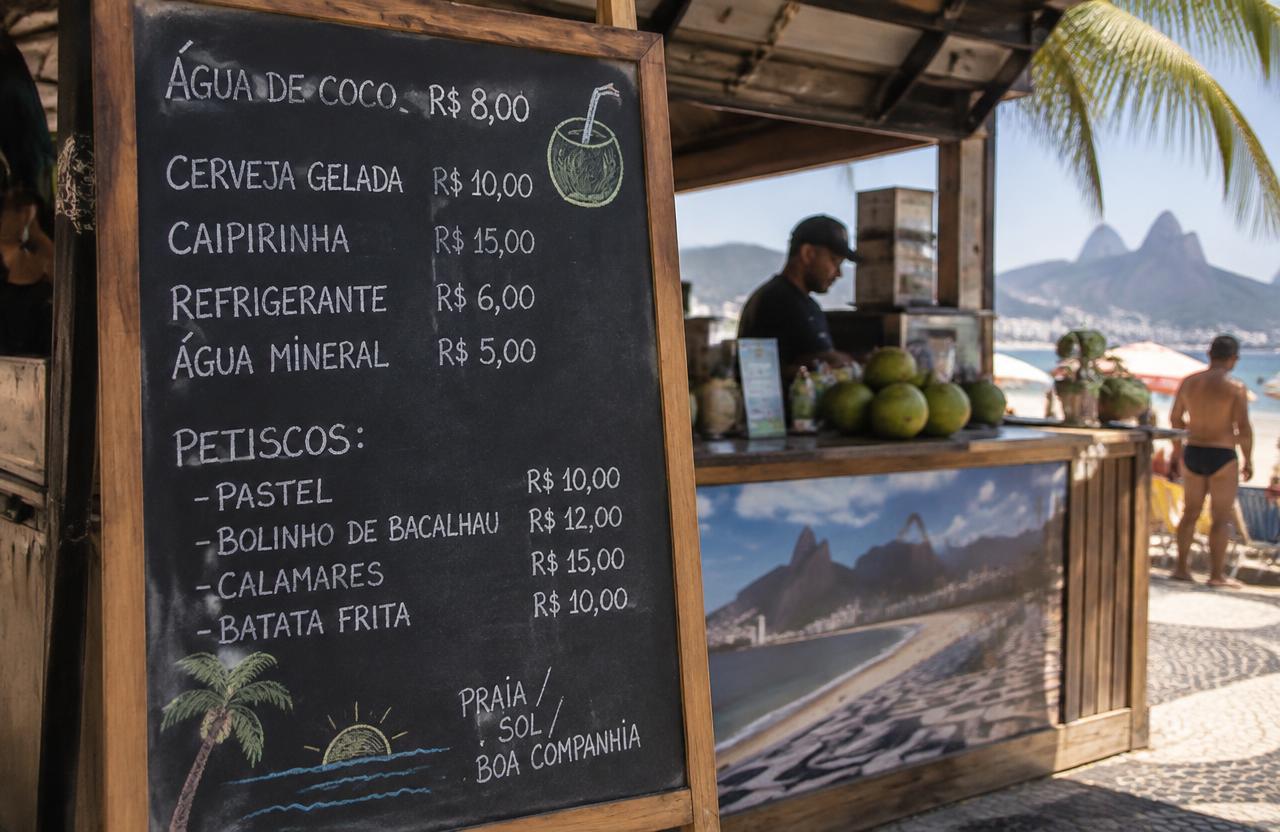
This is where Rio quietly becomes easy. The city is built on the Atlantic, the fish is excellent, and the national snack repertoire is full of things with no meat in them at all. Eat like this and you will eat extremely well for two weeks without once negotiating over a slaughter method.
Peixe grelhado / moqueca
Grilled fish and the coconut-and-dendê fish stew. The single most reliable restaurant order in Rio, on every menu from a beach kiosk to a Leblon dining room.
Camarão and frutos do mar
Shrimp, squid and mixed seafood — the seafood restaurants in Copacabana and Urca are built around it. See our seafood guide for the good rooms.
Açaí na tigela
Frozen açaí blended and served in a bowl with banana and granola. Vegan, everywhere, and about R$20–35 for a decent bowl.
Tapioca
A crêpe made from manioc starch, filled to order. Ask for cheese, coconut or banana; check that the savoury fillings do not include presunto (ham) or calabresa (pork sausage).
Pão de queijo
Cheese bread made with tapioca starch — no meat, no alcohol. If you avoid animal rennet, ask which cheese; most bakeries will not know, so treat it as a judgement call.
Por quilo (per-kilo) buffets
You see the food before you take it, which is exactly what you want. The catch is shared serving tongs moving between the pork and everything else — take from a freshly-refilled tray.
Sucos and água de coco
Rio's juice bars are the best non-alcoholic scene in the city: açaí, caju, graviola, maracujá. A green coconut on the sand costs about R$8–15.
Mate com limão
The sweet iced mate the beach vendors sell from a metal backpack — the drink cariocas grew up on, and completely alcohol-free.
For the rooms we actually send people to, see our guides to the best seafood in Rio, vegan and vegetarian Rio and per-kilo buffets — the last of which is the format that gives you the most control over what lands on your plate.
What to avoid on a Brazilian menu
Feijoada
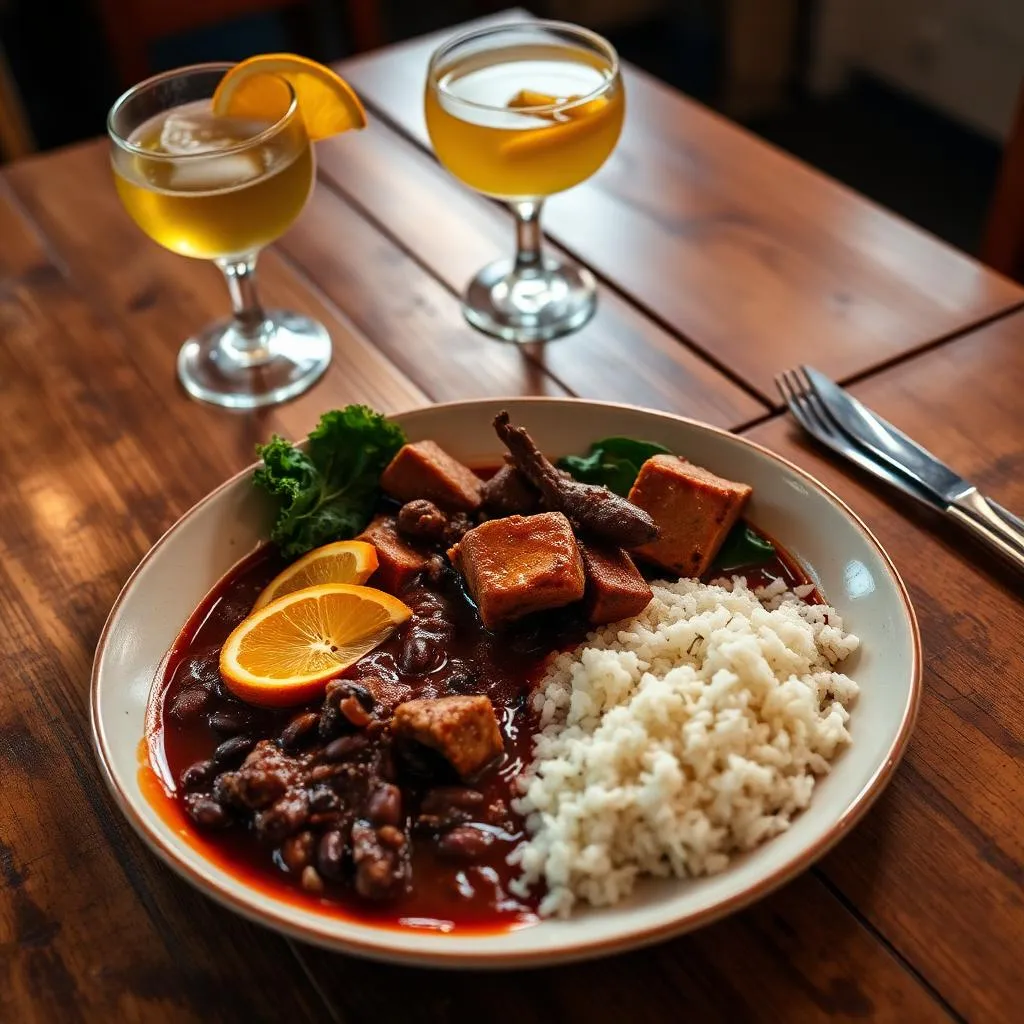
Brazil's national dish is a black-bean stew built on salted pork — ears, trotters, ribs, sausage. It is the Saturday ritual in every boteco, and it is off the table. Order moqueca instead.
Farofa and feijão
The toasted-cassava side and the daily beans are routinely cooked with bacon or linguiça. Ask 'tem bacon?' before assuming a side dish is vegetarian.
Churrascaria (rodízio)
All-you-can-eat grill houses serve pork alongside beef, from the same passadores and the same grill. Brazil exports enormous volumes of halal-slaughtered meat, but nothing on a Rio rodízio is certified.
Misto quente, X-tudo, coxinha
The standard bakery and street snacks. The misto is ham and cheese; the X-burger stack usually hides bacon; the coxinha is chicken but fries in oil shared with pork pastéis.
Molho and sobremesa
Wine and cachaça turn up in sauces and desserts, and gelatina (gelatin) in mousses, pavês and puddings. 'Tem álcool?' and 'tem gelatina?' are worth asking.
The welcome caipirinha
Hotels, tours and boat trips hand one out by default. A polite 'sem álcool, por favor' gets you the same drink built with juice or sparkling water.
Reading a Brazilian supermarket label

Self-catering solves a lot of this problem, and a supermarket (Zona Sul, Pão de Açúcar, Prezunic, Hortifruti) is never far in Copacabana or Ipanema. The words to scan for on an ingredients list:
- banha / toucinho / bacon / presunto / lombo / linguiça / calabresa — lard, pork fat, bacon, ham, loin, pork sausage.
- gelatina — gelatin, usually from pork or unspecified sources; extremely common in desserts, yoghurts and sweets.
- álcool / vinho / licor / essência de rum — alcohol, wine, liqueur and rum essence turn up in cakes, chocolates and sauces.
- coalho animal — animal rennet, if you avoid it in cheese.
- carne mecanicamente separada — mechanically separated meat, common in cheap sausages and pâtés; species is often unstated.
Portuguese that actually works at the table
Waiters in Rio are used to allergy and vegetarian questions and will answer these plainly. Portuguese, not Spanish, and a friendly tone goes a long way — see our Rio phrasebook for pronunciation.
| Eu não como carne de porco. | I don't eat pork. |
| Tem carne de porco nisso? | Does this contain pork? |
| Tem bacon, presunto, linguiça ou calabresa? | Does it have bacon, ham or pork sausage? |
| Esta carne é halal? | Is this meat halal? |
| Sou muçulmano. / Sou muçulmana. | I'm Muslim (male / female speaker). |
| Sem álcool, por favor. | Without alcohol, please. |
| Tem gelatina na sobremesa? | Is there gelatin in the dessert? |
| É frito no mesmo óleo? | Is it fried in the same oil? |
| Sem banha de porco, por favor. | No lard, please. |
| Só peixe ou frutos do mar, por favor. | Only fish or seafood, please. |
Alcohol: navigating a drinking city
Be clear-eyed about this before booking. Alcohol in Rio is legal, cheap, public and constant: beer at breakfast on the beach is not scandalous, every kiosk on the sand sells caipirinhas, and a large share of the city's tourism product — boat parties, bar crawls, open-bar samba nights, Carnaval itself — is organised around it. There are no dry areas and no alcohol-free venues to speak of.
What there isn't, though, is any pressure. Refusing a drink in Brazil provokes nothing. "Sem álcool, por favor" is understood everywhere, and Rio's non-alcoholic repertoire is genuinely one of the world's best: juice bars on every corner, green coconuts on the sand, iced mate com limão, and a virgin caipirinha (lime, sugar, ice, sparkling water) that most kiosks will happily make.
The practical move is product selection. Daytime tours, viewpoints, hikes, football and food markets are alcohol-neutral; sunset boat parties, "funk party" packages and Lapa bar tours are not. Our things to do at night guide flags which evening options do not revolve around a bar.
Beaches, modest dress and swimming

Rio has a global reputation for minimal swimwear, and it is earned. What visitors do not expect is how completely nobody polices the other direction: burkinis, long sleeves, leggings and headscarves on the sand attract glances and no comment. Brazil has no swimwear regulation and no history of burkini bans. Expect curiosity, not confrontation.
- Buy a "lycra". Long-sleeved UPF rash guards are standard Brazilian surf and beach kit, sold in every beach shop and street market on the seafront. Worn with leggings, they read as completely normal here and solve sun protection at the same time.
- Choose the family end of the beach. Leme (Posto 1), Leblon's Baixo Bebê stretch (Postos 11–12) and Praia Vermelha in Urca are calm, family-dominated and far less of a scene than Ipanema's Posto 9.
- Rent shade, not just a chair. Chair-and-umbrella rental runs about R$20–40 for the set for the day and gives you a defined, shaded base — much more comfortable if you are covered up or fasting.
- Hotel pools are the privacy option. Rooftop and enclosed pools are far quieter than the sand; see our rooftop-pool hotels guide.
- Photography. People photograph freely on Rio's beaches and you may end up in the background of someone's video. If that matters to you, sit back from the waterline and away from the volleyball nets.
For the wider unwritten rules — where to sit, what to buy from vendors, how the posto numbering works — read Rio beach etiquette and beach safety.
An alcohol-free week in Rio
Almost everything that makes Rio worth the flight is alcohol-free by nature. A workable shape for a first trip:
- Christ the Redeemer at opening time — book a timed entry, go at 08:00 before the cloud and the crowds. See tickets and access options.
- Sugarloaf at sunset — two cable cars, the best hour of the Rio day. Sugarloaf guide.
- Tijuca National Park — the world's largest urban rainforest, waterfalls and the Vista Chinesa lookout. Jeep tour options.
- Jardim Botânico — 200-year-old palm avenues, shade, and the calmest morning in the city. Botanical garden guide.
- Museu do Amanhã and the port district — Calatrava architecture, and AquaRio next door if you have children. Museum guide.
- A Flamengo match at the Maracanã — the loudest, most joyful thing in Rio. Note that Rio state does permit beer sales inside the stadium, unlike several other Brazilian states, so expect it in the concourse. Match-day guide.
- Ilha de Paquetá or the Niterói ferry — a car-free island and the cheapest great view in Rio. Ferry guide.
Book Corcovado with a timed entry
Christ the Redeemer runs on timed slots and sells out in high season. An early slot is the alcohol-free, family-friendly cornerstone of any Rio week — and going at opening time is the difference between a viewing platform you can move on and a scrum.
Check Christ the Redeemer ticket timesGetting to Rio and arriving at Galeão
From the Gulf, Emirates is the only one-stop-free option: a daily Dubai–Rio (GIG) service that continues to Buenos Aires, restored in late 2025 after a five-year absence and back to seven weekly flights in 2026. The Dubai departure typically lands in Rio mid-afternoon and the northbound leg goes out in the small hours — a brutal check-out time, so book a late checkout or a day room. Qatar Airways has no direct Rio flight; from Doha you connect via São Paulo (GRU). From Istanbul, Turkish connects via GRU as well.
Schedules on this route have moved repeatedly, so reconfirm on the airline's own site. For entry rules by nationality, see our Brazil visa requirements guide, and for what actually happens at the airport, our Galeão arrival guide.
Pre-book the airport transfer, especially with family
GIG is 45–70 minutes from Zona Sul depending on traffic, and the mid-afternoon Dubai arrival lands you squarely in it. A pre-booked private transfer means a named driver, a fixed price, child seats on request and no negotiating at the kerb after a 15-hour flight.
See Galeão airport transfer optionsWhere to stay
There is no "Muslim quarter" to aim for, so the choice comes down to food access, calm and distance to Tijuca:
- Copacabana — the practical winner. Both restaurants claiming halal meat are here, rooms are larger and cheaper than Ipanema, supermarkets are everywhere, and the family end (Leme, Posto 1–2) is calm. Copacabana area guide.
- Ipanema and Leblon — quieter, smarter, better restaurants, further from halal food. Leblon in particular is residential and family-dominated. Ipanema area guide.
- Barra da Tijuca — apartment-style space, malls, calm beaches, and the best option for a large family that wants a kitchen. It is far from everything, including the mosque. Barra area guide.
- Skip Lapa — the nightlife district is loud until dawn every weekend, and Centro empties out and feels bleak after working hours.
Our Copacabana picks for this trip
Copacabana puts you within walking distance of Rio's halal-claiming restaurants, close to supermarkets for self-catering, and a 25–40 minute ride from the Tijuca mosque for Friday prayer.
Dates optional. Set guests and rooms on Booking.com.
Check what your room rate includes
- Breakfast, taxes and any extra fees
- Room type, guest count and bed setup
- Cancellation deadline and when payment is due
Confirm these on Booking.com for the rate you choose.
Windsor Palace Copacabana
Best for: Central Copacabana access without choosing the neighbourhood's grandest tier
Know before booking: Check the exact walking route and room orientation, not only the Copacabana label.
Check Windsor Palace Copacabana availabilityMiramar by Windsor Copacabana
Best for: Comfort-first stays near the Ipanema end of Copacabana
Know before booking: Beach blocks cost more; check whether the room view justifies the premium.
Check Miramar by Windsor Copacabana availabilityOrla Copacabana Hotel
Best for: Posto 6 access close to Arpoador and Ipanema
Know before booking: Beach blocks cost more; check whether the room view justifies the premium.
Check Orla Copacabana Hotel availabilityWhatever you book, two questions are worth asking the hotel directly: whether the room has a bidet shower (ducha higiênica), and whether breakfast can be served without pork — most Rio breakfast buffets are built on presunto and cheese, and kitchens will usually plate eggs, fruit, cheese bread and tapioca instead if asked the night before. Compare neighbourhoods properly in our where to stay in Rio guide.
Common mistakes tourists make
- Assuming an Arabic restaurant is halal. Rio's Arab restaurants descend from Christian Levantine migration. Amir and Al Kuwait are excellent and not halal.
- Assuming Brazilian chicken is halal because Brazil exports halal chicken. Certification here is an export process; nothing on the domestic market is labelled.
- Turning up at the mosque unannounced on a Tuesday. Outside Friday, Mesquita da Luz opens for prayer and visits by appointment. Phone or message first.
- Booking Carnaval week by accident in 2027. Ramadan is expected to start as the parades run. Check both calendars before you book flights.
- Booking a "sunset cruise" or "samba night" blind. A large share of Rio's evening tour products are open-bar by design. Read what is included.
- Ordering the feijoada because it is the national dish. It is pork, all of it. Moqueca is the equivalent-status dish you can actually eat.
- Fasting through a February beach afternoon. Rio's summer humidity is punishing. Move sightseeing to the morning and rest indoors from 13:00 to 17:00.
Local expert tips
- Message the Mesquita da Luz on WhatsApp a week before you travel. It is a small community and they answer; you will get accurate jumu'ah timing and the current women's prayer arrangement rather than guessing.
- Per-kilo (por quilo) restaurants are the best-value meal in Rio and the easiest to control: you can see every dish, skip the pork tray entirely, and pay by weight — usually around R$75–100 per kilo in Zona Sul at lunch.
- Learn "sem carne de porco" before "obrigado". It is the single most useful sentence you will say all week.
- Juice bars (casas de suco) are open from breakfast until late and are Rio's real alternative to bar culture — a mixed juice and a misto de queijo (cheese toastie) is a perfectly good evening.
- If you are fasting, suhoor is easy: Rio's padarias (bakeries) open by 06:00, well before fajr in February, so buy the night before and keep it in the minibar fridge.
- Pair the Petrópolis mosque with the Petrópolis day trip — the Imperial Museum, the cool mountain air and the mosque's religious-circuit visit make one genuinely different day out of Rio.
- Carry cash or Pix for the small restaurants: Baghdad-style family places and beach kiosks are much happier with them than with a foreign card.
Frequently asked questions
Is Rio de Janeiro Muslim-friendly?
Rio is welcoming but under-equipped. Brazilians are relaxed about religion and you will not face hostility for praying, fasting or wearing hijab — but Rio has one congregational mosque (Mesquita da Luz in Tijuca), roughly three restaurants that claim halal meat, and no halal supermarket aisle. Muslim travellers do very well here by planning around fish, seafood and vegetarian food and praying in their hotel room. It is an easy city to visit and a hard city to eat certified-halal in.
Is there a mosque in Rio de Janeiro?
Yes — one. The Mesquita da Luz, run by the Sociedade Beneficente Muçulmana do Rio de Janeiro at Rua Gonzaga Bastos 77 in Tijuca, is the city's only mosque and the only place in Rio where Friday jumu'ah is prayed. Khutbah and prayer begin at 12:30; other days are by appointment. There is also a small Shia cultural centre in Centro, and the Ahmadiyya community's Baitul Awal mosque an hour and a quarter away in Petrópolis.
Where can I find halal food in Rio de Janeiro?
Realistically, three places: Restaurante Baghdad on Rua Bolívar in Copacabana, which has identified as halal since 2006; Basha at the Leme end of Copacabana, which lists halal options on a Lebanese menu; and Taj Mahal in Lagoa, which appears on halal directories. None displays a third-party Brazilian halal certificate, so ask at the table. Everywhere else, eat fish, seafood or vegetarian — Rio does all three exceptionally well.
Is Brazilian meat halal?
Brazil is the world's largest exporter of halal chicken — well over two million tonnes a year, close to half of all its poultry exports, certified by bodies such as CDIAL Halal, FAMBRAS Halal and SIIL. But that system is built for export. The chicken in a Rio supermarket or churrascaria is not certified, and there is no halal labelling on domestic retail meat. Do not assume that because Brazil slaughters halal for the Gulf, the meat on your plate in Copacabana is halal.
Which direction is the qibla in Rio de Janeiro?
From anywhere in Rio the qibla is approximately 68° — east-north-east, measured clockwise from true north — and it barely changes between Barra, Copacabana and Tijuca. From a Copacabana hotel room that is roughly toward the Leme end of the beach, not out to sea. Confirm with a qibla app on arrival, and remember that Brazilian buildings rarely mark it.
When is Ramadan 2027 in Rio, and how long is the fast?
Ramadan 1448 is expected to begin on 7 or 8 February 2027, subject to moon sighting, with Eid al-Fitr around 9–10 March 2027. In Rio that is late summer: on 8 February 2027 the sun rises at about 05:36 and sets at about 18:38, so a fast from fajr to maghrib runs roughly 14 hours 20 minutes, falling to about 13 hours 40 minutes by Eid. Rio's February heat and humidity make it a genuinely demanding fast — plan indoor, air-conditioned afternoons.
Does Ramadan 2027 clash with Rio Carnaval?
Almost exactly. The Grupo Especial parades run 7, 8 and 9 February 2027 with Ash Wednesday on 10 February, and Ramadan is expected to start on 7 or 8 February. The first days of Ramadan will land on Rio's loudest, most alcohol-soaked week of the year, and hotel prices will be at their annual peak. If you are fasting, either come before the blocos start or base yourself away from the Copacabana and Lapa party corridors — Leblon, Barra or Urca are much quieter.
Can I wear a burkini or modest swimwear on Rio's beaches?
Yes. There is no rule against it and nobody will challenge you — Rio's beaches are public and famously unbothered. You will be visually unusual on Ipanema, and you should expect glances rather than comment. A practical local trick: buy a surf 'lycra' (a long-sleeved UPF rash guard) in any beach shop for about R$80–150 and wear it with leggings. It reads as completely normal Brazilian beachwear and solves both modesty and sun.
Is alcohol everywhere in Rio, and can I avoid it?
Alcohol is legal, cheap and woven into public life — beach kiosks, botecos, samba nights and most group tours. There are no dry areas and no alcohol-free zones. Avoiding it is easy but requires you to choose: daytime sightseeing, juice bars, seafood restaurants and family beaches instead of boat parties, bar crawls and open-bar samba shows. 'Sem álcool, por favor' is understood everywhere and provokes no reaction.
How do Muslim families get to Rio from the Gulf?
Emirates flies daily between Dubai and Rio's Galeão (GIG), continuing to Buenos Aires — the route came back in late 2025 after a five-year gap and returned to seven weekly flights in 2026. The Dubai departure typically lands mid-afternoon in Rio and the return leaves in the small hours. Qatar Airways has no direct Rio flight; from Doha you connect through São Paulo (GRU). Always reconfirm the schedule on the airline's own site before booking.