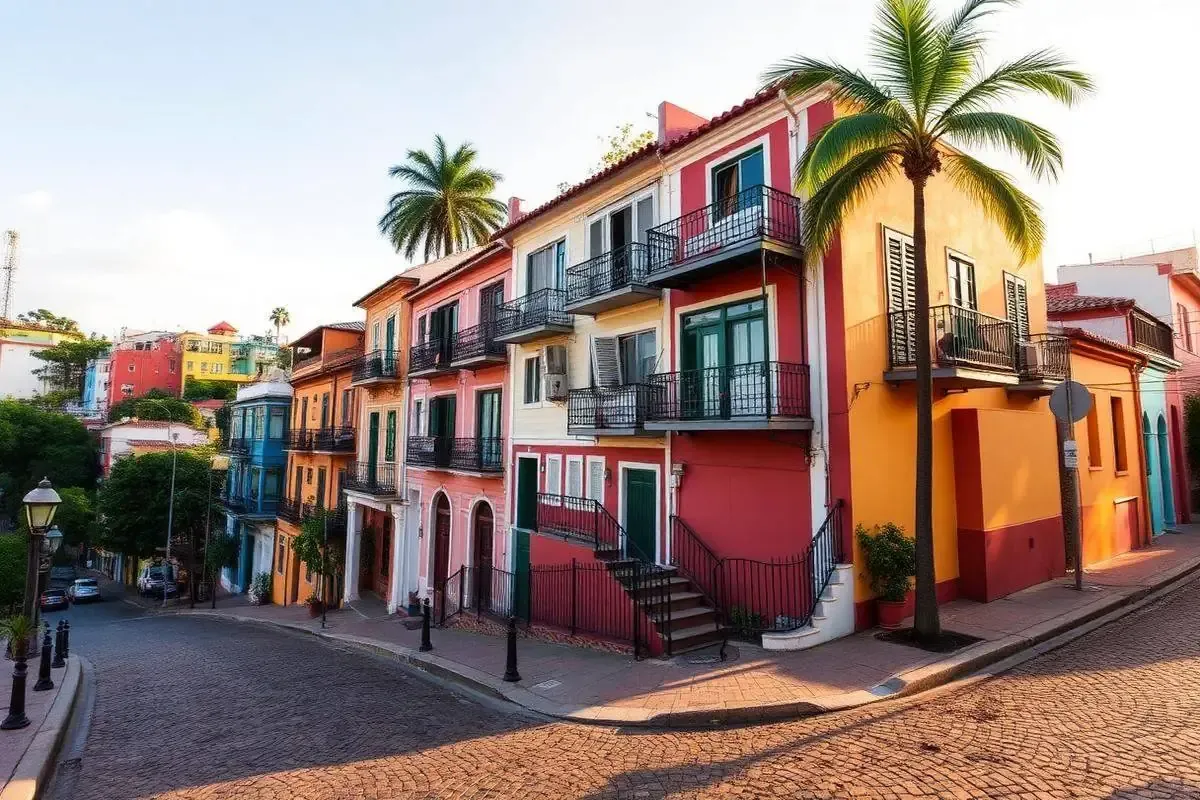
Where to Stay in Santa Teresa, Rio: Best Areas & Hotels
Written and reviewed by Lotte — Rio local, founder & editor of PlanRio · How we research · First published · Last reviewed
Quick answer
Largo dos Guimarães is the best part of Santa Teresa for a first stay because restaurants, bars and the tram sit close together. Choose Curvelo for museums, Rua Aprazível for retreat-style views, or the Glória-side slopes for easier metro access. Santa Teresa suits boutique-loving couples; beach-first travellers should stay elsewhere.
Santa Teresa is the neighbourhood Rio locals send friends to when they want somewhere with a soul — a hilltop of cobbled lanes, artists' studios, tram bells and terrace views over the bay. But it is also the most misunderstood place to book a room in the city. There is no beach, no metro on the hill, and the pretty streets are far steeper than any map suggests. This guide solves the accommodation decision specifically: which part of the hill to choose, what each pocket is good at, and exactly what you trade for the charm. If you're still choosing the neighbourhood itself, start with our where to stay in Rio decision guide first.
Santa Teresa accommodation at a glance
| Best for | Couples, boutique stays, art and repeat visitors |
| Best base | Largo dos Guimarães (food + tram on foot) |
| Ideal stay | 2–3 nights, or a split stay with Ipanema / Copacabana |
| Safety reality | Fine on active daytime streets; ride door-to-door after dark |
| Transport | Historic tram by day; app rides for evenings and beaches |
| Beach access | None on the hill; ~25–45 min ride to Zona Sul |
| Nearest metro | Glória / Cinelândia, at the bottom of the slopes only |
| Main trade-off | Cobbles, steep streets and dependence on ride-hailing |
The honest verdict: should you stay in Santa Teresa?
Stay here if…
The property itself is part of the trip — a garden breakfast, a historic house, a hillside view, a small-team welcome — and you'll spend real time in the neighbourhood rather than commuting out every morning. Santa Teresa rewards couples, creatives and repeat visitors who already know Rio and want atmosphere over convenience.
Skip it if…
You want spontaneous beach swims, step-free streets, a metro at the corner or a night that ends with an easy walk home. Ipanema and Copacabana are simpler first-trip bases, and Lapa is the more direct nightlife choice just below the hill.
Compare Santa Teresa with Lapa →Map the hill: the 5 micro-areas of Santa Teresa
The single most useful thing to understand before booking is that “Santa Teresa” is not one location. The hill folds into distinct pockets connected by steep, cobbled lanes — a listing described simply as “central Santa Teresa” could be a two-minute stroll to dinner or a sweaty fifteen-minute climb. Here is how locals actually divide it, anchored to the streets and landmarks you can point a driver to.
| Micro-area | Best for | Walkability |
|---|---|---|
| Largo dos Guimarães | First visits, food, atmosphere and the shortest evenings | Flat-ish around the largo; steep in every direction off it |
| Largo das Neves | Couples and repeat visitors wanting a village feel | A genuine 10–15 min uphill walk or short ride from Guimarães |
| Curvelo | Museums, viewpoints and daytime Lapa access | Steep; the museums are a signposted downhill walk |
| Rua Aprazível & the upper hills | Views, gardens and retreat-style boutique stays | The least walkable — ride-dependent day and night |
| The Glória / Catete edge (lower slopes) | Travellers who want Santa Teresa character with a metro nearby | Downhill to a metro station; uphill to the ‘real’ Santa Teresa |
Largo dos Guimarães
Rua Almirante Alexandrino, near Bar do Mineiro
The social heart of the hill: the largo where the tram passes, the densest run of restaurants and bars, and the block most guesthouses mean when they write ‘central Santa Teresa’. Choose it if you want to step out of the door into the neighbourhood rather than order a ride to reach it.
Largo das Neves
Small tree-lined square at the western end
Quieter and more residential — a little praça with a couple of botecos and a church, popular with locals at sunset. Prettier and calmer than Guimarães, but you commit to a walk or a ride for most dinners and every trip out of the neighbourhood.
Curvelo
By the tram line, above Chácara do Céu and Parque das Ruínas
The cultural pocket. You wake up minutes from Parque das Ruínas (free, one of Rio's best free viewpoints) and the Chácara do Céu museum, with the tram on your doorstep for the ride down toward the Arcos and Lapa. Fewer restaurants than Guimarães.
Rua Aprazível & the upper hills
Above the largos, toward Mirante Dona Marta side
Where the postcard terraces and garden hotels live, including the neighbourhood's design-hotel and boutique guesthouses. Beautiful and silent, with panoramas over the bay — but every coffee, dinner and outing is a car. Only choose it if the property itself is the holiday.
The Glória / Catete edge (lower slopes)
Bottom of the hill, walkable to Glória metro
The pragmatic compromise. Properties on the lower slopes toward Glória and Catete keep boutique character while putting a metro station within reach — a rare thing up here. You trade some of the hilltop drama for far easier access to Centro, Flamengo and the beaches.
5 hand-picked hotels and guesthouses in Santa Teresa
Start with location, then choose the property: our shortlist covers the practical Glória-side edge, the social heart around Largo dos Guimarães and the quieter upper hills. Each card explains who the stay suits and the trade-off to check before you compare live rooms, payment and cancellation terms.
Dates optional. Set guests and rooms on Booking.com.
Check what your room rate includes
- Breakfast, taxes and any extra fees
- Room type, guest count and bed setup
- Cancellation deadline and when payment is due
Confirm these on Booking.com for the rate you choose.
Villa Paranaguá Hotel & Spa
Best for: Boutique comfort close to Santa Teresa and Glória
Know before booking: The hillside setting is atmospheric, but ride-hailing is more practical than walking to the beach.
Check Villa Paranaguá Hotel & Spa availabilitySanta Teresa Hotel RJ - MGallery
Best for: A retreat-style luxury stay away from the beachfront towers
Know before booking: The hillside setting is atmospheric, but ride-hailing is more practical than walking to the beach.
Check Santa Teresa Hotel RJ - MGallery availabilityAltos de Colombo Guest House Boutique
Best for: A small boutique guesthouse on Santa Teresa's leafy Rua Aprazível
Know before booking: A recently opened hillside guesthouse — read the newest reviews and plan ride-hailing over walking.
Check Altos de Colombo Guest House Boutique availabilityCasa Geranio
Best for: A small-scale, character-led Santa Teresa stay
Know before booking: The hillside setting is atmospheric, but ride-hailing is more practical than walking to the beach.
Check Casa Geranio availabilityLobie Armazém São Joaquim
Best for: A character-led stay in the heart of Santa Teresa
Know before booking: The hillside setting is atmospheric, but ride-hailing is more practical than walking to the beach.
Check Lobie Armazém São Joaquim availabilityLinks may earn us a commission at no extra cost to you. This supports PlanRio and does not influence our recommendations.
The Santa Teresa boutique scene, decoded
Forget the beachfront tower model. Santa Teresa's accommodation is overwhelmingly small: restored casas, garden guesthouses and B&Bs of a handful of rooms, plus a single high-end design hotel at the top of the market. That is exactly why people love it — and exactly why the word “hotel” can mislead. A five-room house with a plunge pool and a personal host is a very different animal from a 200-room property with a 24-hour desk, and both call themselves boutique.
In practice you're choosing between three things. Boutique guesthouses and casas — the majority — give you character, a home-cooked breakfast and a host who'll call you a trusted driver, but check whether reception is staffed late and how a car reaches the door. A small design/luxury hotel buys you a pool, spa, service and a private view, at the cost of sitting high and quiet, so price in the rides to reach restaurants and beaches. An apartment suits confident repeat visitors, but favela-edge and dead-end access can be invisible on a listing map — confirm the exact street and a pickup point a driver can find at night.
Boutique guesthouse / casa
Choose it when: You want personality, a garden breakfast and a host who knows the hill.
Check: Ask how many rooms, whether reception is staffed late, and exactly how a car reaches the door. ‘Boutique’ can mean six rooms and a steep stair with no lift.
Design / small luxury hotel
Choose it when: The property is part of the trip — pool, spa, view, service — not just a bed.
Check: These sit high and quiet. Confirm the ride cost you'll absorb to reach restaurants and beaches, and whether the view is private to your room or only from a shared terrace.
Apartment / self-catering
Choose it when: You already know Rio and want residential independence for a longer stay.
Check: Favela-edge and cul-de-sac access can be unclear from a listing map. Confirm the exact street, key handover and a pickup point a driver can actually find at night.
How many nights should you stay in Santa Teresa?
Two or three nights is the sweet spot for most visitors. That gives you one slow neighbourhood day, two evenings that do not end in a cross-city commute and enough time to enjoy the hotel itself. A one-night stay creates more luggage logistics than atmosphere; a full week becomes inconvenient if beaches, Barra or western Rio dominate your plans.
First-time visitors who want both versions of Rio should consider a split stay: begin with Santa Teresa for Centro, Lapa, the tram and a boutique-property experience, then move to Ipanema or Copacabana for beach mornings and metro convenience. Split only once, and place the beach stay last if an easy final-day routine matters more than waking in the hills.
Four nights or more works when the stay itself is the holiday: you have a pool or garden worth using, you are writing or working slowly, or you already know Rio's major sights. In that case, confirm reliable Wi-Fi, laundry, food within a comfortable route and the property's plan for calling drivers. Santa Teresa rewards unhurried travellers; it punishes a checklist itinerary.
Transport reality from a Santa Teresa base

This is where a Santa Teresa stay is won or lost. The famous yellow bonde (tram) is a genuine joy — it rattles down from the hill, across the top of the 18th-century Arcos da Lapa and into Centro for about R$20 return in 2026 from Estação Carioca. But it is an attraction with limited capacity that can pause without notice, and it does not reach the airports or the beaches. Ride it for the experience, not to catch a flight or make a dinner reservation. Our Santa Teresa tram guide covers the current fare, stops and queues in full.
For everything else, app rides (Uber and 99) are your default. Budget roughly 25–45 minutes to Ipanema or Copacabana depending on traffic and where on the hill you are, and a similar variable ride to the airports. There is no metro on the hill itself — the nearest stations, Glória and Cinelândia, sit at the bottom of the slopes, which is exactly why the lower Glória/Catete edge is the one pocket where a metro is a realistic walk. Plan the neighbourhood as a place you settle into, then head out deliberately, rather than one you dip in and out of a dozen times a day. See our Uber, 99 and taxis in Rio guide for how the apps work locally.
Freshness note: we rechecked the tram information against the official Santa Teresa tram operator on 7 September 2026. Service can still change on the day, so confirm the live notice before using the tram as part of a hotel transfer.
Get oriented on day one
A guided Santa Teresa & Lapa tram tour
If you're basing yourself up here, a half-day walking-and-tram tour is the fastest way to learn the hill's geography — it links Parque das Ruínas, the Selarón Steps, the tram and Lapa with a local who handles the logistics, so you understand the pockets and safe routes before you strike out alone. A worthwhile first afternoon, not a substitute for wandering.
Book Santa Teresa, Lapa & tram tourSafety and the hill after dark
Santa Teresa is comfortable by day on its active blocks — around Largo dos Guimarães, the tram line and the museum route toward Curvelo you'll be among residents, tourists and café tables. The honest caveat is the geography: the neighbourhood is threaded with steep, quiet lanes and sits against favela edges, and those streets empty and change character quickly once the light goes.
The rule locals actually follow is boring and effective: walk the busy central streets by day, and after dark order a car to and from your door. Do not treat the Escadaria Selarón or the staircases down to Lapa as a romantic late-night shortcut — ride to a named venue instead. Ask your property which pickup point drivers use, keep the reception number saved offline, and keep your ride open until the gate has opened and your luggage is inside. For the neighbourhood's viewpoints, studios and daytime routes, our Santa Teresa neighbourhood guide has the full picture.
The rain test: is your property practical in bad weather?
Sunlit terrace photos sell Santa Teresa, but a wet arrival reveals whether a romantic hillside house works as a hotel. Before booking, picture one grey afternoon when the tram isn't your plan, the view has vanished into cloud and every cobble is slippery. Three questions separate a memorable stay from a frustrating one.
Trace the covered route
Ask which parts of the journey from car door to reception to room are exposed. Outdoor stairs and garden paths become the hardest part of the stay in rain — get the number of steps and whether there's a handrail, not just “cars reach the property”.
Can it absorb a slow day?
A lounge, a covered terrace, a reliable kitchen and staffed reception matter far more uphill than at a flat beach hotel. If rain cancels the view, the property should still be somewhere you're happy to spend two hours, not a bedroom you need to escape.
Build a driver backup
App drivers may approach from a different road, stop below the gate or cancel a tricky pickup. Ask whether the property calls known drivers and can explain the entrance in Portuguese. That single detail signals real Santa Teresa hospitality better than the thread count.
Common booking mistakes in Santa Teresa
- Treating ‘Santa Teresa’ as one address. Largo dos Guimarães, Largo das Neves, Curvelo and the upper hills are 10–20 minute walks and different trips.
- Booking the highest view without asking about the final approach — the stairs, the gradient and the ride cost you'll pay several times a day.
- Planning the historic tram as guaranteed transport for a flight, a timed tour or a dinner reservation. It is an experience with limited capacity, not a commuter line.
- Walking down the Escadaria Selarón or toward Lapa after dark because it looked charming in daylight. Order a ride from the door instead.
- Scheduling a beach morning every day, which turns a Santa Teresa stay into two long transfers to Zona Sul and back.
- Assuming ‘boutique’ means quiet. Intimate houses can have event terraces, single-glazed windows and courtyards that carry sound.
- Booking a remote hillside apartment on a first Rio trip with no staffed help and a vague ‘meet me on the street’ arrival plan.
Local expert tips and caveats
- Send the property your driver's screen: the full street number and the phone number. Hillside map pins routinely land on the wrong side of a wall or a level a car can't reach.
- Ask the exact question before you book: ‘How many steps from where a car stops to reception, then to my room, including any garden path?’ The answer decides the stay more than the star rating.
- Budget for ride-hailing as part of the neighbourhood, not a surprise. A Santa Teresa base only works when you accept a car for most evenings and every beach day.
- Group your neighbourhood day: Parque das Ruínas, Chácara do Céu, lunch at Bar do Mineiro and a tram ride belong together, so you aren't paying to cross the city twice.
- For the lower-slope compromise, measure the real walk to Glória metro with luggage and after dark — downhill by day is not the same route you'll want at 1am.
- Book a free-cancellation room first for Carnaval, Réveillon and the Santa Teresa open-studio arts weekends, then re-confirm the exact category and access before the deadline.
- Keep one flexible day. Rain erases the views and can pause the tram, but a good property with a covered terrace still makes the slow afternoon worthwhile.
Frequently asked questions
Where is the best area to stay in Santa Teresa?
Largo dos Guimarães is the best base for a first stay because the restaurants, bars and the tram are within walking distance, so you rely less on ride-hailing. Curvelo is better for museums and daytime Lapa access, Largo das Neves is quieter and more residential, and the upper hills around Rua Aprazível trade convenience for views and silence.
Is Santa Teresa a good place to stay for a first trip to Rio?
Santa Teresa suits a first trip only when boutique character matters more than the beach. There is no metro on the hill, no swimming beach, and you'll use app rides most evenings. Most first-time visitors are better based in Ipanema or Copacabana; choose Santa Teresa if the hillside, the art and a characterful guesthouse are the point of the visit.
Is it safe to stay in Santa Teresa?
Santa Teresa is comfortable on its active daytime streets and around Largo dos Guimarães, but it borders steep, quiet lanes and favela edges that change quickly after dark. The practical rule is simple: walk the busy central blocks by day, and after dark order a car to and from your door rather than walking down toward Lapa or the Selarón Steps.
How do you get from Santa Teresa to Ipanema or Copacabana?
There is no direct metro or beach at your door, so plan an app ride (Uber or 99) of roughly 25–45 minutes to the Zona Sul beaches depending on traffic and which part of the hill you're on. The historic tram runs down to Centro, not to the beaches, so treat the beach as a planned outing rather than a spontaneous morning swim.
Does Santa Teresa have a metro station?
No metro station serves the hill itself. The nearest stations — Glória and Cinelândia — sit at the bottom of the slopes, so only lower-edge properties toward Glória and Catete put a metro within a comfortable walk. From the largos and the upper hills you'll use the tram down to Centro or app rides for everything else.
Should I stay near Largo dos Guimarães or Largo das Neves?
Choose Largo dos Guimarães for the simplest restaurant-and-tram routine and the shortest evenings on foot. Choose Largo das Neves for a quieter, more residential village feel with a couple of local botecos, accepting a 10–15 minute walk or a short ride to reach the main cluster and everything beyond the neighbourhood.
Is the Santa Teresa tram useful if I stay there?
Yes as an experience and a scenic ride down to Centro and the Lapa Arches — it costs about R$20 return in 2026 from Estação Carioca — but no as reliable transport. It has limited capacity, can pause without notice, and does not reach the airports or the beaches, so never build a flight, a tour or a dinner around it. Keep a ride-hailing budget as your default.
Is Santa Teresa suitable for families or travellers with limited mobility?
It is challenging for both. Cobbles, slopes and steps continue well beyond the hotel room, pavements are narrow, and car-seat and stroller logistics are hard on the hills. An accessible bathroom alone does not make a stay accessible here — confirm the complete route from where a car stops to reception, room, breakfast and street before booking.
How much should I budget for a Santa Teresa stay?
Santa Teresa skews to small boutique guesthouses and one design hotel rather than big-brand towers, so nightly rates run from mid-range casas up to a distinct luxury tier at the top design property. Beyond the room, budget realistically for daily app rides in and out of the neighbourhood — that transport cost is the honest difference between a hillside base and a beachfront one.
Keep planning
Where to stay in Rio
Still undecided on the neighbourhood? Start with the citywide decision guide.
Santa Teresa neighbourhood guide
Plan the art, viewpoints, restaurants and safety once the room is booked.
Santa Teresa tram guide
2026 fare, Estação Carioca, the stops that matter and why it isn't a commuter line.
Santa Teresa vs Lapa
Compare the hillside base with a more direct, nightlife-first alternative below.
Where to eat in Santa Teresa
Build dinner plans that respect the hills and the ride home.
Parque das Ruínas
The free 270° viewpoint minutes from a Curvelo stay.
Where to stay in Ipanema
The easier beach-and-metro base if Santa Teresa sounds like too much friction.
Rio airport guide
Arrange the least stressful hillside arrival with luggage from GIG or SDU.